
VMS may refer to:
VMS may refer to:

RMS may refer to:
VM may stand for:
VA, Va and variants may refer to:

In computing, text-based user interfaces (TUI), is a retronym describing a type of user interface (UI) common as an early form of human–computer interaction, before the advent of graphical user interfaces (GUIs). Like GUIs, they may use the entire screen area and accept mouse and other inputs. They may also use color and often structure the display using special graphical characters such as ┌ and ╣, referred to in Unicode as the "box drawing" set. The modern context of use is usually a terminal emulator.
MSA or M.S.A. may refer to:
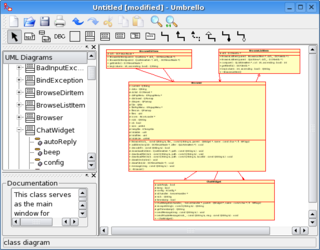
Computer-aided software engineering (CASE) is the domain of software tools used to design and implement applications. CASE tools are similar to and were partly inspired by Computer-Aided Design (CAD) tools used for designing hardware products. CASE tools were used for developing high-quality, defect-free, and maintainable software. CASE software is often associated with methods for the development of information systems together with automated tools that can be used in the software development process.
Product data management (PDM) should not be confused with product information management (PIM). PDM is the name of a business function within product lifecycle management (PLM) that is denotes the management and publication of product data. In software engineering, this is known as version control. The goals of product data management include ensuring all stakeholders share a common understanding, that confusion during the execution of the processes is minimized, and that the highest standards of quality controls are maintained.

Virgin Galactic is an American spaceflight company founded by Richard Branson and his British Virgin Group retains an 11.9% stake through Virgin Investments Limited. It is headquartered in California, USA, and operates from New Mexico. The company is developing commercial spacecraft and aims to provide suborbital spaceflights to space tourists. Virgin Galactic's suborbital spacecraft are air launched from beneath a carrier airplane known as White Knight Two. Virgin Galactic‘s maiden spaceflight occurred in 2018 with its VSS Unity spaceship. Branson had originally hoped to see a maiden spaceflight by 2010, but the date was delayed for several years, primarily due to the October 2014 crash of VSS Enterprise.
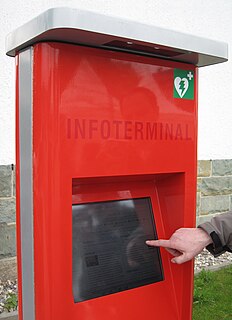
An interactive kiosk is a computer terminal featuring specialized hardware and software that provides access to information and applications for communication, commerce, entertainment, or education.

Check-in is the process whereby people announce their arrival at an office, hotel, airport, hospital, seaport or event.
ACMS may refer to:

DarkStar One is a space trading and combat simulator game developed by German studio Ascaron and published by CDV.

Nghệ An is a province in the North Central Coast region of Vietnam. It is Vietnam's largest province by area. Nghệ An is located in a central position in North Central Coast. To the east lies the Gulf of Tonkin; to the west the province is bordered by Laos; to the south Hà Tĩnh province; and to the north is Thanh Hóa province. It is located on the east–west economic corridor connecting Myanmar, Thailand, Laos and Vietnam along National Route 7 to the port of Cửa Lò.
Airline reservation systems (ARS) are systems that allow an airline to sell their inventory (seats). It contains information on schedules and fares and contains a database of reservations and of tickets issued. ARSs are part of passenger service systems (PSS), which are applications supporting the direct contact with the passenger.
A vendor management system (VMS) is an Internet-enabled, often Web-based application that acts as a mechanism for business to manage and procure staffing services – temporary, and, in some cases, permanent placement services – as well as outside contract or contingent labor. Typical features of a VMS application include order distribution, consolidated billing and significant enhancements in reporting capability that outperforms manual systems and processes.

Vessel Monitoring Systems (VMS) is a general term to describe systems that are used in commercial fishing to allow environmental and fisheries regulatory organizations to track and monitor the activities of fishing vessels. They are a key part of monitoring control and surveillance (MCS) programs at national and international levels. VMS may be used to monitor vessels in the territorial waters of a country or a subdivision of a country, or in the Exclusive Economic Zones (EEZ) that extend 200 nautical miles (370.4 km) from the coasts of many countries. VMS systems are used to improve the management and sustainability of the marine environment, through ensuring proper fishing practices and the prevention of illegal fishing, and thus protect and enhance the livelihoods of fishermen.
Panopticon Software was a multi-national data visualization software company specializing in monitoring and analysis of real-time data. The firm was headquartered in Stockholm, Sweden. It partnered with several large systems integrators and infrastructure software companies, including SAP, Thomson Reuters, Kx Systems, and One Market Data (OneTick). The company's name is derived from the Greek: 'pan' for all, 'optic' for sight. The company name is derived from the word panopticon which is an architectural concept originally intended to facilitate surveillance of prisons.
Corporate travel management is the function of managing a company’s strategic approach to travel, the negotiations with all vendors, day-to-day operation of the corporate travel program, traveler safety and security, credit-card management and travel and expenses ('T&E') data management.
Ship management is the activity of managing marine vessels. The vessels under management could be owned by a sister concern of the ship management company or by independent vessel owners. A vessel owning company that generally has several vessels in its fleet, entrusts the fleet management to a single or multiple ship management companies. Ship management is often entrusted to third parties due to the various hassles that are involved in managing a ship. For instance, ships could be considered as large factories that travel across seas under various weather conditions for several days at a stretch. These vessels are equipped with several types of machinery that require appropriate maintenance and the associated spares on board. In the scenario of a vessel lacking adequate maintenance, this could lead to the breakdown of the equipment in the middle of a voyage at sea. A breakdown could be an expensive affair. A second scenario would be – a vessel is continuously on the move or under some sort of activity and hence requires to be manned by a competent crew. The documents of the crew need to comply with international regulations, their transportation to and from the vessel must be arranged for, their competencies must align with the requirement of the vessel and must complement the skillsets of the existing onboard crew. Hence several parameters must be considered which is a tedious job. In order to ensure such scenarios are considered for and to provide adequate attention to the vessels, ship owners outsource the management. Several management companies provide the owner with a crew on board. When the ship comes out of the shipyard the management company takes it over providing technical management to the owner. Most Management companies also offer other services like inspection prior to purchase, supervision during building, crew management and supply and ship lay-up solutions.
VM-aware storage (VAS) is computer data storage designed specifically for managing storage for virtual machines (VMs) within a data center. The goal is to provide storage that is simpler to use with functionality better suited for VMs compared with general-purpose storage. VM-aware storage allows storage to be managed as an integrated part of managing VMs rather than as logical unit numbers (LUNs) or volumes that are separately configured and managed.