See also
 | This disambiguation page lists articles associated with the title VMT. If an internal link led you here, you may wish to change the link to point directly to the intended article. |
VMT may refer to:
| | This disambiguation page lists articles associated with the title VMT. If an internal link led you here, you may wish to change the link to point directly to the intended article. |
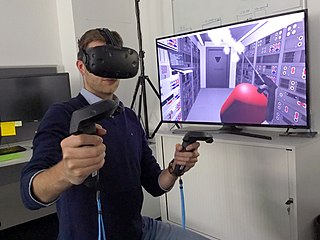
Virtual reality (VR) is a simulated experience that can be similar to or completely different from the real world. Applications of virtual reality can include entertainment and educational purposes. Other, distinct types of VR style technology include augmented reality and mixed reality.
A simulation is an approximate imitation of the operation of a process or system; that represents its operation over time.

An intelligent transportation system (ITS) is an advanced application which aims to provide innovative services relating to different modes of transport and traffic management and enable users to be better informed and make safer, more coordinated, and 'smarter' use of transport networks.

Training is teaching, or developing in oneself or others, any skills and knowledge or fitness that relate to specific useful competencies. Training has specific goals of improving one's capability, capacity, productivity and performance. It forms the core of apprenticeships and provides the backbone of content at institutes of technology. In addition to the basic training required for a trade, occupation or profession, training may continue beyond initial competence to maintain, upgrade and update skills throughout working life. People within some professions and occupations may refer to this sort of training as professional development. Training also refers to the development of physical fitness related to a specific competence, such as sport, martial arts, military applications and some other occupations.
Hybrid may refer to:
The multiple integrated laser engagement system, or MILES, is used by the U.S. military and other armed forces around the world for training purposes. It uses lasers and blank cartridges to simulate actual battle.

A head-mounted display (HMD) is a display device, worn on the head or as part of a helmet, that has a small display optic in front of one or each eye. An HMD has many uses including gaming, aviation, engineering, and medicine. Virtual reality headsets are HMDs combined with IMUs. There is also an optical head-mounted display (OHMD), which is a wearable display that can reflect projected images and allows a user to see through it.
A griefer or bad faith player is a player in a multiplayer video game who deliberately irritates and harasses other players within the game (trolling), using aspects of the game in unintended ways. A griefer derives pleasure primarily or exclusively from the act of annoying other users, and as such is a particular nuisance in online gaming communities. To qualify as griefing, a player must be using aspects of the game in unintended ways to annoy other players—if they are trying to gain a strategic advantage, it is instead called "cheating".
MVA may refer to:
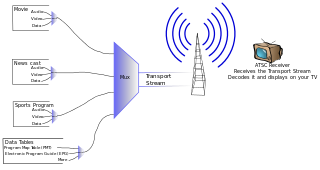
The Program and System Information Protocol (PSIP) is the MPEG and privately defined program-specific information originally defined by General Instrument for the DigiCipher 2 system and later extended for the ATSC digital television system for carrying metadata about each channel in the broadcast MPEG transport stream of a television station and for publishing information about television programs so that viewers can select what to watch by title and description. Its FM radio equivalent is Radio Data System (RDS).
Educational technology is the combined use of computer hardware, software, and educational theory and practice to facilitate learning. Educational technology creates, uses, and manages technological processes and educational resources to help improve user academic performance. The field has been described as a persisting initiative that seeks to bring learners, teacher, and technical means together in an effective way.
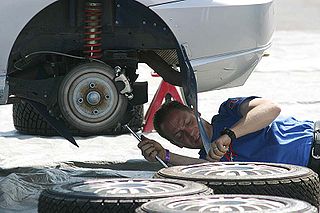
An auto mechanic is a mechanic with a variety of automobile makes or either in a specific area or in a specific make of automobile. In repairing cars, their main role is to diagnose the problem accurately and quickly. They often have to quote prices for their customers before commencing work or after partial disassembly for inspection. Their job may involve the repair of a specific part or the replacement of one or more parts as assemblies.

A passenger is a person who travels in a vehicle but bears little or no responsibility for the tasks required for that vehicle to arrive at its destination or otherwise operate the vehicle. The vehicles may be bicycles, buses, passenger trains, airliners, ships, ferryboats, and other methods of transportation.
VT or Vt may refer to:
e-Report - transnational virtual study circles: e-learning supports for tutorship and learning groups - is a communitarian project aiming at the constitution of a repertory of reference material with regard to the development of innovative methods in the field of e-learning system for educational projects and also for distance learning in VET. The activities of research, experimentation and analysis are combined with the use of ICT with massive use of tutoring activities, learning groups and transnational virtual study circles.

The Virtual Army Experience (VAE) is a mobile US Army simulator created by the Army development team with the digital development handled by Zombie Studios. The interactive exhibit brings the army’s popular computer game, America’s Army: Special Forces (Overmatch), to a life-size, networked environment to provide visitors with an experience of soldiering. Using computers, LAN based scenarios, motion simulators, and videos, the VAE is a display of technological invention.
WETP-TV, virtual channel 2, is a Public Broadcasting Service (PBS) member television station licensed to Sneedville, Tennessee, United States. The station is owned by the East Tennessee Public Communications Corporation. WETP-TV's transmitter is located atop Short Mountain near Mooresburg, Tennessee.

Waymo LLC is an American autonomous driving technology development company. It is a wholly owned subsidiary of Alphabet Inc. Waymo originated as a project of Google and became a stand-alone company in December 2016.
Virtual Maintenance Training is a type of training method that includes computer-based interactive 3D simulations of virtual equipment that replicates the actual real life vehicle or device. It safely teaches vehicle and device crewmembers the procedures to properly service, repair, and maintain equipment. It is the learning method commonly used by training schools and centers of the United States Armed Forces for the maintenance of its defense vehicles. Its integration into current training courses has continued to increase in popularity.
Transportation and health is a branch of public health dealing with efforts to improve health outcomes related to transportation.