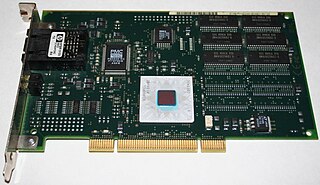
Asynchronous Transfer Mode (ATM) is a telecommunications standard defined by the American National Standards Institute and ITU-T for digital transmission of multiple types of traffic. ATM was developed to meet the needs of the Broadband Integrated Services Digital Network as defined in the late 1980s, and designed to integrate telecommunication networks. It can handle both traditional high-throughput data traffic and real-time, low-latency content such as telephony (voice) and video. ATM provides functionality that uses features of circuit switching and packet switching networks by using asynchronous time-division multiplexing.

In computing, a device driver is a computer program that operates or controls a particular type of device that is attached to a computer or automaton. A driver provides a software interface to hardware devices, enabling operating systems and other computer programs to access hardware functions without needing to know precise details about the hardware being used.
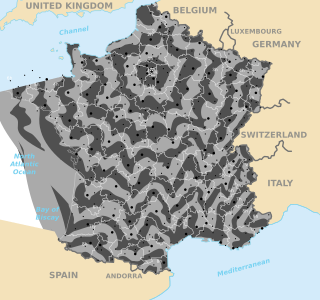
Transportation in France relies on one of the densest networks in the world with 146 km of road and 6.2 km of rail lines per 100 km2. It is built as a web with Paris at its center. Rail, road, air and water are all widely developed forms of transportation in France.

X.25 is an ITU-T standard protocol suite for packet-switched data communication in wide area networks (WAN). It was originally defined by the International Telegraph and Telephone Consultative Committee in a series of drafts and finalized in a publication known as The Orange Book in 1976.

RAD is a privately held corporation, headquartered in Tel Aviv, Israel that designs and manufacturers specialized networking equipment.
vCloud Air was a public cloud computing service built on vSphere from VMware. vCloud Air has three "infrastructure as a service" (IaaS) subscription service types: dedicated cloud, virtual private cloud, and disaster recovery. vCloud Air also offers a pay-as-you-go service named Virtual Private Cloud OnDemand.

Voies navigables de France is the French navigation authority responsible for the management of the majority of France's inland waterways network and the associated facilities—towpaths, commercial and leisure ports, lock-keeper's houses and other structures. VNF was established in 1991 and took over the responsibility for all waterways from the National Office of Navigation in 1993. It is a public body and is under the control of the Minister of Ecology, Energy, Sustainable Development and Territorial Development. The headquarters of VNF are in Béthune, Pas-de-Calais with local offices throughout France.
Netcracker Technology Corp., a wholly owned subsidiary of NEC Corporation, is a provider of business support system (BSS), operations support systems (OSS) and software-defined networking (SDN) and network functions virtualization (NFV) solutions. The company also offers professional services, as well as managed services.
The Web 2.0 Suicide Machine is a service that helps users tired of MySpace, LinkedIn and Twitter, to "commit suicide in social networks", by automatically "removing their private content and friend relationships". The service is part of the non-profit foundation WORM, based in Rotterdam, Netherlands.

OpenNebula is an open source cloud computing platform for managing heterogeneous data center, public cloud and edge computing infrastructure resources. OpenNebula manages on-premise and remote virtual infrastructure to build private, public, or hybrid implementations of Infrastructure as a Service and multi-tenant Kubernetes deployments. The two primary uses of the OpenNebula platform are data center virtualization and cloud deployments based on the KVM hypervisor, LXD/LXC system containers, and AWS Firecracker microVMs. The platform is also capable of offering the cloud infrastructure necessary to operate a cloud on top of existing VMware infrastructure. In early June 2020, OpenNebula announced the release of a new Enterprise Edition for corporate users, along with a Community Edition. OpenNebula CE is free and open-source software, released under the Apache License version 2. OpenNebula CE comes with free access to patch releases containing critical bug fixes but with no access to the regular EE maintenance releases. Upgrades to the latest minor/major version is only available for CE users with non-commercial deployments or with significant open source contributions to the OpenNebula Community. OpenNebula EE is distributed under a closed-source license and requires a commercial Subscription.
Software-defined networking (SDN) technology is an approach to network management that enables dynamic, programmatically efficient network configuration in order to improve network performance and monitoring, in a manner more akin to cloud computing than to traditional network management. SDN is meant to address the static architecture of traditional networks and may be employed to centralize network intelligence in one network component by disassociating the forwarding process of network packets from the routing process. The control plane consists of one or more controllers, which are considered the brain of the SDN network, where the whole intelligence is incorporated. However, centralization has certain drawbacks related to security, scalability and elasticity.
Network functions virtualization (NFV) is a network architecture concept that leverages IT virtualization technologies to virtualize entire classes of network node functions into building blocks that may connect, or chain together, to create and deliver communication services.

SoftEther VPN is free open-source, cross-platform, multi-protocol VPN client and VPN server software, developed as part of Daiyuu Nobori's master's thesis research at the University of Tsukuba. VPN protocols such as SSL VPN, L2TP/IPsec, OpenVPN, and Microsoft Secure Socket Tunneling Protocol are provided in a single VPN server. It was released using the GPLv2 license on January 4, 2014. The license was switched to Apache License 2.0 on January 21, 2019.
5G network slicing is a network architecture that enables the multiplexing of virtualized and independent logical networks on the same physical network infrastructure. Each network slice is an isolated end-to-end network tailored to fulfil diverse requirements requested by a particular application.
A Cloud-Native Network Function (CNF) is a software-implementation of a function, or application, traditionally performed on a physical device, but which runs inside Linux containers. The features that differ CNFs from VNFs, one of the components of Network Function Virtualization, is the approach in their orchestration.
Fatma Uruk is a Turkish world record holder female free-diver and school teacher.
