
Honey is a sweet and viscous substance made by several species of bees, the best-known of which are honey bees. Honey is made and stored to nourish bee colonies. Bees produce honey by gathering and then refining the sugary secretions of plants or the secretions of other insects, like the honeydew of aphids. This refinement takes place both within individual bees, through regurgitation and enzymatic activity, and during storage in the hive, through water evaporation that concentrates the honey's sugars until it is thick and viscous.

Mead, also called honey wine, and hydromel, is an alcoholic beverage made by fermenting honey mixed with water, and sometimes with added ingredients such as fruits, spices, grains, or hops. The alcoholic content ranges from about 3.5% ABV to more than 20%. Possibly the most ancient alcoholic drink, the defining characteristic of mead is that the majority of the beverage's fermentable sugar is derived from honey. It may be still, carbonated, or naturally sparkling, and despite a common misconception that mead is exclusively sweet, it can also be dry or semi-sweet.
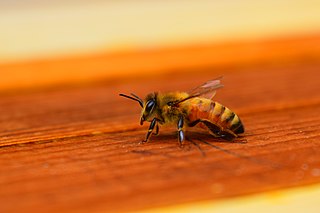
A honey bee is a eusocial flying insect within the genus Apis of the bee clade, all native to mainland Afro-Eurasia. After bees spread naturally throughout Africa and Eurasia, humans became responsible for the current cosmopolitan distribution of honey bees, introducing multiple subspecies into South America, North America, and Australia.

Yogurt is a food produced by bacterial fermentation of milk. Fermentation of sugars in the milk by these bacteria produces lactic acid, which acts on milk protein to give yogurt its texture and characteristic tart flavor. Cow's milk is most commonly used to make yogurt. Milk from water buffalo, goats, ewes, mares, camels, and yaks is also used to produce yogurt. The milk used may be homogenized or not. It may be pasteurized or raw. Each type of milk produces substantially different results.
Buzzard is the common name of several species of birds of prey.
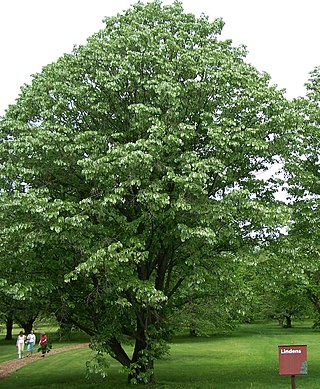
Tilia is a genus of about 30 species of trees or bushes, native throughout most of the temperate Northern Hemisphere. The tree is known as linden for the European species, and basswood for North American species. In Britain and Ireland they are commonly called lime trees, although they are not related to the citrus lime. The genus occurs in Europe and eastern North America, but the greatest species diversity is found in Asia. Under the Cronquist classification system, this genus was placed in the family Tiliaceae, but genetic research summarised by the Angiosperm Phylogeny Group has resulted in the incorporation of this genus, and of most of the previous family, into the Malvaceae.
Grayanotoxins are a group of closely related neurotoxins named after Leucothoe grayana, a plant native to Japan and named for 19th-century American botanist Asa Gray. Grayanotoxin I is also known as andromedotoxin, acetylandromedol, rhodotoxin and asebotoxin. Grayanotoxins are produced by Rhododendron species and other plants in the family Ericaceae. Honey made from the nectar and so containing pollen of these plants also contains grayanotoxins and is commonly referred to as mad honey.

Calluna vulgaris, common heather, ling, or simply heather, is the sole species in the genus Calluna in the flowering plant family Ericaceae. It is a low-growing evergreen shrub growing to 20 to 50 centimetres tall, or rarely to 1 metre (40 in) and taller, and is found widely in Europe and Asia Minor on acidic soils in open sunny situations and in moderate shade.

Jif is an American brand of peanut butter made by The J.M. Smucker Company, which purchased the brand from Procter & Gamble in 2001.
Post Consumer Brands is an American consumer packaged goods food manufacturer headquartered in Lakeville, Minnesota.
Manuka or Mānuka may refer to:

Chrysin, also called 5,7-dihydroxyflavone, is a flavone found in honey, propolis, the passion flowers, Passiflora caerulea and Passiflora incarnata, and in Oroxylum indicum. It is extracted from various plants, such as the blue passion flower. Following oral intake by humans, chrysin has low bioavailability and rapid excretion. It is under basic research to evaluate its safety and potential biological effects.
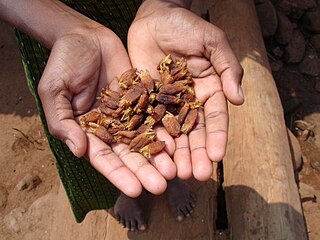
Non-timber forest products (NTFPs) are useful foods, substances, materials and/or commodities obtained from forests other than timber. Harvest ranges from wild collection to farming. They typically include game animals, fur-bearers, nuts, seeds, berries, mushrooms, oils, sap, foliage, pollarding, medicinal plants, peat, mast, fuelwood, fish, insects, spices, and forage. Overlapping concepts include non-wood forest products (NWFPs), wild forest products, minor forest produce, special, minor, alternative and secondary forest products – for further distinctions see the definition section below

Hash oil or cannabis oil is an oleoresin obtained by the extraction of cannabis or hashish. It is a cannabis concentrate containing many of its resins and terpenes – in particular, tetrahydrocannabinol (THC), cannabidiol (CBD), and other cannabinoids. Hash oil is usually consumed by smoking, vaporizing or eating. Preparations of hash oil may be solid or semi-liquid colloids depending on both production method and temperature and are usually identified by their appearance or characteristics. Color most commonly ranges from transparent golden or light brown, to tan or black. There are various extraction methods, most involving a solvent, such as butane or ethanol.

Lacto-ovo vegetarianism or ovo-lacto vegetarianism is a type of vegetarianism which forbids animal flesh but allows the consumption of animal products such as dairy and eggs. Unlike pescetarianism, it does not include fish or other seafood. A typical ovo-lacto vegetarian diet may include fruits, vegetables, grains, legumes, meat substitutes, nuts, seeds, soy, cheese, milk, yogurt and eggs.

"Honey Bee" is a song written by Rhett Akins and Ben Hayslip and recorded by American country music artist Blake Shelton. It was released in April 2011 as the first single from Shelton's 2011 album Red River Blue. The song reached number one on the US Billboard Hot Country Songs chart in July 2011. On November 30, the song received a Grammy Award nomination for Best Country Solo Performance, but it lost to Taylor Swift's "Mean".
Honey flower is a common name for several plants and may refer to:
