An aerial tramway, sky tram,cable car, ropeway or aerial tram is a type of aerial lift which uses one or two stationary ropes for support while a third moving rope provides propulsion. With this form of lift, the grip of an aerial tramway cabin is fixed onto the propulsion rope and cannot be decoupled from it during operations.

Thuin or [twɛ̃]) is a Walloon municipality located in the Belgian province of Hainaut. The Thuin municipality includes the old communes of Leers-et-Fosteau, Biesme-sous-Thuin, Ragnies, Biercée, Gozée, Donstiennes, and Thuillies.
A diol is a chemical compound containing two hydroxyl groups. An aliphatic diol is also called a glycol. This pairing of functional groups is pervasive, and many subcategories have been identified.
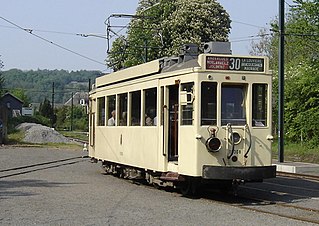
The ASVi is a tramway museum in Thuin in Belgium, which specialises in the history of the Belgian narrow gauge Vicinal system. The museum includes an operating museum tram line which runs from Thuin to Lobbes.
A halohydrin dehalogenase is an enzyme involved in the bacterial degradation of vicinal halohydrins. In several species of bacteria, it catalyses the dehalogenation of halohydrins to produce the corresponding epoxides. Different isoforms of the enzyme fall into one of three groups, A, B or C. Halogenases of the same class are genetically similar, but differ greatly from halogenases from a different group. Currently the most well-studied isoform is HheC which is purified from the bacterial species Agrobacterium radiobacter. The ability to dehalogenate organic compounds as well as form enantiomeric selective epoxides have generated interest in the potential of this enzyme in the biochemical field.
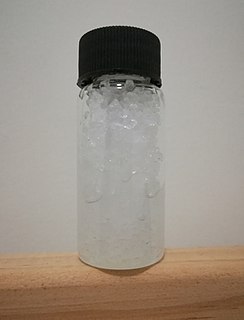
Periodic acid ( "per-i-OH-dic") is the highest oxoacid of iodine, in which the iodine exists in oxidation state VII. Like all periodates it can exist in two forms: orthoperiodic acid, with the chemical formula H5IO6 and metaperiodic acid, which has the formula HIO4.
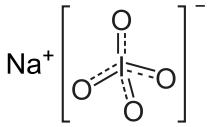
Sodium periodate is an inorganic salt, composed of a sodium cation and the periodate anion. It may also be regarded as the sodium salt of periodic acid. Like many periodates it can exist in two different forms: sodium metaperiodate, which has the formula NaIO4, and sodium orthoperiodate, normally this means sodium hydrogen periodate (Na2H3IO6) but the fully reacted sodium orthoperiodate salt, Na5IO6, can also be prepared. Both salts are useful oxidising agents.
A pinacol coupling reaction is an organic reaction in which a carbon–carbon covalent bond is formed between the carbonyl groups of an aldehyde or a ketone in presence of an electron donor in a free radical process. The reaction product is a vicinal diol. The reaction is named after pinacol, which is the product of this reaction when done with acetone as reagent. The reaction is usually a homocoupling but intramolecular cross-coupling reactions are also possible. Pinacol was discovered by Wilhelm Rudolph Fittig in 1859.
Dihydroxylation is the process by which an alkene is converted into a vicinal diol. Although there are many routes to accomplish this oxidation, the most common and direct processes use a high-oxidation-state transition metal. The metal is often used as a catalyst, with some other stoichiometric oxidant present. In addition, other transition metals and non-transition metal methods have been developed and used to catalyze the reaction.
The semipinacol rearrangement is a rearrangement reaction in organic chemistry involving a heterosubstituted alcohol of the type R1R2(HO)C–C(X)R3R4. The hetero substituent can be a halogen (Cl, Br, I), a tosylate, a mesylate or a thiol group. This reaction proceeds by removal of the leaving group X forming a carbocation as electron deficient center. One of the adjacent alkyl groups then migrates to the positive carbon in a 1,2-shift. Simultaneously with the shift, a pi bond forms from the oxygen to carbon, assisting in driving the migrating group off its position. The result is a ketone or aldehyde. In another definition all semipinacol rearrangements "share a common reactive species in which an electrophilic carbon center, including but not limited to carbocations, is vicinal to an oxygen-containing carbon and can drive the 1,2-migration of a C–C or C–H bond to terminate the process, generating a carbonyl group ".

Société Régionale Wallonne du Transport (SRWT), is responsible for the supervision, strategic planning and marketing of a group of five regional public transport companies branded as TEC or "Transport En Commun" in Wallonia, Belgium. It is primarily a bus operator, but also operates the Charleroi tram system. TEC buses and trams are distinctively painted yellow and red.

Han-sur-Lesse is a Walloon village in the municipality of Rochefort, Namur Province in southeastern Belgium. It is famous for the exceptional caves carved under a nearby hill by the river Lesse, which tourists reach via a preserved remnant of the country's vicinal tramway system.

The asbl TTA or Tramway Touristique de l'Aisne is the official designation of the tourist use of a former rural vicinal tramway in Belgium.
Vicinal difunctionalization refers to a chemical reaction involving transformations at two adjacent centers. This transformation can be accomplished in α,β-unsaturated carbonyl compounds via the conjugate addition of a nucleophile to the β-position followed by trapping of the resulting enolate with an electrophile at the α-position. When the nucleophile is an enolate and the electrophile a proton, the reaction is called Michael addition.
Schepdaal is a village and deelgemeente of Dilbeek.
Atomic Terrace Low Angle Shadowing (ATLAS) is a surface science technique which enables the growth of planar nanowire or nanodot arrays using molecular beam epitaxy on a vicinal surface. ATLAS utilises the inherent step-and-terrace structure of the surface as a template for such nanostructures. The technique involves the low angle incidence of flux material on vicinal substrates. Vicinal substrates are composed of atomic terraces separated by atomic steps. The ATLAS technique allows for the fabrication of well defined planar arrays of plasmonic nanostructures, of dimensions unachievable by lithography.
The Société des Transports Intercommunaux de Charleroi, abbreviated and referred to as STIC, was a company operating a local and regional public transport network in Charleroi, Belgium. The company was active from 1962 until 1991, when it was merged with the Charleroi part of the SNCV to form the TEC Charleroi, the current public transport company in Charleroi.
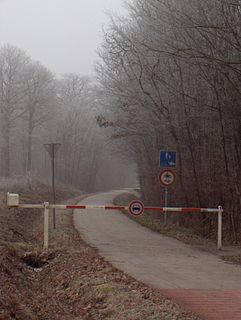
RAVeL, French for réseau autonome de voies lentes, is a Walloon initiative aimed at creating a network of itineraries reserved for pedestrians, cyclists, horse riders and people with reduced mobility.