
Villa Castelbarco is a rural palace described as a villa di delizia which translates as villa of delights, located just west of the Martesana canal and Adda river, just north of the town of Vaprio d'Adda, in the region of Lombardy, Italy.
Villa Castelbarco is a rural palace described as a villa di delizia which translates as villa of delights, located just west of the Martesana canal and Adda river, just north of the town of Vaprio d'Adda, in the region of Lombardy, Italy.
Originally, the site hosted a Vallombrosan monastery, with sustaining farms and a chapel to St Carpoforo. The general layout seems to reflect the cloisters of the former monastery. In a 19th-century description, it was called Villa Monasterolo. [1]
These were repurposed by Count Giuseppe Simonetta (died 1733) with construction of a lodge. The monastic church was formulated as a family chapel, refurbished in Baroque style with a polychrome marble altar. The villa was transferred from the Simonetta to the Castelbarco family by the late 18th-century, when Francesca Simonetta married Count Cesare Castelbarco. This count pursued renovation of the buildings and surrounding area, which had been used as a hunting lodge in the past.
In 1804, he expanded and decorated reception rooms, doubled the size of the south wing with the construction of a limonaia or orangery. On the esplanade next to the terrace, he built two Empire-style palazzini used as museum and theater. The park with enhanced with benches and statuary.
Between 1835 and 1837, Cesare's nephew, Carlo Castelbarco created in the basement a series of rooms with individual themes: Egyptian, Etruscan, Roman, Oceanic, and finely a room with a Renaissance or Raphaelesque theme. The rooms, often cave-like, were furnished with fountains with playful water jets and waterfalls. A guide from 1907 depicts in situ a Northern Italian sculpture collected by Carlo, [2] now in the Cloisters collection of the Metropolitan Museum of Art in New York. [3]
At the end of the nineteenth century, the villa passed to the Massimini family, then the Quintavalle in the early twentieth century, which occupied it until the mid-1960s. Currently the property is owned by a private company called "Barco art and culture center". It is used for cultural events and private functions. [4]

The Vatican Museums are the public museums of Vatican City. They display works from the immense collection amassed by the Catholic Church and the papacy throughout the centuries, including several of the most well-known Roman sculptures and most important masterpieces of Renaissance art in the world. The museums contain roughly 70,000 works, of which 20,000 are on display, and currently employ 640 people who work in 40 different administrative, scholarly, and restoration departments.

The Cloisters, also known as the Met Cloisters, is a museum in the Washington Heights neighborhood of Upper Manhattan, New York City. The museum, situated in Fort Tryon Park, specializes in European medieval art and architecture, with a focus on the Romanesque and Gothic periods. Governed by the Metropolitan Museum of Art, it contains a large collection of medieval artworks shown in the architectural settings of French monasteries and abbeys. Its buildings are centered around four cloisters—the Cuxa, Saint-Guilhem, Bonnefont and Trie—that were acquired by American sculptor and art dealer George Grey Barnard in France before 1913, and moved to New York. Barnard's collection was bought for the museum by financier and philanthropist John D. Rockefeller Jr. Other major sources of objects were the collections of J. P. Morgan and Joseph Brummer.

Iglesias is a comune and city in the province of South Sardinia, Italy. It was co-capital of the province of Carbonia-Iglesias with Carbonia, and the province's second-largest community.

Cassano d'Adda is a town and comune in the Metropolitan City of Milan, Lombardy, Italy, located on the right side of the Adda River. It is on the border of the Metropolitan City of Milan and the province of Bergamo. It is served by Cassano d'Adda railway station.

The abbey of Saint-Michel-de-Cuxa is a Benedictine abbey located in the territory of the commune of Codalet, in the Pyrénées-Orientales département, in southwestern France. It was founded initially in 840, and then refounded at its present site in 878, after a flood destroyed the original buildings. It was an important cultural centre in the regency of Abbot Oliba.

The Certosa di Pavia is a monastery and complex in Lombardy, Northern Italy, situated near a small town of the same name in the Province of Pavia, 8 km (5.0 mi) north of Pavia. Built in 1396–1495, it was once located on the border of a large hunting park belonging to the Visconti family of Milan, of which today only scattered parts remain. It is one of the largest monasteries in Italy.

The National Roman Museum is a museum, with several branches in separate buildings throughout the city of Rome, Italy. It shows exhibits from the pre- and early history of Rome, with a focus on archaeological findings from the period of Ancient Rome.
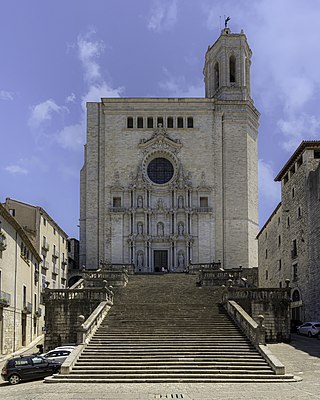
Girona Cathedral, also known as the Cathedral of Saint Mary of Girona, is a Roman Catholic church located in Girona, Catalonia, Spain. It is the seat of the Roman Catholic Diocese of Girona. The cathedral's interior includes the widest Gothic nave in the world, with a width of 23 metres (75 ft), and the second-widest of any church after that of St. Peter's Basilica. Its construction was begun in the 11th century in the Romanesque architectural style, and continued in the 13th century in the Gothic style. Of the original Romanesque edifice only the 12th-century cloister and a bell tower remain. The second bell tower was completed in the 18th century.

Vaprio d'Agogna is a comune (municipality) in the Province of Novara in the Italian region Piedmont, located about 90 kilometres (56 mi) northeast of Turin and about 15 kilometres (9 mi) northwest of Novara.

Trezzo sull'Adda is a comune (municipality) in the Metropolitan City of Milan in the Italian region Lombardy, located about 30 kilometres (19 mi) northeast of Milan on the Adda River.

Vaprio d'Adda is a comune (municipality) in the Metropolitan City of Milan in the Italian region Lombardy, about 30 kilometres (19 mi) northeast of Milan.
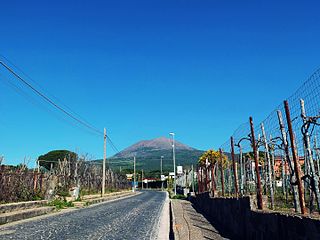
Boscotrecase is a town and municipality of 9,790 inhabitants in the metropolitan city of Naples in Campania, Italy.

Emilio Giuseppe Dossena was an Italian painter who was born in Cavenago d'Adda, Italy and died in Milan, Italy. He was also known simply as Giuseppe Dossena.

Battista Mombrini is an Italian painter and sculptor.

Kloster Allerheiligen is a former Benedictine monastery in the Swiss municipality of Schaffhausen in the Canton of Schaffhausen. The church Münster Allerheiligen is the oldest building in Schaffhausen, and houses also the Museum zu Allerheiligen.
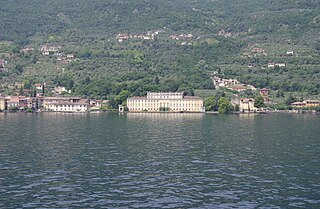
Villa Bettoni is a large lake-side Neoclassical-style rural palace located in the frazione of Bogliaco, on the shores of Lake Garda, within the town limits of Gargnano, Province of Brescia, region of Lombardy, Italy. The villa includes lakefront and gardens.
Villa Jacini is a large rural palace located on Via Conte Stefano Jacini the frazione of Zuccone Robasacco, within the town limits of Triuggio, Province of Monza and Brianza, region of Lombardy, Italy.

The Villa La Rotonda is a 19th-century villa located on Via Privata D'Adda #2 just outside the town of Inverigo, Province of Como, Lombardy, Italy.
The Villa Litta Modignani is a 17th-century rural palace and park located on Via Taccioli in the north suburbs of Milan, in the Province of Milan, Lombardy, Italy.
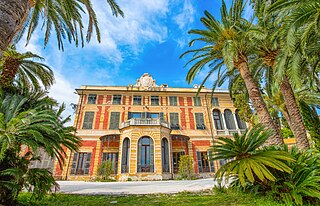
The Villa Saluzzo Serra is a civil building in the Nervi district, in via Capolungo, in the municipality of Genoa. Municipal property, and located in the parks of Nervi, it has been the seat of the Genoa's Gallery of Modern Art (GAM) since 1928.