
A tax is a compulsory financial charge or some other type of levy imposed on a taxpayer by a governmental organization in order to fund government spending and various public expenditures. A failure to pay in a timely manner, along with evasion of or resistance to taxation, is punishable by law. Taxes consist of direct or indirect taxes and may be paid in money or as its labour equivalent. The first known taxation took place in Ancient Egypt around 3000–2800 BC.
An income tax is a tax imposed on individuals or entities (taxpayers) in respect of the income or profits earned by them. Income tax generally is computed as the product of a tax rate times the taxable income. Taxation rates may vary by type or characteristics of the taxpayer and the type of income.
A nonprofit organization (NPO), also known as a non-business entity, not-for-profit organization, or nonprofit institution, is a legal entity organized and operated for a collective, public or social benefit, in contrast with an entity that operates as a business aiming to generate a profit for its owners. A nonprofit is subject to the non-distribution constraint: any revenues that exceed expenses must be committed to the organization's purpose, not taken by private parties. An array of organizations are nonprofit, including some political organizations, schools, business associations, churches, social clubs, and consumer cooperatives. Nonprofit entities may seek approval from governments to be tax-exempt, and some may also qualify to receive tax-deductible contributions, but an entity may incorporate as a nonprofit entity without securing tax-exempt status.
A tax credit is a tax incentive which allows certain taxpayers to subtract the amount of the credit they have accrued from the total they owe the state. It may also be a credit granted in recognition of taxes already paid or a form of state "discount" applied in certain cases. Another way to think of a tax credit is as a rebate.
Capital gain is an economic concept defined as the profit earned on the sale of an asset which has increased in value over the holding period. An asset may include tangible property, a car, a business, or intangible property such as shares.
A capital gains tax (CGT) is a tax on the profit realized on the sale of a non-inventory asset. The most common capital gains are realized from the sale of stocks, bonds, precious metals, real estate, and property.
In corporate finance, free cash flow (FCF) or free cash flow to firm (FCFF) is the amount by which a business's operating cash flow exceeds its working capital needs and expenditures on fixed assets. It is that portion of cash flow that can be extracted from a company and distributed to creditors and securities holders without causing issues in its operations. As such, it is an indicator of a company's financial flexibility and is of interest to holders of the company's equity, debt, preferred stock and convertible securities, as well as potential lenders and investors.

Trickle-down economics, was a term coined by political satirist Will Rogers, also known as the horse and sparrow theory; it is a pejorative characterization of the economic proposition that taxes on businesses and the wealthy in society should be reduced as a means to stimulate business investment in the short term and benefit society at large in the long term. In each of the aforementioned tax reforms, taxes were cut across all income brackets, but the biggest reductions were given to the highest income earners, In recent history, the term has been used by critics of supply-side economic policies, such as "Reaganomics". Whereas general supply-side theory favors lowering taxes overall, trickle-down theory more specifically advocates for a lower tax burden on the upper end of the economic spectrum. Empirical evidence shows that the proposition is regressive and has never managed to achieve all of its stated goals as described by the Reagan administration.
Tax advantage refers to the economic bonus which applies to certain accounts or investments that are, by statute, tax-reduced, tax-deferred, or tax-free. Examples of tax-advantaged accounts and investments include retirement plans, education savings accounts, medical savings accounts, and government bonds. Governments establish tax advantages to encourage private individuals to contribute money when it is considered to be in the public interest.

Most individual U.S. states collect a state income tax in addition to federal income tax. The two are separate entities. Some local governments also impose an income tax, often based on state income tax calculations. Forty-two states and many localities in the United States impose an income tax on individuals. Eight states impose no state income tax, and a ninth, New Hampshire, imposes an individual income tax on dividends and interest income but not other forms of income. Forty-seven states and many localities impose a tax on the income of corporations.
A tax refund or tax rebate is a payment to the taxpayer when the taxpayer pays more tax than they owe.

Taxes in New Zealand are collected at a national level by the Inland Revenue Department (IRD) on behalf of the Government of New Zealand. National taxes are levied on personal and business income, and on the supply of goods and services. There is no capital gains tax, although certain "gains" such as profits on the sale of patent rights are deemed to be income – income tax does apply to property transactions in certain circumstances, particularly speculation. There are currently no land taxes, but local property taxes (rates) are managed and collected by local authorities. Some goods and services carry a specific tax, referred to as an excise or a duty, such as alcohol excise or gaming duty. These are collected by a range of government agencies such as the New Zealand Customs Service. There is no social security (payroll) tax.
Income Support is an income-related benefit in the United Kingdom for some people who are on a low income, but have a reason for not actively seeking work. Claimants of Income Support may be entitled to certain other benefits, for example, Housing Benefit, Council Tax Reduction, Child Benefit, Carer's Allowance, Child Tax Credit and help with health costs. A person with capital over £16,000 cannot get Income Support, and savings over £6,000 affect how much Income Support can be received. Claimants must be between 16 and Pension Credit age, work fewer than 16 hours a week, and have a reason why they are not actively seeking work.
The American middle class is a social class in the United States. While the concept is typically ambiguous in popular opinion and common language use, contemporary social scientists have put forward several ostensibly congruent theories on the American middle class. Depending on the class model used, the middle class constitutes anywhere from 25% to 66% of households.
The problem of tax equalization arises when an individual is working for an international company and starts to work abroad his home country. There are questions of who should pay taxes and how much should they pay. Usually, the individual is receiving a net pay, which is the money they would have received in their home country after taxation. However, the company is obliged to pay taxes for its employee. If they are working in a country with lower taxes, the company takes the savings. On the other hand, if they work in a country with higher taxation, the company pays the excess. Either way, the amount received by the employee is same. If the policy only benefits the employee, then it is referred to as a tax protection policy.
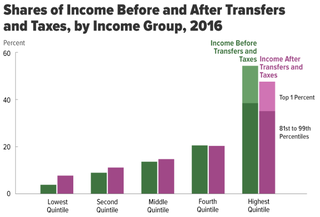
Income inequality in the United States is the extent to which income is distributed in differing amounts among the American population. It has fluctuated considerably since measurements began around 1915, moving in an arc between peaks in the 1920s and 2000s, with a 30-year period of relatively lower inequality between 1950 and 1980.
Poverty in Canada refers to people that do not have "enough income to purchase a specific basket of goods and services in their community."
Working family was a term used by Kevin Rudd, former Prime Minister of Australia, and members of his leadership team, during the lead-up to the 2007 Australian federal election.

The United States federal earned income tax credit or earned income credit is a refundable tax credit for low- to moderate-income working individuals and couples, particularly those with children. The amount of EITC benefit depends on a recipient's income and number of children. For a person or couple to claim one or more persons as their qualifying child, requirements such as relationship, age, and shared residency must be met.
Taxation in Finland is mainly carried out through the Finnish Tax Administration, an agency of the Ministry of Finance. Finnish Customs and the Finnish Transport and Communications Agency Traficom, also collect taxes. Taxes collected are distributed to the Government, municipalities, church, and the Social Insurance Institution, Kela.
