This page is based on this
Wikipedia article Text is available under the
CC BY-SA 4.0 license; additional terms may apply.
Images, videos and audio are available under their respective licenses.

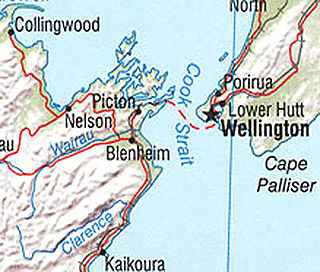
The Marlborough Region, commonly known simply as Marlborough, is one of the regions of New Zealand, located in the northeast of the South Island. Marlborough is a unitary authority, both a region and a district, and its council is located at Blenheim. It has a population of 46,600.

Renwick is a small town in Marlborough, New Zealand, close to the south bank of the Wairau River. It is located on State Highway 6, 12 kilometres (7 mi) west of Blenheim. Havelock is 31 km (19 mi) north. State Highway 63 runs southwest from Renwick through the Wairau River valley.
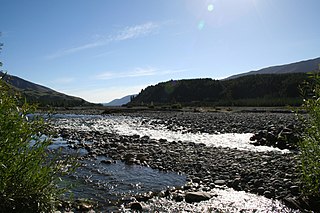
The Wairau River is one of the longest rivers in New Zealand's South Island. It flows for 170 kilometres (110 mi) from the Spenser Mountains, firstly in a northwards direction and then northeast down a long, straight valley in inland Marlborough.

William Henry Eyes was a British-born, New Zealand politician who was the fifth Superintendent of the Marlborough Province, and who represented the Wairau electorate in the New Zealand House of Representatives for many years. Born in England, Eyes had emigrated to Australia in 1839. He was jailed at Parramatta Gaol for a year before he was pardoned, after which he immediately emigrated to New Zealand.

Arthur Penrose Seymour was a 19th-century New Zealand politician from Picton. He was the 4th Superintendent of the Marlborough Province and was a member of the provincial government for all 16 years of its existence. With his strong advocacy for Picton, he successfully had the Seat of Government moved to Picton. When the Blenheim party secured a majority in the Provincial Council by 1865, Seymour negotiated the removal of the Seat of Government back to Blenheim.
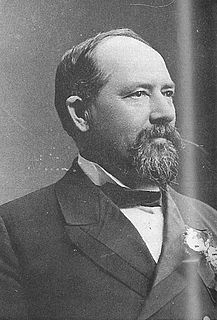
Charles Houghton Mills was a member of parliament for Waimea and Wairau, in the South Island of New Zealand.

Wairau Valley is the valley of the Wairau River in Marlborough, New Zealand and also the name of the main settlement in the upper valley. State Highway 63 runs through the valley. The valley opens onto the Wairau Plain, where Renwick and Blenheim are sited. The Alpine–Wairau Fault runs along the length of the valley.
Marlborough is a former New Zealand parliamentary electorate, in the Marlborough region at the top of the South Island. It existed from 1938 to 1996, and was represented by five Members of Parliament.
Waimea-Sounds was a fully rural parliamentary electorate in the Marlborough and Nelson Regions of New Zealand, from 1893 to 1896. During its one parliamentary term of existence, the Waimea-Sounds electorate was represented by one Member of Parliament.
Wamea-Picton was a parliamentary electorate in the Marlborough and Nelson Regions of New Zealand, from 1887 to 1893.
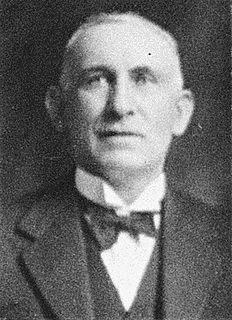
Edward Francis Healy was a United Party Member of Parliament in New Zealand.
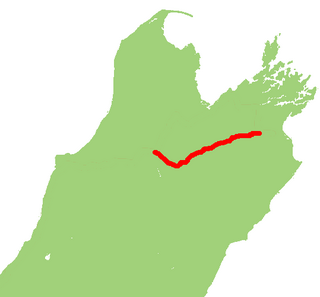
State Highway 63 is a state highway located in the northern parts of the South Island of New Zealand. It is 117 km long and runs between the settlements of Renwick and Kawatiri Junction via Saint Arnaud, providing a bypass of the city of Nelson. Despite being a convenient link between the West Coast and Marlborough, and being a relatively straight highway along most of its length, it is only classified by the NZTA as a secondary collector highway.

The Marlborough Fault System is a set of four large dextral strike-slip faults and other related structures in the northern part of South Island, New Zealand, which transfer displacement between the mainly transform plate boundary of the Alpine fault and the mainly destructive boundary of the Kermadec Trench, and together form the boundary between the Australian and Pacific Plates.
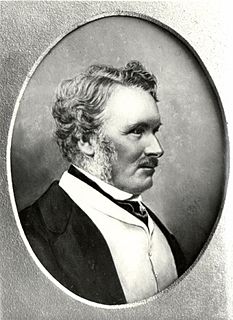
William Adams was a 19th-century Member of Parliament from Marlborough, New Zealand and the first Superintendent of Marlborough Province.
Joseph Ward was a 19th-century Member of Parliament from Marlborough, New Zealand.

Thomas "Tom" Carter was the third Superintendent of Marlborough Province. Together with two of his brothers, he was a large runholder.
The Wairau by-election 1872 was a by-election held in the Wairau electorate during the 5th New Zealand Parliament, on 19 February 1872. The by-election was caused by the resignation of incumbent MP William Henry Eyes and was won by Arthur Seymour, who defeated Joseph Ward. Both candidates were prominent Marlborough politicians, and for both of them, this was their first attempt at election to the General Assembly.

The 21 June 1875 Wairau by-election was a by-election held in the Wairau electorate in the Marlborough Province during the 5th New Zealand Parliament. The by-election was caused by the resignation of incumbent MP Arthur Seymour and was won by Joseph Ward, who defeated William Sefton Moorhouse. Ward was a well-known politician in Marlborough. Moorhouse had political seniority over Ward and was at the time Mayor of Wellington, but had no personal connection to Marlborough.