
Year 835 (DCCCXXXV) was a common year starting on Friday of the Julian Calendar.
Year 571 (DLXXI) was a common year starting on Thursday of the Julian calendar. The denomination 571 for this year has been used since the early medieval period, when the Anno Domini calendar era became the prevalent method in Europe for naming years.

劉 / 刘 is an East Asian surname. pinyin: Liú in Mandarin Chinese, Lau4 in Cantonese. It is the family name of the Han dynasty emperors. The character 劉 originally meant 'kill', but is now used only as a surname. Today, it is the 4th most common surname in Mainland China as well as one of the most common surnames in the world.

Wang is the pinyin romanization of the common Chinese surnames 王 (Wáng) and 汪 (Wāng). It is currently the most common surname in mainland China, as well as one of the most common surnames in the world, with more than 100 million worldwide.
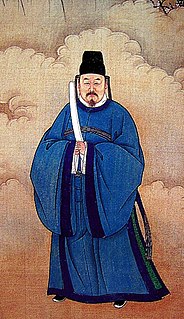
Jinshi was the highest and final degree in the imperial examination in Imperial China. The examination was usually taken in the imperial capital in the palace, and was also called the Metropolitan Exam. Recipients are sometimes referred to in English-language sources as Imperial Scholars.
The grand chancellor, also translated as counselor-in-chief, chancellor, chief councillor, chief minister, imperial chancellor, lieutenant chancellor and prime minister, was the highest-ranking executive official in the imperial Chinese government. The term was known by many different names throughout Chinese history, and the exact extent of the powers associated with the position fluctuated greatly, even during a particular dynasty. During the Six Dynasties period, the term denoted a number of power-holders serving as chief administrators, including zhongshun jian, zhongshu ling, shizhong, shangshu ling and puye.

Wei Zheng (580–643), courtesy name Xuancheng, posthumously known as Duke Wenzhen of Zheng, was a Chinese politician and historian. He served as a chancellor of the Tang dynasty for about 13 years during the reign of Emperor Taizong. He was also the lead editor of the official history of the Sui dynasty, the Book of Sui, which was composed in 636.
Fàn is a Chinese family name. Is it also one of the most common surnames in Vietnam, where it is written Pham, and occurs in Korea as Beom. It is the 46th name on the Hundred Family Surnames poem in Chinese.
Cui, alternatively spelled Tsui or Tsway, is one of the 80 most common surnames in China, with around 0.28% of the Chinese population having the surname. It is also one of the most common surnames in Korea, with around 4.7% of the population having the surname in South Korea.
The chancellor was a semi-formally designated office position for a number of high-level officials at one time during the Tang dynasty of China. This list also includes chancellors of the short-lived Wu Zhou dynasty, which is typically treated as an interregnum of the Tang dynasty by historians.
Wang Gui (571–639), courtesy name Shujie, posthumously known as Duke Yi of Yongning, was a Chinese official who served as a chancellor during the reign of Emperor Taizong in the Tang dynasty. He had previously served Li Shimin's elder brother, Li Jiancheng, with whom Li Shimin was locked in an intense rivalry during the reign of their father, Emperor Gaozu, but after Li Shimin killed Li Jiancheng and then took the throne, he knew that Wang was faithful to Li Jiancheng and was capable, and therefore retained him, eventually making him chancellor. Wang was known for his honest and blunt criticism of the emperor, and for that was honored by Taizong, who appreciated such criticism.
Wang Xuan (王璿) was an official of Wu Zetian's Zhou Dynasty, briefly serving as chancellor.
Su Gui, courtesy name Changrong (昌容) or Tingshuo (廷碩), formally Duke Wenzhen of Xu (許文貞公), was an official of the Chinese dynasty Tang Dynasty and Wu Zetian's Zhou Dynasty, serving as a chancellor during the reigns of Emperor Zhongzong, Emperor Shang, and Emperor Ruizong.
Liu Youqiu, formally Duke Wenxian of Xu (徐文獻公), was an official of the Chinese dynasty Tang Dynasty and Wu Zetian's Zhou Dynasty, serving as a chancellor during the reigns of Emperor Ruizong and Emperor Xuanzong.
Su Ting, courtesy name Tingshuo (廷碩), formally Duke Wenxian of Xu (許文憲公), was an official of the Chinese dynasty Tang Dynasty and Wu Zetian's Zhou Dynasty, serving as a chancellor during the reign of Emperor Xuanzong. He was a capable supporting chancellor to Song Jing, and he was also immensely gifted literarily, ranking with Zhang Yue as the two great literary figures of their time. They were known in unison as 燕许大手笔.
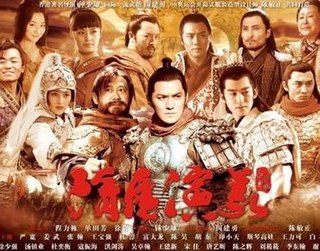
Heroes in Sui and Tang Dynasties is a Chinese television series based on Chu Renhuo's historical novel Sui Tang Yanyi, which romanticises the historical events leading to the fall of the Sui dynasty and the rise of the Tang dynasty. The series was first broadcast in mainland China on various television networks on 14 January 2013. It is not to be confused with Heroes of Sui and Tang Dynasties 1 & 2, a similar television series also based on the novel, but was released earlier in December 2012. Filming for the series started on 5 November 2011 at the Hengdian World Studios and wrapped up in May 2012.
An Congjin was a general of the Chinese Five Dynasties and Ten Kingdoms Period states Later Tang and Later Jin. In 941, he rebelled against the rule of Later Jin's founding emperor Shi Jingtang, but was defeated, and he then committed suicide.

Lu is the pinyin and Wade–Giles romanization of the Chinese surname written 陆 in simplified character and 陸 in traditional character. It is also spelled Luk or Loke according to the Cantonese pronunciation. Lu 陆 is the 61st most common surname in China, shared by 4.2 million people. Most people with the surname live in southern China; 44% live in just two provinces: Jiangsu and Guangxi. Lu 陸 is listed 198th in the Song Dynasty classic text Hundred Family Surnames.
