Washington Cemetery may refer to:
 | This disambiguation page lists articles associated with the title Washington Cemetery. If an internal link led you here, you may wish to change the link to point directly to the intended article. |
Washington Cemetery may refer to:
| | This disambiguation page lists articles associated with the title Washington Cemetery. If an internal link led you here, you may wish to change the link to point directly to the intended article. |

Arlington National Cemetery is a United States military cemetery in Arlington County, Virginia, across the Potomac River from Washington, D.C., in whose 624 acres (253 ha) the dead of the nation's conflicts have been buried, beginning with the Civil War, as well as reinterred dead from earlier wars. The United States Department of the Army, a component of the United States Department of Defense (DoD), controls the cemetery.

The United States National Cemetery System is a system of 147 nationally important cemeteries in the United States. The authority to create military burial places came during the American Civil War, in an act passed by the U.S. Congress on July 17, 1862. By the end of 1862, 14 national cemeteries had been established. A national cemetery is generally a military cemetery containing the graves of U.S. military personnel, veterans and their spouses, but not exclusively so. The best known national cemetery is Arlington National Cemetery in Arlington County, Virginia, outside Washington, D.C.. Some national cemeteries, especially Arlington, contain the graves of important civilian leaders and other important national figures. Some national cemeteries also contain sections for Confederate soldiers. In addition to national cemeteries, there are also state veteran cemeteries.

Mount Auburn Cemetery is the first rural, or garden, cemetery in the United States, located on the line between Cambridge and Watertown in Middlesex County, Massachusetts, 4 miles (6.4 km) west of Boston. It is the burial site of many prominent members of the Boston Brahmins, as well being a National Historic Landmark.

Arlington Cemetery is a side platformed Washington Metro station in Arlington, Virginia, United States. The station was opened on July 1, 1977, and is operated by the Washington Metropolitan Area Transit Authority (WMATA). The station provides service for only the Blue Line, and is located at the entrance to Arlington National Cemetery, underneath Memorial Drive. There is no public parking near the station except at the cemetery, which is reserved for cemetery visitors. It is the only station that closes earlier than the rest of the system, closing at 7 PM from October to March, and 10 PM from April to September. The station is also unique in its design. It is just below ground level, and is only covered by a bridge carrying Memorial Drive.

The Congressional Cemetery, officially Washington Parish Burial Ground, is an historic and active cemetery located at 1801 E Street, SE, in Washington, D.C., on the west bank of the Anacostia River. It is the only American "cemetery of national memory" founded before the Civil War. Over 65,000 individuals are buried or memorialized at the cemetery, including many who helped form the nation and the city of Washington in the early 19th century.

The Roman Catholic Archdiocese of Washington is a particular church of the Roman Catholic Church in the United States. It comprises the District of Columbia and Calvert, Charles, Montgomery, Prince George's and Saint Mary's counties in the state of Maryland. It was originally part of the Archdiocese of Baltimore

Arlington House, The Robert E. Lee Memorial, formerly named the Custis-Lee Mansion, is a Greek revival style mansion located in Arlington, Virginia, United States that was once the home of Confederate Army General Robert E. Lee. It overlooks the Potomac River and the National Mall in Washington, D.C. During the American Civil War, the grounds of the mansion were selected as the site of Arlington National Cemetery, in part to ensure that Lee would never again be able to return to his home. The United States has since designated the mansion as a National Memorial. Although the United States Department of the Army controls Arlington National Cemetery, the National Park Service, a component of the United States Department of the Interior, administers Arlington House.
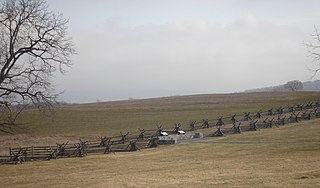
Antietam National Battlefield is a National Park Service protected area along Antietam Creek in Sharpsburg, Washington County, northwestern Maryland. It commemorates the American Civil War Battle of Antietam that occurred on September 17, 1862.

Indian Mound Cemetery is a cemetery located along the Northwestern Turnpike on a promontory of the "Yellow Banks" overlooking the South Branch Potomac River and Mill Creek Mountain in Romney, West Virginia, United States. The cemetery is centered on a Hopewellian mound, known as the Romney Indian Mound. Indian Mound Cemetery is also the site of Fort Pearsall, the Confederate Memorial, Parsons Bell Tower, and reinterments from Romney's Old Presbyterian Cemetery. The cemetery is currently owned and maintained by the Indian Mound Cemetery Association, Inc.

Mount Olivet Cemetery is an historic rural cemetery located at 1300 Bladensburg Road, NE in Washington, D.C. It is maintained by the Roman Catholic Archdiocese of Washington. The largest Catholic burial ground in the District of Columbia, it was one of the first in the city to be racially integrated.

Oak Hill Cemetery is a historic 22-acre (8.9 ha) cemetery located in the Georgetown neighborhood of Washington, D.C., in the United States. It was founded in 1848 and completed in 1853, and is a prime example of a rural cemetery. Many famous politicians, business people, military people, diplomats, and philanthropists are buried at Oak Hill, and the cemetery has a number of Victorian-style memorials and monuments. Oak Hill has two structures which are listed on the National Register of Historic Places, the Oak Hill Cemetery Chapel and the Van Ness Mausoleum.
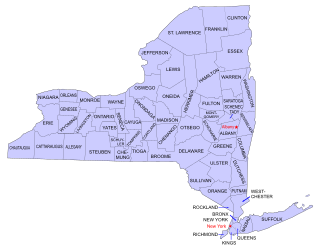
Buildings, sites, districts, and objects in New York listed on the National Register of Historic Places:
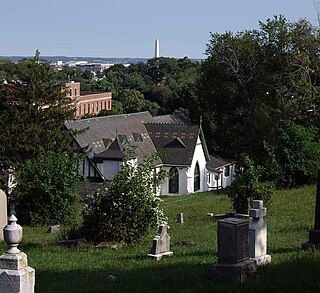
Holy Rood Cemetery is located at 2126 Wisconsin Avenue NW at the southern end of the Glover Park neighborhood of Washington, D.C. It stands at one of the highest elevations in Washington, D.C. and has memorable views. Holy Rood Cemetery contains approximately 7,000 graves, including as many as 1,000 free and enslaved African Americans, and may be the best-documented slave burial ground in the District of Columbia. At the western edge of the cemetery is the grave of Joseph Nevitt, a veteran of the American Revolution.
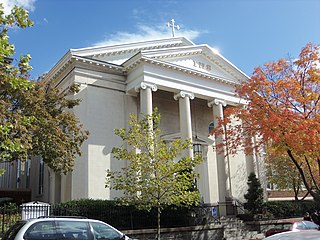
Holy Trinity Catholic Church is a Catholic church located in the Georgetown neighborhood of Washington, D.C., in the United States. Holy Trinity Parish was founded in 1787 and is the oldest Roman Catholic community and house of worship in continuous operation in both Georgetown and the larger city of Washington, D.C. The original church building was completed in 1794. It is now called the Chapel of St. Ignatius, and is used for smaller ecclesiastical celebrations and as an auxiliary space for parish activities. A larger church building, necessitated by the growing community, was dedicated in 1851, and still serves as the parish church today.

North Capitol Street is a street in Washington, D.C. that separates the Northwest and Northeast quadrants of the city.

Douglass is a residential neighborhood in Southeast Washington, D.C., on the eastern side of St. Elizabeths Hospital, on the border of the Congress Heights Metro Station. It is bounded by Suitland Parkway to the north and east, Alabama Avenue to the south, and the St. Elizabeths campus to the west.

The Oak Hill Cemetery Chapel, also known as the Renwick Chapel or James Renwick Chapel, is a historic building in the Georgetown neighborhood of Washington, D.C., United States. Designed by James Renwick, Jr. in 1850, Oak Hill Cemetery Chapel is the architect's only known example of Gothic Revival church architecture in Washington, D.C. It is located on the highest ridge in Oak Hill Cemetery, near the intersection of 29th and R Streets NW. The chapel is one of two structures in Oak Hill Cemetery listed on the National Register of Historic Places, the other being the Van Ness Mausoleum. The chapel, mausoleum, and cemetery are contributing properties to the Georgetown Historic District, a National Historic Landmark.
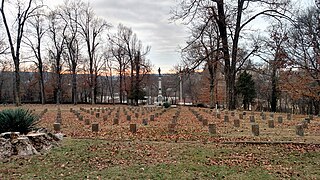
Fayetteville Confederate Cemetery is a cemetery for soldiers of the Confederate States located on the eastern side of Fayetteville in Washington County, Arkansas. Added to the National Register of Historic Places (NRHP) in 1993, the cemetery encompasses 3.5 acres (1.4 ha).

The Presbyterian Burying Ground, also known as the Old Presbyterian Burying Ground, was a historic cemetery which existed between 1802 and 1909 in the Georgetown neighborhood of Washington, D.C., in the United States. It was one of the most prominent cemeteries in the city until the 1860s. Burials there tapered significantly after Oak Hill Cemetery was founded nearby in 1848. The Presbyterian Burying Ground closed to new burials in 1887, and about 500 to 700 bodies were disinterred after 1891 when an attempt was made to demolish the cemetery and use the land for housing. The remaining graves fell into extensive disrepair. After a decade of effort, the District of Columbia purchased the cemetery in 1909 and built Volta Park there, leaving nearly 2,000 bodies buried at the site. Occasional human remains and tombstones have been discovered at the park since its construction. A number of figures important in the early history of Georgetown and Washington, D.C., military figures, politicians, merchants, and others were buried at Presbyterian Burying Ground.