
Yemen, officially the Republic of Yemen, is a country in West Asia. It is located in the southern end of the Arabian Peninsula, and borders Saudi Arabia to the north and Oman to the northeast. It shares maritime borders with Eritrea, Djibouti and Somalia. Covering 555,000 square kilometres and having a coastline of approximately 2,000 kilometres, Yemen is the second-largest Arab sovereign state on the Arabian Peninsula. Sanaa is its constitutionally stated capital and largest city. The country's population is estimated to be 34.7 million as of 2023. Yemen is a member of the Arab League, the United Nations, the Non-Aligned Movement and the Organisation of Islamic Cooperation.
The surname Al-Zaidi (Az-Zaidi) can denote one or both of the following:
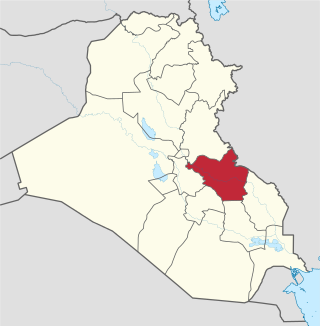
Wasit Governorate is a governorate in eastern Iraq, south-east of Baghdad and bordering Iran. Prior to 1976 it was known as Kut Province. Major cities include the capital Al-Kut, Al-Hai and Al-Suwaira. The governorate contains the Mesopotamian Marshes of Shuwayja, Al-Attariyah, and Hor Aldelmj. Its name comes from the Arabic word meaning "middle", as the former city of Wasit lay along the Tigris about midway between Baghdad and Basra. Wasit city was abandoned after the Tigris shifted course.

Wasit was an early Islamic city in Iraq. It was founded in the 8th century by the Umayyad viceroy of Iraq, al-Hajjaj ibn Yusuf, to serve as the region's seat and as the garrison of the Syrian troops who enforced Umayyad rule there. It was situated between the two traditional administrative centers and garrisons of Iraq, Kufa and Basra, hence its name Wasit. The city was abandoned centuries later and its ruins are located in the eponymous Wasit Governorate, southeast of Kut in southeastern Iraq.
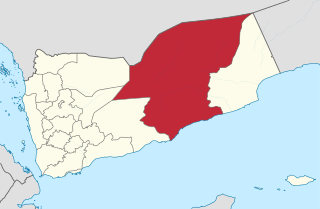
Hadhramaut or Hadramawt or Hadramout is a governorate of Yemen. Lying within the large historical region of Hadhramaut, it is the country's largest governorate.

Sanaa, also spelled San'a' or Sana, is a governorate of Yemen. Its capital is Sanaa, which is also the national capital. However, the city of Sanaa is not part of the governorate but instead forms the separate governorate of Amanat Al-Asemah. The Governorate covers an area of 13,850 km2 (5,350 sq mi). As of 2004, the population was 2,918,379 inhabitants. Within this place is Jabal An-Nabi Shu'ayb or Jabal Hadhur, the highest mountain in the nation and the Arabian Peninsula.
Abdul Majeed al-Zindani is a leading Islamist, founder and head of the Iman University in Yemen, head of the Yemeni Muslim Brotherhood political movement and founder of the Commission on Scientific Signs in the Quran and Sunnah, based in Saudi Arabia. He has been described by Daniel Golden of the Wall Street Journal as "a charismatic Yemeni academic and politician." and by CNN as "a provocative cleric with a flaming red beard".

Anwar Nasser Abdulla al-Awlaki was an American Islamic scholar and lecturer who was killed in 2011 in Yemen by a U.S. government drone strike ordered by President Barack Obama. Al-Awlaki became the first U.S. citizen to be targeted and killed by a drone strike from the U.S. government. U.S. government officials argued that Awlaki was a key organizer for the Islamist terrorist group al-Qaeda, and in June 2014, a previously classified memorandum issued by the U.S. Department of Justice was released, justifying al-Awlaki's death as a lawful act of war. Civil liberties advocates have described the incident as "an extrajudicial execution" that breached al-Awlaki's constitutional right to due process, including a trial.

Qasim Yahya Mahdi al-Raymi was a Yemeni militant who was the emir of al-Qaeda in the Arabian Peninsula (AQAP). Al-Raymi was one of 23 men who escaped in the 3 February 2006 prison-break in Yemen, along with other notable al-Qaeda members. Al-Raymi was connected to a July 2007 suicide bombing that killed eight Spanish tourists. In 2009, the Yemeni government accused him of being responsible for the running of an al-Qaeda training camp in Abyan province. After serving as AQAP's military commander, al-Raymi was promoted to leader after the death of Nasir al-Wuhayshi on 12 June 2015.
Wāsiṭī is a toponymic surname originating from the city of Wasit, Iraq. Twelver Shias in India and Pakistan descending from Zayd ibn Ali also carry the surname along with Zaidi. Notable people bearing the name include:
Ansar al-Sharia or Ansar al-Shariah is a name used by a collection of radical or militant Islamist groups or militias, in at least eight countries. While they share names and ideology, they lack a unified command structure.
Al-Murtaḍá al-Husaynī al-Zabīdī, or Muḥammad ibn Muḥammad Murtaḍá al-Zabīdī, also known as Murtada al-Zabidi, was a prominent Indian Sunni polymath based in Cairo. He was a Hanafi scholar, lexicographer, linguist, a hadith specialist, genealogist, biographer, historian, philologist, mystic and theologian. He was considered one of the leading intellectuals of the 18th century. He was also regarded as the leading hadith scholar of his time. He was the famous student of the prominent and renowned scholar, Shah Waliullah Dehlawi.

The Third Fitna was a series of civil wars and uprisings in the Islamic community. It followed the death of the twelfth Umayyad caliph Yazid III in 744 and lasted for about six years. The war culminated with the overthrow of the Umayyad Caliphate and the establishment of the Abbasid Caliphate in 750. Following the death of Yazid III in 744 and the abdication of his successor Ibrahim the same year, Marwan II became the sole ruler of the caliphate.
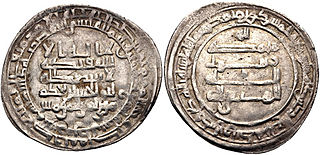
Abū al-Husayn Bajkam al-Mākānī, referred to as Bajkam, Badjkam or Bachkam, was a Turkish military commander and official of the Abbasid Caliphate. A former ghulam of the Ziyarid dynasty, Bajkam entered Abbasid service following the assassination of the Ziyarid ruler Mardavij in 935. During his five-year tenure at the Caliphate's court at Baghdad, he was granted the title of amir al-umara, consolidating his dominance over the caliphs al-Radi and al-Muttaqi and giving him absolute power over their domains. Bajkam was challenged throughout his rule by various opponents, including his predecessor as amir al-umara, Muhammad ibn Ra'iq, the Basra-based Baridis, and the Buyid dynasty of Iran, but he succeeded in retaining control until his death. He was murdered by a party of Kurds during a hunting excursion in 941, shortly after the accession of al-Muttaqi as Caliph. Bajkam was known both for his firm rule and for his patronage of Baghdad intellectuals, who respected and in some cases befriended him. His death led to a void in central power, resulting in a brief period of instability and fighting in Baghdad.
Abu'l-Walid Ma'n ibn Za'ida al-Shaybani was an 8th-century Arab general of the Shayban tribe, who served both the Umayyads and the Abbasids.

Al-Hay is a town located in Iraq's Wasit Province. It 45 kilometers south of the Kut and 220 kilometers south of Baghdad. It has a population of 85,500 citizens.
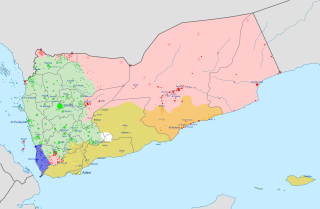
On 26 March 2015, Saudi Arabia, leading a coalition of nine countries from West Asia and North Africa, launched an intervention in Yemen following a request from Yemeni president Abdrabbuh Mansur Hadi for military support after his forces were ousted from Sanaʽa by Houthi insurgents during the Yemeni Civil War. Government forces, Houthi rebels, and other armed groups fought after the draft constitution and power-sharing arrangements collapsed, despite progress made by the UN during the political transition at that time. Violence escalated in mid-2014. Houthis and allied insurgents seized control of Sana'a in September 2014 and thereafter. In response, President Hadi asked Saudi Arabia to intervene against the Iranian-backed Houthis.
Thulth al-Wasit is a sub-district located in Kharif District, 'Amran Governorate, Yemen. Thulth al-Wasit had a population of 2153 according to the 2004 census.
