
The Cricetidae are a family of rodents in the large and complex superfamily Muroidea. It includes true hamsters, voles, lemmings, muskrats, and New World rats and mice. At almost 608 species, it is the second-largest family of mammals, and has members throughout the Americas, Europe and Asia.

Heteromyidae is a family of rodents consisting of kangaroo rats, kangaroo mice, pocket mice and spiny pocket mice. Most heteromyids live in complex burrows within the deserts and grasslands of western North America, though species within the genus Heteromys are also found in forests and their range extends down as far as northern South America. They feed mostly on seeds and other plant parts, which they carry in their fur-lined cheek pouches to their burrows.

The Eumuroida are a clade defined in 2004 by Steppan et al. that includes rats, mice and related species, though not all rodents; in other words, a specific group of muroid rodents. The clade is not defined in the standard taxonomic hierarchy, but it is between superfamily and family.
The Old World rats and mice, part of the subfamily Murinae in the family Muridae, comprise at least 519 species. Members of this subfamily are called murines. In terms of species richness, this subfamily is larger than all mammal families except the Cricetidae and Muridae, and is larger than all mammal orders except the bats and the remainder of the rodents.

The subfamily Deomyinae consists of four genera of mouse-like rodents that were placed in the subfamilies Murinae and Dendromurinae until very recently. They are sometimes called the Acomyinae, particularly in references that antedate the discovery that the link rat, Deomys ferugineus, is part of the clade. Deomyinae is the older name and therefore has priority over Acomyinae.
Swamp rat(s) may refer to:
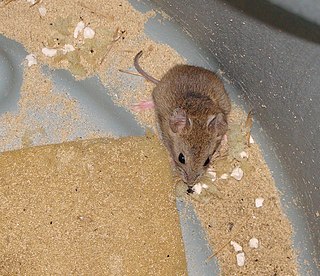
Vesper mice are rodents belonging to a genus Calomys. They are widely distributed in South America. Some species are notable as the vectors of Argentinian hemorrhagic fever and Bolivian hemorrhagic fever.
Water rat(s) may refer to:
The Awash multimammate mouse or Awash mastomys is a species of rodent in the family Muridae found only in Ethiopia. Phylogentically the Awash multimammate mouse is the sister taxon of the Natal multimammate mouse, a species found almost everywhere in Africa south of the Sahara and considered a serious agricultural pest throughout its range.

The Ethiopian amphibious rat also known as the Ethiopian water mouse is an insectivorous and semiaquatic species of rodent in the monotypic genus Nilopegamys of the family Muridae. There has only been one known specimen. It was found along the Lesser Abay River near its source at an altitude of 2600 m in the highlands of northwestern Ethiopia in 1928. N. plumbeus is considered to be the most aquatically adapted African murid; its unusually large brain is thought to be one consequence of this lifestyle. The species is considered to be critically endangered or possibly extinct, since its habitat has been severely damaged by overgrazing and monoculture.

The cactus mouse is a species of rodent in the family Cricetidae. It is a species of the genus Peromyscus, a closely related group of New World mice often called "deermice". They are native to desert areas of southwestern North America.

The Nayarit mouse or Sinaloan deer mouse is a species of cricetid rodent endemic to Mexico. It was considered a subspecies of brush mouse until 1977.
Petromyscus is a genus of rodent in the family Nesomyidae. It is so distinct from other rodents that it is placed as the only genus in subfamily Petromyscinae. In previous classifications, Delanymys brooksi has also been placed in the subfamily. They are found in southwestern Africa. These animals have a sharp lower point to their V-shaped infraorbital canal. Their molars are intermediate between the ancestral cricetid style tooth and the dendromurine style tooth.
The slender harvest mouse(Reithrodontomys gracilis) is a species of rodent in the family Cricetidae. A small mouse-like rodent distributed throughout a portion Central America.
The Mexican water mouse, Mexican fishing mouse or Goodwin's water mouse, is a species of semiaquatic rodent in the family Cricetidae. It has a restricted range in the state of Oaxaca in southern Mexico, Threatened by deforestation and water pollution, it is listed as Endangered by the International Union for Conservation of Nature (IUCN).

Alston's brown mouse, also called Alston's singing mouse, short-tailed singing mouse, or singing mouse, is a species of rodent in the family Cricetidae. It is found in Central America, from Chiapas, Mexico, to western Panama.

The spiny pocket mouse is a species of rodent in the family Heteromyidae and order Rodentia. It is found in Baja California in Mexico and in Arizona, California and Nevada.
Prospect Hill orthohantavirus is a single-stranded, negative-sense Hantaan-like zoonotic RNA virus isolated from meadow voles and microtine and other cricetid rodents in the United States. It has a widespread distribution in Pennsylvania, Maryland, West Virginia, Minnesota and California. The overall risk of infection in humans is low. It was first isolated from a meadow vole found in Prospect Hill, Maryland for which it is named.
This page is based on this
Wikipedia article Text is available under the
CC BY-SA 4.0 license; additional terms may apply.
Images, videos and audio are available under their respective licenses.
