
Nashia is a genus of flowering plant in the vervain family, Verbenaceae.

Carl Ludwig Willdenow was a German botanist, pharmacist, and plant taxonomist. He is considered one of the founders of phytogeography, the study of the geographic distribution of plants. Willdenow was also a mentor of Alexander von Humboldt, one of the earliest and best known phytogeographers. He also influenced Christian Konrad Sprengel, who pioneered the study of plant pollination and floral biology.
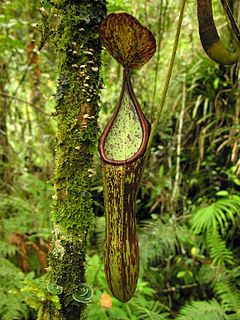
Nepenthes copelandii is a species of pitcher plant native to the island of Mindanao in the Philippines. Originally known from Mount Apo near Davao City and Mount Pasian near Bislig, it has since been discovered on a number of peaks throughout Mindanao. It may also be present on the nearby island of Camiguin. The species has a wide altitudinal distribution of 1100–2400 m above sea level. Nepenthes copelandii has no known natural hybrids. No forms or varieties have been described.

Nepenthes mindanaoensis is a tropical pitcher plant native to the Philippine islands of Mindanao and Dinagat.
Nepenthes saranganiensis is a tropical pitcher plant native to the Philippine island of Mindanao. It is noted for its extremely decurrent leaf attachment that extends a large distance down the stem, often continuing into the next internode.
Minuartia dirphya is a rare species of plant in the family Caryophyllaceae. It is endemic to Mt. Dirfi on Euboea in Greece. It is restricted to the higher peaks of this single mountain on an island with many endemic plant species. Its natural habitat is Mediterranean-type shrubby vegetation. It is threatened by habitat loss.

Anthemideae is a tribe of flowering plants in the aster family, Asteraceae, and the subfamily Asteroideae. They are distributed worldwide with concentrations in central Asia, the Mediterranean Basin, and southern Africa.

Nepenthes ceciliae is a tropical pitcher plant endemic to the Philippine island of Mindanao, where it grows at 1500–1880 m above sea level. Its discovery was announced online in August 2011.

Willdenowia: Annals of the Botanic Garden and Botanical Museum Berlin is a triannual peer-reviewed scientific journal on plant, algal, and fungal taxonomy published by the Botanic Garden and Botanical Museum Berlin, Freie Universität Berlin. It was established in 1895 as Notizblatt des Königlichen botanischen Gartens und Museums zu Berlin, and was renamed to the current title in 1954 to honour botanist Carl Ludwig Willdenow (1765-1812), director of the Royal Botanic Garden in Schöneberg near Berlin.
Willdenowia is a small genus of flowering plants in the family Restionaceae described as a genus in 1790. The entire genus is endemic to the fynbos of the Western Cape Province of South Africa.

Sarraceniaceae of South America is a monograph on the pitcher plants of the genus Heliamphora by Stewart McPherson, Andreas Wistuba, Andreas Fleischmann, and Joachim Nerz. It was published in September 2011 by Redfern Natural History Productions and covered all species known at the time.
Nepenthes negros is a tropical pitcher plant native to the Philippines, specifically the islands of Biliran and Negros.
Nepenthes ultra is a tropical pitcher plant native to the Philippine island of Luzon, where it grows at low altitude on ultramafic soils.

Nepenthes extincta is a tropical pitcher plant native to the Philippines. It is known only from Surigao del Sur, Mindanao, where it has been recorded at c. 400 metres (1,300 ft) altitude.

Nepenthes kitanglad is a tropical pitcher plant native to the Philippines. It is known only from Mount Kitanglad in Bukidnon Province, Mindanao, where it has been recorded as an epiphyte in mossy forest at 1800–2100 m altitude. This species belongs to the informal "N. alata group", which also includes N. alata, N. ceciliae, N. copelandii, N. extincta, N. graciliflora, N. hamiguitanensis, N. kurata, N. leyte, N. mindanaoensis, N. negros, N. ramos, N. saranganiensis, and N. ultra. These species are united by a number of morphological characters, including winged petioles, lids with basal ridges on the lower surface, and upper pitchers that are usually broadest near the base.

Nepenthes leyte is a tropical pitcher plant native to the Philippines. It appears to be endemic to the island of Leyte, after which it is named. It has been recorded from submontane mossy forest at 900 m altitude.
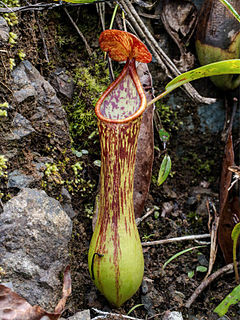
Nepenthes cornuta is a tropical pitcher plant native to the Philippines. It is known only from the Pantaron Mountain Range of central Mindanao, where it grows terrestrially on ultramafic soils at around 1000 m above sea level.

Nepenthes talaandig is a tropical pitcher plant native to the Philippines. It is known only from the Pantaron Mountain Range of central Mindanao, where it grows terrestrially on ultramafic soils at around 1000 m above sea level.
Hypodiscus is a group of plants in the Restionaceae described as a genus in 1836.
Gnomophalium is a genus of flowering plants in the sunflower family.
