
Beeston is a hamlet of about 530 acres (2.1 km2) in the town of Sandy in the Wixamtree hundred of the county of Bedfordshire, England, about a half a mile south of Sandy, north of Biggleswade and east of Bedford. Beeston appears in the Domesday Book of 1086 where it shown as having a mill: "Bistone: Roland, Norman and Pirot from Eudo FitzHubert; William Speke; Thurstan the Chamberlain; Godmund; Alwin from the King. Mill."

Beeston is a village in the county of Norfolk, England, in the civil parish of Beeston with Bittering, west of East Dereham and south of Fakenham. It may also be known as Beeston All Saints or Beeston-next-Mileham to distinguish it from the three other villages in Norfolk named Beeston.

Beeston is a town in the Borough of Broxtowe, Nottinghamshire, England, it is 3 miles south-west of Nottingham. To its north-east is the University of Nottingham's main campus, University Park. The headquarters of pharmaceutical and retail chemist group Boots are 0.6 miles (1 km) east of the centre of Beeston, on the border with Broxtowe and the City of Nottingham. To the south lie the River Trent and the village of Attenborough, with extensive wetlands.

Beeston Castle is a former Royal castle in Beeston, Cheshire, England, perched on a rocky sandstone crag 350 feet (107 m) above the Cheshire Plain. It was built in the 1220s by Ranulf de Blondeville, 6th Earl of Chester (1170–1232), on his return from the Crusades. In 1237, Henry III took over the ownership of Beeston, and it was kept in good repair until the 16th century, when it was considered to be of no further military use, although it was pressed into service again in 1643, during the English Civil War. The castle was slighted in 1646, in accordance with Cromwell's destruction order, to prevent its further use as a bastion. During the 18th century, parts of the site were used as a quarry.

Beeston is a suburb of Leeds, West Yorkshire, England located on a hill about 2 miles (3 km) south of the city centre.

Broxtowe is a parliamentary constituency in Nottinghamshire, England, represented in the House of Commons of the UK Parliament since 2024 by Juliet Campbell, from the Labour Party.
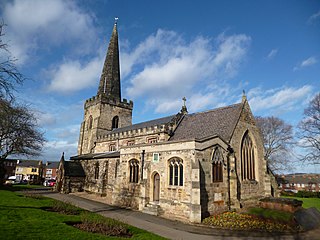
Stapleford is a town and civil parish in the Borough of Broxtowe, Nottinghamshire, England, 6 miles (9.7 km) west of Nottingham. The population of the civil parish at the 2001 census was 14,991, at the 2011 census it was 15,241, and 15,453 at the 2021 census.

Beeston railway station serves the town of Beeston in Nottinghamshire, England. It lies on a spur of the Midland Main Line and is managed by East Midlands Railway. It is situated 3.2 miles (5.1 km) south-west of Nottingham railway station and 750 metres (0.5 mi) south-east of Beeston transport interchange, for local bus services and Nottingham Express Transit trams. The station building is Grade II listed.

Ashmanhaugh is a village and civil parish in the English county of Norfolk, situated some 20 km north east of Norwich. See Inside the churches of St Swithins here & Beeston St Lawrence here. Apart from Ashmanhaugh village itself, the parish also includes Beeston St Lawrence, which was a separate parish until 1935.

Beeston and Stapleford was an urban district in Nottinghamshire, England, from 1935 to 1974.

The Cockpit was a theatre in London, operating from 1616 to around 1665. It was the first theatre to be located near Drury Lane. After damage in 1617, it was named The Phoenix.
William Beeston was an English actor and theatre manager, the son and successor to the more famous Christopher Beeston.
Beeston's Boys was the popular and colloquial name of The King and Queen's Young Company, a troupe of boy actors of the Caroline period, active mainly in the years 1637–1642.
Queen Henrietta's Men was an important playing company or troupe of actors of the Caroline era in London, England. At their peak of popularity, Queen Henrietta's Men were the second leading troupe of the day, after only the King's Men.
Beeston was an urban district in Nottinghamshire, England, from 1894 to 1935.
Beeston is a surname. Notable people with the surname include:
Sir William Beeston was an English political and legal figure, lieutenant-governor of Jamaica.
Beeston Hill may refer to the following places:

Henry Beeston was an English educator.
