
In Japanese cooking, a makisu (巻き簾) is a mat woven from bamboo and cotton string that is used in food preparation. Makisu are most commonly used to make a kind of rolled sushi called makizushi (巻き寿司), but they are also used to shape other soft foods such as omelets, and to squeeze excess liquid out of food.
Ikat is a dyeing technique used to pattern textiles that employs resist dyeing on the yarns prior to dyeing and weaving the fabric.

The Asian conical hat, commonly known as an Asian rice hat, coolie hat, or farmer's hat, is a simple style of conical hat originating in East, South, and Southeast Asia; and notable in modern-day nations and regions of Bangladesh, Bhutan, China, Cambodia, India, Indonesia, Japan, Korea, Laos, Malaysia, Myanmar, Nepal, Philippines, parts of Russian Manchuria and Vietnam.

A kasa (笠) is a term used for any one of several traditional Japanese hats. These include amigasa and jingasa.
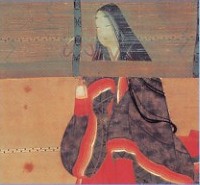
Sudare are screens or blinds. They are sometimes called misu as well, particularly if they have a green fabric hem. Sudare are made of horizontal slats of decorative wood, bamboo, or other natural material woven together with simple string, colored yarn, or other decorative material to make nearly solid blinds. They could be either rolled or folded up out of the way. Yoshizu, non-hanging type sudare, are made of vertical slats of Common reed and used as screen.

Basket weaving is the process of weaving or sewing pliable materials into two- or three dimensional artifacts, such as mats or containers. Craftspeople and artists specialized in making baskets are usually referred to as basket makers and basket weavers.
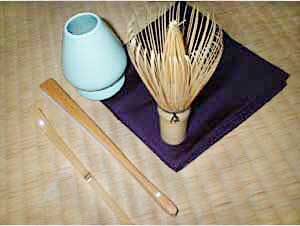
Tea utensils are tools or implements used in chadō, the art of Japanese tea. Chadōgu can be divided into five major categories: sōshoku dōgu ; temae dōgu ; kaiseki dōgu ; mizuya dōgu ; and machiai dōgu / roji dōgu. A wide range of dōgu is necessary for even the most basic tea ceremony. Generally, items which guests prepare themselves with for attending a chanoyu gathering are not considered as chadōgu; rather, the term fundamentally applies to items involved to "host" a chanoyu gathering. This article, however, includes all forms of implements and paraphernalia involved in the practice of chanoyu.

The tumpong is a type of Philippine bamboo flute used by the Maguindanaon, half the size of the largest bamboo flute, the palendag. A lip-valley flute like the palendag, the tumpong makes a sound when players blow through a bamboo reed placed on top of the instrument and the air stream produced is passed over an airhole atop the instrument. This masculine instrument is usually played during family gatherings in the evening and is the most common flute played by the Maguindanaon.

A bamboo wife, also known as a Dutch wife, in Tagalog as kawil ; in Burmese as ဖက်လုံး and in Indonesian as guling, is a hollow bamboo bolster roughly the size of the human body.
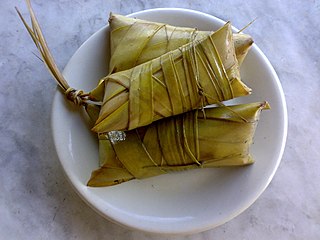
Suman is a rice cake originating in the Philippines. It is made from glutinous rice cooked in coconut milk, often wrapped in banana leaves or buli or buri palm (Corypha) leaves for steaming. It is usually eaten sprinkled with sugar or laden with latik. Suman is also known as budbod in the Visayan languages that dominate the central half of the country. A widespread variant of suman uses cassava instead of glutinous rice.
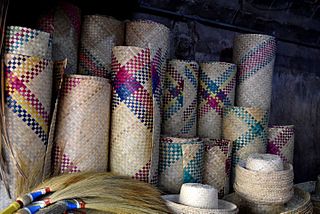
A baníg is a handwoven mat usually used in East Asia and the Philippines for sleeping and sitting. This type of mat is traditionally made in the Philippines.

The I.S.T. XL-14 Maya was a single-engine, light experimental aircraft designed and built in the Republic of the Philippines in the early 1950s to investigate the use of indigenous materials in aircraft construction. Its construction uses a type of woven bamboo.
Bamboo weaving is a form of bambooworking and a traditional craft of Taiwan.
The Ceylon reed-bamboo,, also known as Reed bamboo, and Forest bamboo, is a species of bamboo in the grass family). It is endemic to Sri Lanka. It can be found extensively in Ratnapura and Kegalle districts, in waste lands of rainforest and also along stream banks and I in forest gaps.

Bamboo weaving is a form of bambooworking and a craft of China. It involves manipulating bamboo into various traditional knit and woven patterns to create both useful and decorative objects.
Bambooworking is the activity or skill of making items from bamboo, and includes architecture, carpentry, furniture and cabinetry, carving, joinery, and weaving. Its historical roots in Asia span cultures, civilizations, and millennia.

Bamboo weaving is a type of bambooworking in which two distinct sets of bamboo strips are interlaced at normally right angles to form an object. The longitudinal threads are called the warp and the lateral threads are the weft or filling. The method in which these strips are inter-woven affects the characteristics of the fabric.
Bamboo is usually woven by hand.

Madurkathi are mats woven from a locally available soft reed called Madur kottir. Madur is the Bengali vernacular for floor mats. Madur is a tradition and pride of Medinipur district of West Bengal. Usually, women of the households are involved in weaving this beautiful craft.


