
Avicenna was a Persian polymath who is regarded as one of the most significant physicians, astronomers, thinkers and writers of the Islamic Golden Age. He has been described as the father of early modern medicine. Of the 450 works he is known to have written, around 240 have survived, including 150 on philosophy and 40 on medicine.
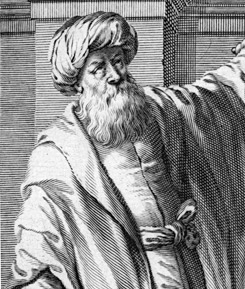
Hasan Ibn al-Haytham was an Arab mathematician, astronomer, and physicist of the Islamic Golden Age. Sometimes called "the father of modern optics", he made significant contributions to the principles of optics and visual perception in particular, his most influential work being his Kitāb al-Manāẓir, written during 1011–1021, which survived in the Latin edition. A polymath, he also wrote on philosophy, theology and medicine.
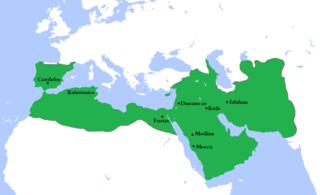
The Umayyad Caliphate, also spelt Omayyad, was the second of the four major caliphates established after the death of Muhammad. The caliphate was ruled by the Umayyad dynasty, hailing from Mecca. The third Caliph, Uthman ibn Affan, was a member of the Umayyad clan. The family established dynastic, hereditary rule with Muawiya ibn Abi Sufyan, long-time governor of Syria, who became the sixth Caliph after the end of the First Muslim Civil War in 661. After Mu'awiyah's death in 680, conflicts over the succession resulted in a Second Civil War and power eventually fell into the hands of Marwan I from another branch of the clan. Syria remained the Umayyads' main power base thereafter, and Damascus was their capital.
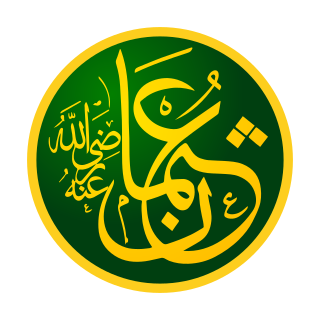
Uthman ibn Affan, also known in English by the Turkish and Persian rendering Osman, was a second cousin, son-in-law and notable companion of the Islamic prophet Muhammad, the third of the Rashidun, or "Rightly Guided Caliphs". Born into a prominent Meccan clan, Banu Umayya of the Quraysh tribe, he played a major role in early Islamic history. When Caliph Umar ibn al-Khattab died in office aged 59/60 years, ʿUthmān, aged 64/65 years, succeeded him and was the second-oldest to rule as Caliph.
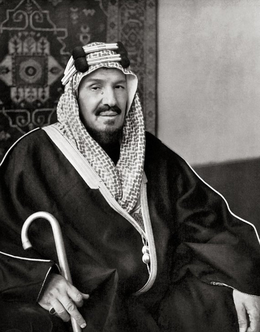
Abdulaziz ibn Abdul Rahman ibn Faisal ibn Turki ibn Abdullah ibn Muhammad Al Saud, usually known within the Arab world as Abdulaziz and in the West as Ibn Saud, was the first monarch and founder of Saudi Arabia, the "third Saudi state".

Ibn Khaldun was a leading Arab historiographer and historian.
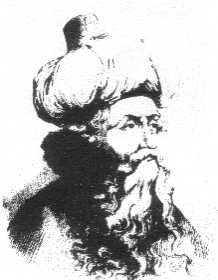
Ibn ʿArabi, full name Abū ʿAbd Allāh Muḥammad ibn ʿAlī ibn Muḥammad ibnʿArabī al-Ḥātimī aṭ-Ṭāʾī, was an Arab Andalusian Muslim scholar, mystic, poet, and philosopher, whose works have grown to be very influential beyond the Muslim world. Of the over 800 works which are attributed to him, 100 survive in the original manuscript. His cosmological teachings became the dominant worldview in many parts of the Islamic world.

Taqī ad-Dīn Ahmad ibn Taymiyyah, known as Ibn Taymiyyah for short, was a controversial medieval Sunni Muslim theologian, jurisconsult, logician, and reformer. A member of the Hanbali school of jurisprudence founded by Ahmad ibn Hanbal, Ibn Taymiyyah was also a member of the Qadiriyya Sufi order founded by the twelfth-century mystic and saint Abdul-Qadir Gilani. A polarizing figure in his own lifetime, Ibn Taymiyyah's iconoclastic views on widely accepted Sunni doctrines such as the veneration of saints and the visitation to their tomb-shrines made him unpopular with the majority of the orthodox religious scholars of the time, under whose orders he was imprisoned several times.

Abū ʿĪsā Muḥammad ibn ʿĪsā as-Sulamī aḍ-Ḍarīr al-Būghī at-Tirmidhī, often referred to as Imām al-Termezī/Tirmidhī, was a Persian Islamic scholar and collector of hadith who wrote al-Jami` as-Sahih, one of the six canonical hadith compilations in Sunni Islam. He also wrote Shama'il Muhammadiyah, a compilation of hadiths concerning the person and character of the Islamic prophet, Muhammad. At-Tirmidhi was also well versed in Arabic grammar, favoring the school of Kufa over Basra due to the former's preservation of Arabic poetry as a primary source.

The House of Saud is the ruling royal family of Saudi Arabia. It is composed of the descendants of Muhammad bin Saud, founder of the Emirate of Diriyah, known as the First Saudi state (1744–1818), and his brothers, though the ruling faction of the family is primarily led by the descendants of Ibn Saud, the modern founder of Saudi Arabia. The most influential position of the royal family is the King of Saudi Arabia. King Salman, who reigns currently, chose first his nephew and then his son as the crown prince without consulting the Allegiance Council. The family is estimated to comprise 15,000 members, but the majority of the power and wealth is possessed by a group of about 2,000 of them.

Al-Ḥusayn ibn ʿAlī ibn Abi Talib was a grandson of the Islamic prophet Muhammad and a son of Ali ibn Abi Talib and Muhammad's daughter Fatimah. He is an important figure in Islam as he was a member of the Bayt (Household) of Muhammad and the Ahl al-Kisā', as well as the third Shia Imam.

The Battle of Karbala took place on Muharram 10, in the year 61 AH of the Islamic calendar in Karbala, in present-day Iraq. The battle took place between a small group of supporters and relatives of Muhammad's grandson, Husayn ibn Ali, and a larger military detachment from the forces of Yazid I, the Umayyad caliph.
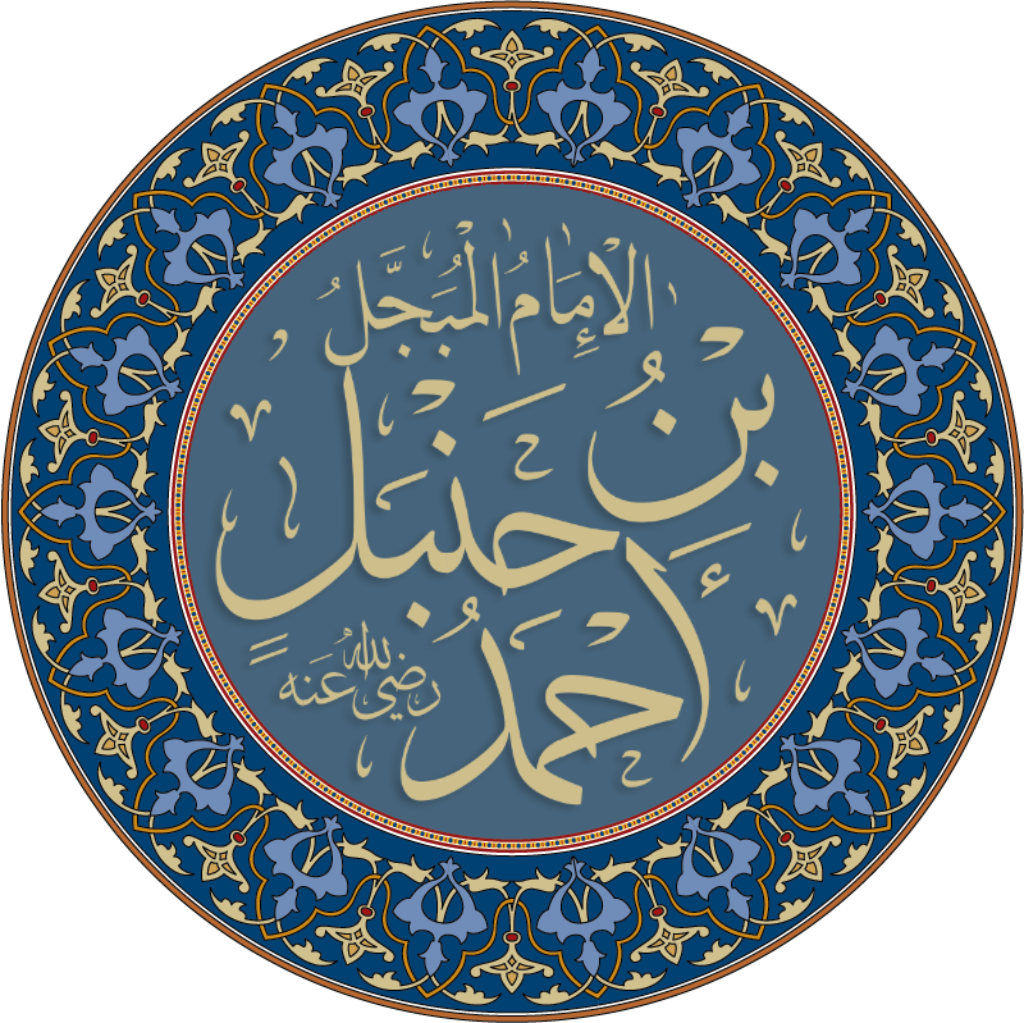
Aḥmad Ibn Muḥammad Ibn Ḥanbal Abū ʿAbdullāh Ash-Shaybānī, often referred to as Aḥmad ibn Ḥanbal or Ibn Ḥanbal or Ibn Hambal or Ahmad Ibn Hambal for short, or reverentially as Imam Aḥmad by Sunni Muslims, was an Arab Muslim jurist, theologian, ascetic, and hadith traditionist. An enormously influential and vigorous scholar during his lifetime, Ibn Hanbal went on to become "one of the most venerated" and celebrated personalities in the tradition of Sunni Islam, within which he was often referred to by such reverent epithets as True Shaykh of Islam, Proof of the Faith, and Seal of the Mujtahid Imams. He has been retrospectively described as "the most significant exponent of the traditionalist approach in Sunni Islam," with his "profound influence affecting almost every area of" orthodox Sunni thought. One of the foremost classical proponents of the importance of using hadith literature to govern Islamic law and life, Ibn Hanbal is famous for compiling one of the most important Sunni hadith collections, the celebrated Musnad, an enormous compendium of prophetic traditions that has continued to wield considerable influence in the field of hadith studies up to the present time. Additionally, Ibn Hanbal is also honored as the founder of the Hanbali school of Sunni jurisprudence, which is one of the four major orthodox legal schools of Sunni Islam.
Zayd ibn 'Alī was the grandson of Husayn ibn Ali, and great-grandson of Ali. Zayd was born in Medina in 695. He was the son of Ali ibn Husayn Zayn al-Abidin. Ibn Qutaybah in his book "al-Ma'ārif", republished in 1934 in Egypt, writes that one of the wives of the 4th Shia Imam was from Sindh and that she was the mother of Zayd ibn Ali. A similar claim has also been made in the book "Zayd Shaheed" by Abd al-Razzaq al-Hasani, published in Najaf. Zayd ibn Ali's mother Jodha, known by Muslim chroniclers as Jayda al-Sindhi.

Ismail ibn Kathir was a highly influential historian, exegete and scholar during the Mamluk era in Syria. An expert on tafsir and faqīh (jurisprudence), he wrote several books, including a fourteen-volume universal history. Al-Hafiz Ibn Hajar Al-Asqalani said about him, “Ibn Kathir worked on the subject of the hadith in the texts (متون) and chains of narrators (رجال). He had a good memory; his books became popular during his lifetime, and people benefited from them after his death.”

{{Infobox person
| name = Ali ibn Husayn
علي بن حسين (Arabic)
| honorific_suffix = 4th Imam of Twelver and 3rd Imam of Ismaili
| image = Baghi tomb.jpg
| alt =
| caption = The historical tomb of Al-Baqi' was destroyed by Wahhabis in 1925. Imam Ali ibn Husayn is one of four Shia Imams buried here.
| birth_name =
| birth_date = c. 4 January 659
(5 Sha'aban 38 AH) Or
| birth_place = Kufa, Iraq or Medina, Hejaz
| death_date = c. 20 October 713 (aged 54)
(25 Muharram 95 AH)
| death_place = Medina, Umayyad Empire
| death_cause = Poisoning by Al-Walid I
| resting_place = Jannatul Baqi, Saudi Arabia
| resting_place_coordinates = 24°28′1″N 39°36′50.21″E

Ṣaḥīḥ al-Bukhārī, also known as Bukhari Sharif, is one of the Kutub al-Sittah of Sunni Islam. These prophetic traditions, or hadith, were collected by the Muslim scholar Muhammad al-Bukhari, after being transmitted orally for generations. It was completed around 846 AD / 232 AH. Sunni Muslims view this as one of the two most trusted collections of hadith along with Sahih Muslim. The Arabic word sahih translates as authentic or correct. Sahih al-Bukhari, together with Sahih Muslim is known as Sahihayn.
Al-Dhahabi, known also as Ibn al-Dhahabī, a Shafi‘i Muhaddith and historian of Islam.

Ala-al-din abu Al-Hassan Ali ibn Abi-Hazm al-Qarshi al-Dimashqi, known as Ibn al-Nafis, was an Arab physician from Damascus mostly famous for being the first to describe the pulmonary circulation of the blood. The work of Ibn al-Nafis regarding the right sided (pulmonary) circulation pre-dates the later work (1628) of William Harvey's De motu cordis. Both theories attempt to explain circulation.

Khadijah bint Khuwaylid or Khadījah al-Kubra 555 – 22 November 619 CE) was the first wife and first follower of the Islamic prophet, Muhammad. She is commonly regarded by Muslims as the "Mother of the Believers". Khadijah is regarded as one of the most important female figures in Islam, like her daughter, Fatimah. Muhammad was monogamously married to her for 25 years. After the death of Khadijah, Muhammad re-married.


