
The Three Pure Ones, also translated as the Three Pure Pellucid Ones, the Three Pristine Ones, the Three Divine Teachers, the Three Clarities, or the Three Purities, are the three highest gods in the Taoist pantheon. They are regarded as pure manifestations of the Tao and the origin of all sentient beings, along with the "lords of the Three Life Principles or 'Breaths' (qi)". They were also gods who were "associated with the sky, the earth and the underworld."
Yuanjia'ao (袁家嶴) is a village in Fenghua municipality, Zhejiang province, China. Situated at approx. 280m above sea level in the Tiantai Mountain range, its main products are bamboo and timber. The village is traditionally considered the ancestral home of the Yuans of the greater Ningbo, who have been estimated to number some 20,000.
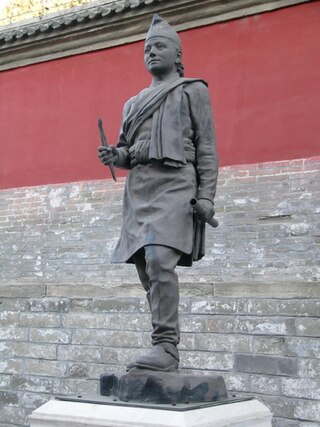
Aniko, Anige or Araniko was one of the key figures in the arts of Nepal and the Yuan dynasty of China, and the artistic exchanges in these areas. He was born in Kathmandu Valley during the reign of Abhaya Malla. He is known for building the White Stupa at the Miaoying Temple in Beijing. During the reign of Jayabhimadeva, he was sent on a project to build a golden stupa in Tibet, where he also initiated into monkhood. From Tibet he was sent further to northern China to work in the court of the emperor Kublai Khan, the founder of the Yuan dynasty, where he brought the trans-Himalayan artistic tradition to China. Araniko led a team of 80 artists to China proper and Tibet to make a number of pagoda-style buildings. In his later life, he renounced monkhood and started a family.

Hami (Qumul) is a prefecture-level city in Eastern Xinjiang, China. It is well known for sweet Hami melons. In early 2016, the former Hami county-level city merged with Hami Prefecture to form the Hami prefecture-level city with the county-level city becoming Yizhou District. Since the Han dynasty, Hami has been known for its production of agricultural products and raw resources.
Duwa Temür (Дуватөмөр) or Tore Temur (Төртөмөр) was khan of the Chagatai Khanate for a period in 1329/1330. He was the son of Duwa.

Yuanshi Tianzun, the Celestial Venerable of the Primordial Beginning or the Primeval Lord of Heaven, is one of the highest deities of Taoism. He is one of the Three Pure Ones and is also known as the Jade Pure One. He resides in the Great Web or the Heaven of Jade Purity. It is believed that he came into being at the beginning of the universe as a result of the merging of pure breaths. He then created Heaven and Earth.
Hongjun Laozu lit. "Ancestor of the Great Balance" is a deity in Chinese folk religion and Taoism, teacher of the Three Pure Ones in Taoist mythology. Hongjun 鴻鈞 is a graphic variant of hungjun "primordial nature", as used in the Chinese idiom Xian you hongjun hou you tian 先有鸿钧后有天 "First there was Hongjun and then there was Heaven".
Tianzun (天尊), literally the Lord of Heaven may refer to:
Bayan of the Merkid, or Bayan, was a Mongol general of the Merkid clan and an official in the Yuan dynasty.
The History of Yuan, also known as the Yuanshi, is one of the official Chinese historical works known as the Twenty-Four Histories of China. Commissioned by the court of the Ming dynasty, in accordance to political tradition, the text was composed in 1370 by the official Bureau of History of the Ming dynasty, under direction of Song Lian (1310–1381).

Yuanshi County is located in the southwest of Hebei Province, North China, 40 kilometres (25 mi) to the south of Shijiazhuang, the provincial capital. Yuanshi County borders Gaoyi County to the south, Zhao County and Luancheng District to the east, Jingxing County to the west and Luquan District to its north.
Chengqu may refer to the following locations in the People's Republic of China:
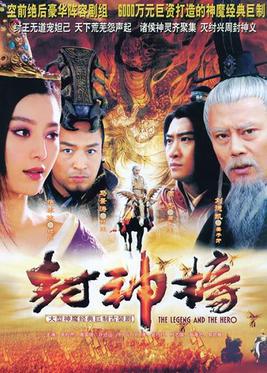
The Legend and the Hero is a 2007 Chinese television series adapted from the 16th-century novel Fengshen Yanyi written by Xu Zhonglin and Lu Xixing. The first season started airing on CCTV-8 in February 2007. It was followed by a sequel, The Legend and the Hero 2 in 2009.

The Yuan dynasty in Inner Asia was the domination of the Yuan dynasty in Inner Asia in the 13th and the 14th centuries. The Borjigin rulers of the Yuan came from the Mongolian steppe, and the Mongols under Kublai Khan established the Yuan dynasty (1271–1368) based in Khanbaliq. The Yuan was a Chinese dynasty that incorporated many aspects of Mongol and Inner Asian political and military institutions.

Manchuria under Yuan rule refers to the Yuan dynasty's rule over Manchuria, corresponding to modern Manchuria and Outer Manchuria, from 1271 to 1368. Mongol rule over Manchuria was established after the Mongol Empire's conquest of the Jin dynasty and the Eastern Xia dynasty in the early 13th century. It became a part of the Yuan dynasty of China led by Kublai Khan in 1271. During the Yuan, it was administered as Liaoyang province. Even after the overthrow of the Yuan dynasty by the Ming dynasty in 1368, Manchuria was still controlled by the Northern Yuan dynasty for almost 20 years, until it was conquered by the Ming during its campaign against Naghachu and put under Ming rule.

Nirvana in Fire 2 is a 2017 Chinese television series starring Huang Xiaoming, Liu Haoran, Tong Liya and Zhang Huiwen. It is the sequel to Nirvana in Fire, which is based on Hai Yan's novel with the same name. The stories take place after the events of the original series, which revolves around the Langya Hall. The series aired on Dragon TV and Beijing TV from December 18, 2017 to February 12, 2018.
Chaghan Temur, Courtesy name Tingrui (廷瑞), was a Yuan dynasty officer and military leader of Naiman Mongol tribe.

Yuanshi railway station is a station on Beijing–Guangzhou railway in Yuanshi County, Shijiazhuang, Hebei.
Park Bul-hwa or Piao Buhua was a Korean eunuch serving Empress Gi of the Yuan dynasty. He was the first ethnic Korean eunuch in Chinese history. Bak assisted Empress Gi's campaign to force Toghon Temür to pass the imperial throne to her son, Ayushiridara.

Ke Shaomin, courtesy name Fengsun, also known by his art name Liaoyuan, was a Chinese historian from Jiaozhou, Shandong. He is most known for writing the New History of Yuan, one of the Twenty-Five Histories, and helping to lead the compilation of the Draft History of Qing. He was a secretary in the Qing dynasty court in its final years.
