
Zhao is a Chinese-language surname. The name is first in the Hundred Family Surnames – the traditional list of all Chinese surnames – because it was the emperor's surname of the Song dynasty (960–1279) when the list was compiled. The first line of the poem is 趙錢孫李.

Ming Yuzhen was a peasant rebel leader who established the dynasty of Ming Xia during the late Yuan dynasty in China.

Yin is a Chinese surname. In 800 BCE, Bo Jifu, a renowned judge during the reign of King Xuan of Zhou, held the position of Yin and changed his name to Yin Jifu. During the era of the Imperial Examination System, three other magistrates took on the surname Yǐn (尹) to denote their Imperial rank and favoured status. It is the 100th name on the Hundred Family Surnames poem.
Oh or O is a family name in Korea. It is written using the hanja characters, 吳, 五, 伍, 吾, and 晤. According to the 2015 census in South Korea, there were 763,281 people carrying the O surname.

Mei is a romanized spelling of a Chinese surname, transcribed in the Mandarin dialect. In Hong Kong and other Cantonese-speaking regions, the name may be transliterated as Mui or Moy. In Vietnam, this surname is written as Mai. In romanized Korean, it is spelled Mae. The name literally translates in English to the plum fruit. The progenitor of the Méi clan, Méi Bo, originated from near a mountain in ancient China that was lined at its base with plum trees.

Tang, is a Chinese surname. The three languages also have the surname with the same character but different pronunciation/romanization. In Korean, it is usually romanized also as Dang. In Japanese, the surname is often romanized as To. In Vietnamese, it is commonly written as Đường. It is pronounced dhɑng in Middle Chinese, and lhāŋ in Old Chinese. It is the 64th name on the Hundred Family Surnames poem.
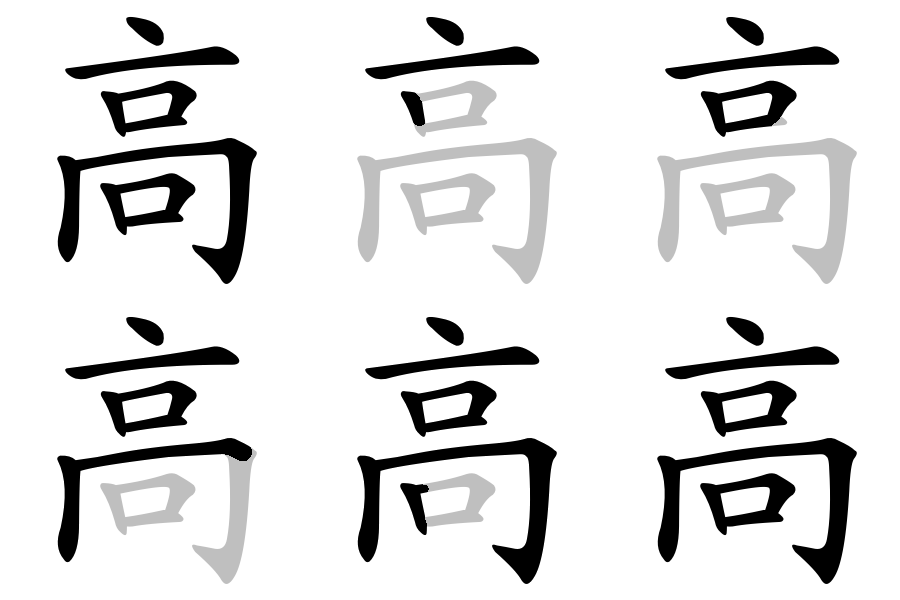
Gao is an East Asian surname of Chinese origin that can be literally translated as "high" or "tall". There are approximately 17 million living people with this surname. Some places, such as Taiwan, usually romanise this family name into "Kao". In Hong Kong, it is romanized to "Ko". In Macau, it is romanized to "Kou". In English, it is romanized to "Kauh". In 2019 it was the 19th most common surname in Mainland China. The Korean surname, "Ko" or "Koh", is derived from and written with the same Chinese character (高).
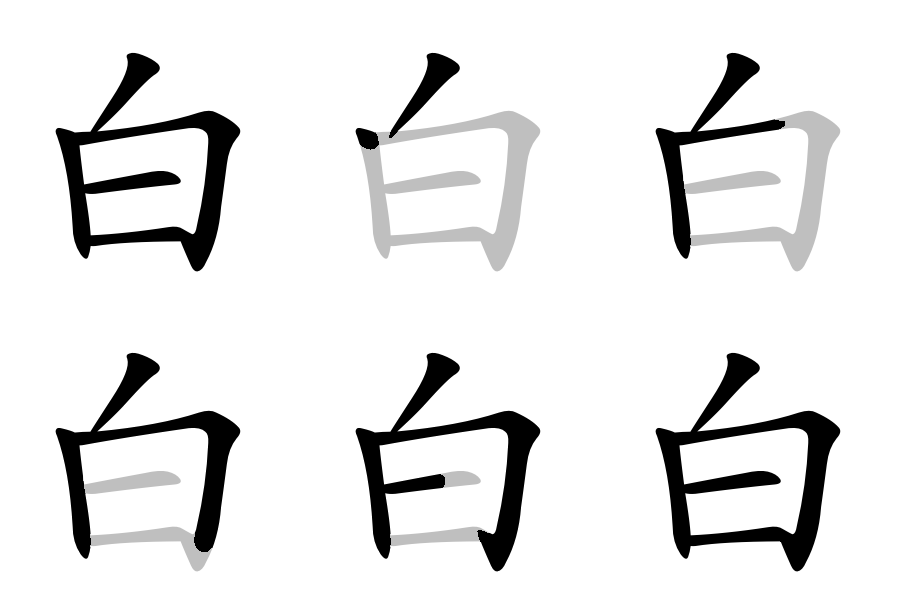
Bái is the pinyin of the surname 白, meaning the colour white.

Ruan is a Chinese surname.

Ning is the romanisation of the Chinese surnames 寧 Níng and its variant 甯 Nìng. After the introduction of simplified characters, both names were written as 宁 in Mainland China until 2000, when the character 甯 was restored as an accepted variant for people whose family had originally used that character. However, usage of 甯 remains rare, with most continuing to use 宁.

Shěn is the Mandarin Hanyu pinyin romanization of the Chinese surname 沈.

Yun is a Chinese surname, listed 41st in the Song dynasty classic text Hundred Family Surnames.

Liǔ is an East Asian surname of Chinese origin found in China, Korea, and Japan, as well as in Vietnam and throughout Southeast Asia. It is the 60th name in the Hundred Family Surnames poem.

Li or Lee is a common Chinese surname, it is the 4th name listed in the famous Hundred Family Surnames. Li is one of the most common surnames in Asia, shared by 92.76 million people in China, and more than 100 million in Asia. It is the second-most common surname in China as of 2018, the second-most common surname in Hong Kong, the most common surname in Macau and the 5th most common surname in Taiwan, where it is usually romanized as "Lee". The surname is pronounced as in Cantonese, Lí (poj) in Taiwanese Hokkien, but is often spelled as "Lee" in Hong Kong, Macau, Taiwan, Thailand and many overseas Chinese communities. In Macau, it is also spelled as "Lei". In Indonesia it is commonly spelled as "Lie". The common Korean surname, "Lee", and the Vietnamese surname, "Lý", are both derived from Lee and written with the same Chinese character (李). The character also means "plum" or "plum tree".
Yun (Korean: 윤) is a family name in Korea, which means "governor". The name is sometimes also transliterated as Yoon, Yune, Yiun, or Youn. According to the 2000 census, 948,600 people had the surname in South Korea. It derives from the Chinese character 尹.
This page is based on this
Wikipedia article Text is available under the
CC BY-SA 4.0 license; additional terms may apply.
Images, videos and audio are available under their respective licenses.
