
The slender-billed curlew is a bird in the wader family Scolopacidae. It breeds in marshes and peat bogs in the taiga of Siberia, and is migratory, formerly wintering in shallow freshwater habitats around the Mediterranean. This species has occurred as a vagrant in western Europe, the Canary Islands, the Azores, Oman, Canada and Japan.
Dmitri Shostakovich’s Symphony No. 13 in B-flat minor, titled Babi Yar, was completed on July 20, 1962, and first performed in Moscow in December of that year. The hour-long work requires a bass soloist, men's chorus, and large orchestra and is laid out in five movements, each a setting of a Yevgeny Yevtushenko poem. This unusual form gives rise to various descriptions: choral symphony, song cycle, giant cantata. The five earthily vernacular poems denounce Soviet life one aspect at a time: brutality, cynicism, deprivation, anxiety, corruption. Kirill Kondrashin conducted the 1962 premiere after Yevgeny Mravinsky had declined the assignment under pressure; Vitaly Gromadsky sang the solo part alongside the combined choruses of the RSFSR State Academy and Gnessin Institute and the Moscow Philharmonic.

Aleko is the first of three completed operas by Sergei Rachmaninoff. The Russian libretto was written by Vladimir Nemirovich-Danchenko and is an adaptation of the poem The Gypsies by Alexander Pushkin. The opera was written in 1892 as a graduation work at the Moscow Conservatory, and it won the highest prizes from the conservatory judges that year. It was first performed in Moscow 19 May 1892.

The Yurlov Crower is an old Russian breed of chicken primarily selected and used for long crowing cock contests in Russia.

Georgy Vasilyevich Sviridov was a Russian neoromantic composer, active in the Soviet era. He is most widely known for his choral music, strongly influenced by the traditional chant of the Russian Orthodox Church, as well as his orchestral works which often celebrate elements of Russian culture. Sviridov employed, in his choral music especially, rich and dense harmonic textures, embracing a romantic-era tonality; his works would come to incorporate not only sacred elements of Russian church music, including vocal work for the basso profundo, but also display the influence of Eastern European folk music, 19th-century European romantic composers, as well as neoromantic contemporaries outside of Russia. He wrote musical settings of Russian Romantic-era poetry by poets such as Lermontov, Tyutchev and Blok. Sviridov enjoyed critical acclaim for much of his career in the USSR.

Kashchey the Deathless, a.k.a.Kashchey the Immortal, is a one-act opera in three scenes by Nikolai Rimsky-Korsakov. The libretto was written by the composer, and is based on a Russian fairy tale about Koschei the Deathless, an evil, ugly old wizard, who menaced principally young women. A similar fairy tale was also used by Igor Stravinsky and Michel Fokine to create their iconic ballet, The Firebird.
Irina Zhurina is a Russian operatic coloratura soprano.
Freddy Cadena is an Ecuadorian orchestra conductor, who is currently resides in Russia. From 2000 to 2006 he taught at Moscow Conservatory. He is a founder and a chief conductor of Amadeus Chamber Orchestra of Moscow Composers' Union.

Aleksandr Yakovlevich Mikhailov is a Soviet and Russian actor. He has appeared in 42 films since 1973. He starred in the 1981 film Muzhiki! which was entered into the 32nd Berlin International Film Festival, where it won an Honourable Mention.

Rudolf Borisovich Barshai was a Soviet and Russian conductor and violist.
Konstantin Konstantinovich Ivanov (1907–1984), was a Soviet and Russian conductor. The third man to hold the post of conductor of the USSR State Symphony Orchestra, he is known from a number of recordings made by the old USSR state recording company Melodiya, but biographical information about him has been hard to find.
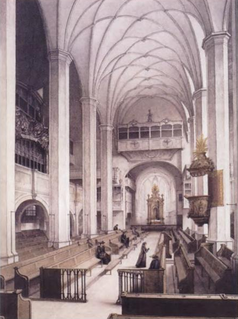
Johann Sebastian Bach composed the church cantata Wer sich selbst erhöhet, der soll erniedriget werden, BWV 47, in Leipzig for the 17th Sunday after Trinity and first performed it on 13 October 1726.
Mikhail Zlatopolsky was a Soviet and Russian singer and occasional actor. Zlatopolsky was listed as the lowest bass in the world with a documented low note of E♭1.
Gennady Dmitryak is a Russian conductor and Meritorious Artist.
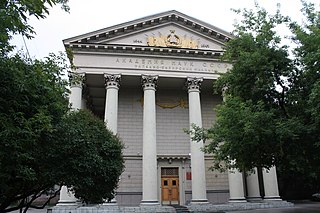
The Institute of Systematics and Ecology of Animals (ISEA) located in Novosibirsk is one of the oldest research organization in the Siberian Branch of the Russian Academy of Sciences. The Institute was founded in 1944 as Biomedical Institute, the first Siberian academic establishment working in biology. The Siberian Zoological Museum of the ISEA SB RAS has the third-largest coleopteran collection in Russia. Some Siberian research organizations as the Central Siberian Botanical Garden SB RAS and the Institute of Soil Science and Agricultural Chemistry SB RAS were derived from the Institute former laboratories.
The Sun Shines over Our Motherland «Над Родиной нашей солнце сияет» (Op.90) is a Russian-language cantata written in 1952 by Dimitri Shostakovich on a libretto by Yevgeniy Dolmatovsky.
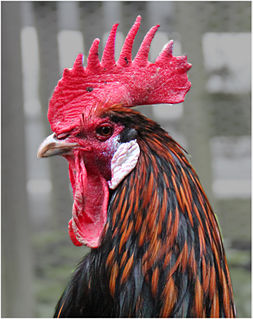
Long-crowing chicken breeds are characterised by the unusually long-drawn-out crow of the cocks, which may in some cases last for up to 60 seconds. The oldest references to long-crowing cocks are from China. Long-crowing breeds are found in the Far East, in Turkey, in the Balkans and in western Germany.
Yurlov is a Russian masculine surname, its feminine counterpart is Yurlova. It may refer to

Bless the Woman is a Russian film that was released in 2003. The film is based on the novel Hostess, by Irina Grekova.
