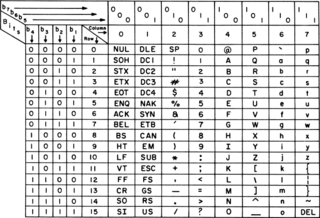
ASCII, abbreviated from American Standard Code for Information Interchange, is a character encoding standard for electronic communication. ASCII codes represent text in computers, telecommunications equipment, and other devices. Most modern character-encoding schemes are based on ASCII, although they support many additional characters.
Federal Information Processing Standards (FIPS) are publicly announced standards developed by the National Institute of Standards and Technology for use in computer systems by non-military American government agencies and government contractors.
ISO 3166 is a standard published by the International Organization for Standardization (ISO) that defines codes for the names of countries, dependent territories, special areas of geographical interest, and their principal subdivisions. The official name of the standard is Codes for the representation of names of countries and their subdivisions.

ISO 4217 is a standard first published by International Organization for Standardization in 1978, which delineates currency designators, country codes, and references to minor units in three tables:

Morse code is a method used in telecommunication to encode text characters as standardized sequences of two different signal durations, called dots and dashes or dits and dahs. Morse code is named for Samuel F. B. Morse, an inventor of the telegraph.

Transport in Niger is composed of the transportation systems and methods used in this landlocked nation, with cities separated by huge uninhabited deserts, mountain ranges, and other natural features. A poor nation, Niger's transport system was little developed during the colonial period (1899–1960), relying upon animal transport, human transport, and limited river transport in the far south west and south east. No railways were constructed in the colonial period, and roads outside the capital remained unpaved. The Niger River is unsuitable for large-scale river transport, as it lacks depth for most of the year and is broken by rapids at many spots. Camel caravan transport was historically important in the Sahara desert and Sahel regions which cover most of the north.

A ZIP Code is a postal code used by the United States Postal Service (USPS). Introduced in 1963, the basic format consists of five digits. In 1983, an extended ZIP+4 code was introduced; it includes the five digits of the ZIP Code, followed by a hyphen and four digits that designate a more specific location.
An IATA airport code, also known as an IATA location identifier, IATA station code or simply a location identifier, is a three-letter geocode designating many airports and metropolitan areas around the world, defined by the International Air Transport Association (IATA). The characters prominently displayed on baggage tags attached at airport check-in desks are an example of a way these codes are used.
In software engineering, porting is the process of adapting software for the purpose of achieving some form of execution in a computing environment that is different from the one that a given program was originally designed for. The term is also used when software/hardware is changed to make them usable in different environments.
ISO 3166-1 is part of the ISO 3166 standard published by the International Organization for Standardization (ISO), and defines codes for the names of countries, dependent territories, and special areas of geographical interest. The official name of the standard is Codes for the representation of names of countries and their subdivisions – Part 1: Country codes. It defines three sets of country codes:

ISO 3166-1 alpha-2 codes are two-letter country codes defined in ISO 3166-1, part of the ISO 3166 standard published by the International Organization for Standardization (ISO), to represent countries, dependent territories, and special areas of geographical interest. They are the most widely used of the country codes published by ISO, and are used most prominently for the Internet's country code top-level domains. They are also used as country identifiers extending the postal code when appropriate within the international postal system for paper mail, and has replaced the previous one consisting one-letter codes. They were first included as part of the ISO 3166 standard in its first edition in 1974.
ISO 639-2:1998, Codes for the representation of names of languages — Part 2: Alpha-3 code, is the second part of the ISO 639 standard, which lists codes for the representation of the names of languages. The three-letter codes given for each language in this part of the standard are referred to as "Alpha-3" codes. There are 487 entries in the list of ISO 639-2 codes.

The ICAOairport code or location indicator is a four-letter code designating aerodromes around the world. These codes, as defined by the International Civil Aviation Organization and published in ICAO Document 7910: Location Indicators, are used by air traffic control and airline operations such as flight planning.

Zinder, formerly also spelled Sinder, is the third largest city in Niger, with a population of 170,574 ; by the 2012 census its population reached 235,605. It is situated 861 km (535 mi) east of the capital Niamey and 240 km (150 mi) north of the Nigerian city of Kano.
A telephone numbering plan is a type of numbering scheme used in telecommunication to assign telephone numbers to subscriber telephones or other telephony endpoints. Telephone numbers are the addresses of participants in a telephone network, reachable by a system of destination code routing. Telephone numbering plans are defined in each of administrative regions of the public switched telephone network (PSTN) and they are also present in private telephone networks. For public number systems, geographic location plays a role in the sequence of numbers assigned to each telephone subscriber.

QR code is the trademark for a type of matrix barcode first designed in 1994 for the automotive industry in Japan. A barcode is a machine-readable optical label that contains information about the item to which it is attached. In practice, QR codes often contain data for a locator, identifier, or tracker that points to a website or application. A QR code uses four standardized encoding modes to store data efficiently; extensions may also be used.

Zinder Airport is an airport serving Zinder, Niger, near the city.
This page is based on this
Wikipedia article Text is available under the
CC BY-SA 4.0 license; additional terms may apply.
Images, videos and audio are available under their respective licenses.
