
Methanol is an organic chemical compound and the simplest aliphatic alcohol, with the chemical formula CH3OH. It is a light, volatile, colorless and flammable liquid with a distinctive alcoholic odour similar to that of ethanol . Methanol acquired the name wood alcohol because it was once produced chiefly by the destructive distillation of wood. Today, methanol is mainly produced industrially by hydrogenation of carbon monoxide.

Zeolite is a family of several microporous, crystalline aluminosilicate materials commonly used as commercial adsorbents and catalysts. They mainly consist of silicon, aluminium, oxygen, and have the general formula Mn+
1/n(AlO
2)−
(SiO
2)
x・yH
2O where Mn+
1/n is either a metal ion or H+. These positive ions can be exchanged for others in a contacting electrolyte solution. H+
exchanged zeolites are particularly useful as solid acid catalysts.

Moonshine is high-proof liquor, traditionally made or distributed illegally. Its clandestine distribution is known as bootlegging. The name was derived from a tradition of creating the alcohol during the nighttime, thereby avoiding detection. In the first decades of the 21st century, commercial distilleries have adopted the term for its outlaw cachet and begun producing their own legally sanctioned, novelty "moonshine", including many flavored varieties, that in some sense continue its tradition, generally having a similar method and/or location of production.

Trisodium phosphate (TSP) is an inorganic compound with the chemical formula Na3PO4. It is a white, granular or crystalline solid, highly soluble in water, producing an alkaline solution. TSP is used as a cleaning agent, builder, lubricant, food additive, stain remover, and degreaser.
Kenneth S. Deffeyes was a geologist who worked with M. King Hubbert, the creator of the Hubbert peak theory, at the Shell Oil Company research laboratory in Houston, Texas. He claimed Chickasaw ancestry.

Chabazite is a tectosilicate mineral of the zeolite group, closely related to gmelinite, with the chemical formula (Ca,K
2,Na
2,Mg)Al
2Si
4O
12•6H
2O. Recognized varieties include Chabazite-Ca, Chabazite-K, Chabazite-Na, and Chabazite-Sr, depending on the prominence of the indicated cation.

A molecular sieve is a material with pores of uniform size. These pore diameters are similar in size to small molecules, and thus large molecules cannot enter or be adsorbed, while smaller molecules can. As a mixture of molecules migrates through the stationary bed of porous, semi-solid substance referred to as a sieve, the components of the highest molecular weight leave the bed first, followed by successively smaller molecules. Some molecular sieves are used in size-exclusion chromatography, a separation technique that sorts molecules based on their size. Another important use is as a desiccant. Most of molecular sieves are aluminosilicate zeolites with Si/Al molar ratio less than 2, but there are also examples of activated charcoal and silica gel.

Gas to liquids (GTL) is a refinery process to convert natural gas or other gaseous hydrocarbons into longer-chain hydrocarbons, such as gasoline or diesel fuel. Methane-rich gases are converted into liquid synthetic fuels. Two general strategies exist: (i) direct partial combustion of methane to methanol and (ii) Fischer–Tropsch-like processes that convert carbon monoxide and hydrogen into hydrocarbons. Strategy ii is followed by diverse methods to convert the hydrogen-carbon monoxide mixtures to liquids. Direct partial combustion has been demonstrated in nature but not replicated commercially. Technologies reliant on partial combustion have been commercialized mainly in regions where natural gas is inexpensive.

The Bavarian State Collection of Zoology or ZSM is a major German research institution for zoological systematics in Munich. It has over 20 million zoological specimens. It is one of the largest natural history collections in the world. The sections are Entomology, Invertebrates and Vertebrates. The history of the museum is outlined on the museum's home page together with a biography of Johann Baptist von Spix the first curator of zoology.

ZSM-5, Zeolite Socony Mobil–5 (framework type MFI from ZSM-5 (five)), is an aluminosilicate zeolite belonging to the pentasil family of zeolites. Its chemical formula is NanAlnSi96–nO192·16H2O (0<n<27). Patented by Mobil Oil Company in 1975, it is widely used in the petroleum industry as a heterogeneous catalyst for hydrocarbon isomerization reactions.

SSZ-13 (framework type code CHA) is a high-silica aluminosilicate zeolite possessing 0.38 × 0.38 nm micropores. It belongs to the ABC-6 family of zeolites as well as offretite, cancrinite, erionite and other related small-pore zeolites. The framework topology is the same as that of chabazite but SSZ-13 has a high silica composition with Si/Al > 5, which leads to low cation exchange capacity. The typical chemical formula of the unit cell can be described as QxNayAl2.4Si33.6O72•zH2O (1.4 < x <27)(0.7 < y < 4.3)(1 < z <7), where Q is N,N,N-1-trimethyladamantammonium. The material was patented by Chevron research Company in 1985, and could potentially be used as a solid catalyst for the methanol-to-olefins (MTO) process and the selective catalytic reduction (SCR) of NOx.

Erionite is a naturally occurring fibrous mineral that belongs to a group of minerals called zeolites. It usually is found in volcanic ash that has been altered by weathering and ground water. Erionite forms brittle, wool-like fibrous masses in the hollows of rock formations and has an internal molecular structure similar to chabazite. Some properties of erionite are similar to the properties of asbestos; however, erionite is not currently regulated by the U.S. Environmental Protection Agency and there are no occupational exposure limits for erionite fibers. Erionite was first described by A.S. Eakle in 1898, as white woolly fibrous masses in cavities in rhyolite lava near Durkee, Oregon. It was originally thought to be another relatively rare zeolite named offretite, which is very similar to erionite in appearance and chemical composition.

Trachylepis homalocephala, commonly known as the red-sided skink, is a small, slender species of skink in the subfamily Mabuyinae.

Ryoo Ryong FRSC is a distinguished professor of chemistry at KAIST in Daejeon, South Korea. He was the head of the Center for Nanomaterials and Chemical Reactions, an Extramural Research Center of the Institute for Basic Science. Ryoo has won a variety of awards, including the Top Scientist and Technologist Award of Korea given by the South Korean government in 2005. He obtained the KOSEF Science and Technology Award in 2001 for his work on the synthesis and crystal structure of mesoporous silica.
Syngas to gasoline plus (STG+) is a thermochemical process to convert natural gas, other gaseous hydrocarbons or gasified biomass into drop-in fuels, such as gasoline, diesel fuel or jet fuel, and organic solvents.
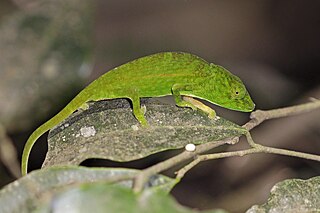
Frank Rainer Glaw is a German herpetologist working at the Zoologische Staatssammlung München. Glaw studied biology in Cologne from 1987, where he completed his diploma. Thereafter, he attended the University of Bonn, from which he graduated in 1999, after completing his Ph.D. thesis titled Untersuchungen zur Bioakustik, Systematik, Artenvielfalt und Biogeographie madagassischer Anuren about the frogs of Madagascar, supervised by Professor Wolfgang Böhme.

Cu-Y zeolites are copper-containing high-silica derivatives of the faujasite mineral group which in turn is a member of the zeolite family. Cu-Y zeolites are synthesized through aqueous or gaseous ionic exchange unlike the naturally occurring faujasites: faujasite-Ca, faujasite-Mg, and faujasite-Na. The exchanged copper atom can vary in oxidation states, but the most studied Cu-Y zeolite variants include Cu(I) or Cu(II) cations. Due to their high catalytic potential, they are utilized as desulfurization agents and in the production of nitrogen gas from nitrogen monoxide.
Raymond John Gorte is an American chemical engineer, currently the Russel Pearce and Elizabeth Crimian Heuer Endowed Professor of Chemical and Biomolecular Engineering (CBE) and Materials Science & Engineering (MSE) at the University of Pennsylvania. Throughout his career at the University of Pennsylvania and the University of Minnesota, he has advanced the study of fuel cells and catalysts including heterogeneous metals and zeolite materials. He is a member of the U.S. National Academy of Engineering.

α-O (alpha-oxygen) is a reactive oxygen species formed from an oxygen-atom abstraction (OAT) from nitrous oxide (N2O) by alpha-iron (α-Fe) catalysts. The latter is defined as a high spin (S=2) divalent iron(II) ion in a constrained square planar coordination with an accessible axial coordination position. The stabilization of α-O requires structural strain on the equatorial ligand field to maintain the reactive oxygen atom in the axial position and it is this forced geometry, similar to the 'entatic state' known in metalloproteins, that lies at the basis of its reactivity in inert C-H bond activation.
Alexis Tarassov Bell is an American chemical engineer. He is currently the Dow professor of Sustainable Chemistry in the Department of Chemical and Biomolecular Engineering in UC Berkeley's college of chemistry. He is also the Faculty Senior Scientist at Lawrence Berkeley National Laboratory. He is known for his work with heterogenous catalysts and characterizing the mechanisms of these reactions on a quantum level.
