Zaghawa may refer to:
 | This disambiguation page lists articles associated with the title Zaghawa. If an internal link led you here, you may wish to change the link to point directly to the intended article. |
Zaghawa may refer to:
| | This disambiguation page lists articles associated with the title Zaghawa. If an internal link led you here, you may wish to change the link to point directly to the intended article. |
The military of Chad consists of the National Army, Republican Guard, Rapid Intervention Force, Police, and National and Nomadic Guard (GNNT). Currently the main task of the Chadian military is to combat the various rebel forces inside the country.
The Kanem–Bornu Empire existed in areas which are now part of Chad and Nigeria. It was known to the Arabian geographers as the Kanem Empire from the 8th century AD onward and lasted as the independent kingdom of Bornu until 1900. The Kanem Empire was located in the present countries of Chad, Nigeria and Libya. At its height it encompassed an area covering not only most of Chad, but also parts of southern Libya (Fezzan) and eastern Niger, northeastern Nigeria and northern Cameroon. The Bornu Empire (1380s–1893) was a state in what is now northeastern Nigeria, in time becoming even larger than Kanem, incorporating areas that are today parts of Chad, Niger, Sudan, and Cameroon. The early history of the Empire is mainly known from the Royal Chronicle or Girgam discovered in 1851 by the German traveller Heinrich Barth.
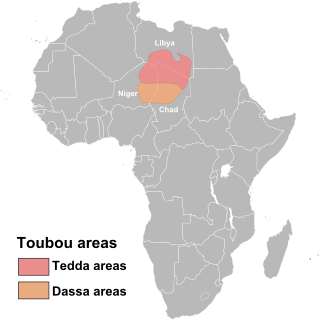
Daza is a Nilo-Saharan language spoken by the Daza people inhabiting northern Chad. The Daza are also known as the Gouran (Gorane) in Chad. Dazaga is spoken by around 380,000 people, primarily in the Djurab Desert region and the Borkou region, locally called Haya or Faya-Largeau northern-central Chad, the capital of the Dazaga people. Dazaga is spoken in the Tibesti Mountains of Chad, in the eastern Niger near N'guigmi and to the north. It is also spoken to a smaller extent in Libya and in Sudan, where there is a community of 3,000 speakers in the city of Omdurman. There's also a small diaspora community working in Jeddah, Saudi Arabia.
The Zaghawa people, also called Beri or Zakhawa, are a Central African Muslim ethnic group of eastern Chad and western Sudan, including Darfur.

The Saharan languages are a small family of languagesacross parts of the eastern Sahara, extending from northwestern Darfur to southern Libya, north and central Chad, eastern Niger and northeastern Nigeria. Noted Saharan languages include Kanuri, Daza, Teda, and Zaghawa. They are a part of the proposed Nilo-Saharan family.
Nagmeldin Ali Abubakr is a Sudanese athlete who mainly competes in the 400 metres. He was born in Khartoum.
Awlad Mana is an ethnic group of Sudan. It is a minority, that speaks Zaghawa, a Chad-Saharan language. The number of persons in this group exceeds 150,000.

Iriba is a small town in the Wadi Fira Region of the African country of Chad. It is known as part of the Kobé Department as well as having its own prefecture and area court. It is currently being served by the Iriba Airport.
Dar Tama is one of three departments in Wadi Fira, a region of Chad. Its capital is Gueréda, 165 kilometres (100 mi) northeast of Abéché. The population consists primarily of non-Arab tribes. Dar Tama is the historical home of the Tama, who make up the majority of the population. The Zaghawa make up a significant minority and migrated during the Sahelian drought in the 1980s. Both are non-Arab tribes. Chadian president Idriss Déby is from the Zaghawa tribe.
Tama is a non-Arab, African ethnic group of people who live in eastern Chad and western Sudan. They speak Tama, a Nilo-Saharan language. The population is 200,000–300,000 people and they practice Islam. Many Tama are subsistence farmers who live in permanent settlements and some raise livestock. In the civil war in Chad (2005–2010) the Tama were involved in ethnic conflicts with the Zaghawa tribe.

Suliman Arcua Minnawi, known as "Minni Minnawi", is a Sudanese politician who was the leader of the largest faction of the Sudanese Liberation Army. A former educator, Minnawi was the Secretary of Sudan Liberation Army leader, Abdul Wahid Nur, before the organisation split in 2004. Minnawi belongs to the Zaghawa ethnic group, the Ila Digen clan of the non-Arab, Saharan Zaghawa people.
The 2004 Chadian coup d'état attempt was an attempted coup d'état against the Chadian President Idriss Déby that was foiled on the night of May 16, 2004.
Tuba, also Bidayat (Bideyat), is a dialect of the Zaghawa language found in Chad and western Sudan. In contrast to their Zaghawa kin, Bidayat speakers are more nomadic. This difference led early ethnographers to refer to them as different groups until linguistic similarities proved their close relationship.

Sudan is a multilingual country dominated by Sudanese Arabic. In the 2005 constitution of the Republic of Sudan, the official languages of Sudan are Literary Arabic and English.
Zaghawa is a Saharan language spoken by the Zaghawa people of east-central Chad and northwestern Sudan (Darfur). The people who speak this language call it Beria, from Beri, the endonym of the Zaghawa people, and a, Zaghawa for "mouth". It has been estimated that there are between 750,000 and 1,350,000 Zaghawa speakers, who primarily live in Chad and the Darfur region of Sudan.

The populations of eastern Chad and western Sudan established social and religious ties long before either nation's independence, and these remained strong despite disputes between governments. In recent times, relations have been strained due to the conflict in Darfur and a civil war in Chad, which both governments accuse the other of supporting.
The population of Chad has numerous ethnic groups. SIL Ethnologue reports more than 130 distinct languages spoken in Chad.
Yaya Dillo Djérou became a prominent political figure in Chad. On October 14, 2005, when the government of Idriss Déby had to admit desertions in the army, especially from the Zaghawa, the President's ethnic group. These deserters were under the leadership of Djérou; based in the Sudanese region of Darfur Djérou, a former telecommunications engineer, had left Déby's party MPS and became president of a revolutionary junta heading an organization called Platform for Change, Unity and Democracy (SCUD), a rebel alliance. The group has declared it plans to overthrow Déby, and is of zaghawa ethnicity. To open negotiations with the government, he has demanded that all political prisoners be freed.
The Kabka Sultanate, also called the Sultanate of Kabka and the Kabka Sultanate of Tundubay, is a remote Zaghawa-populated country subdivision on the Sudanese frontier within Chad. It was created by Chadian President Idriss Deby in order to appease Zaghawa nationalism and national pride.
The Zaghawa or Beria script, Beria Giray Erfe, is an indigenous alphabetic script proposed for the Zaghawa language of Darfur and Chad.