
The Grand Army of the Republic (GAR) was a fraternal organization composed of veterans of the Union Army, Union Navy, Marines and the U.S. Revenue Cutter Service who served in the American Civil War. It was founded in 1866 in Springfield, Illinois, and grew to include hundreds of "posts" across the nation. It was dissolved in 1956 at the death of its last member, Albert Woolson (1850–1956) of Duluth, Minnesota.

Gars are members of the Lepisosteiformes, an ancient holosteian order of ray-finned fish; fossils from this order are known from the Late Jurassic onwards. The family Lepisosteidae includes seven living species of fish in two genera that inhabit fresh, brackish, and occasionally marine, waters of eastern North America, Central America and the Caribbean islands. Gars have elongated bodies that are heavily armored with ganoid scales, and fronted by similarly elongated jaws filled with long, sharp teeth. Gars are sometimes referred to as "garpike," but are not related to pike, which are in the fish family Esocidae. All of the gars are relatively large fish, but the alligator gar is the largest - the alligator gar often grows to a length of over 2 m (6.5 ft) and a weight of over 45 kg (100 lb), and specimens of up to 3 m (9.8 ft) in length have been reported. Unusually, their vascularised swim bladders can function as lungs, and most gars surface periodically to take a gulp of air. Gar flesh is edible and the hard skin and scales of gars are used by humans, but gar eggs are highly toxic.
The Fourth Battle of the Dardanelles in the Fifth Ottoman-Venetian War took place between 17 and 19 July 1657 outside the mouth of the Dardanelles Strait. The Ottomans succeeded in breaking the Venetian blockade over the Straits.
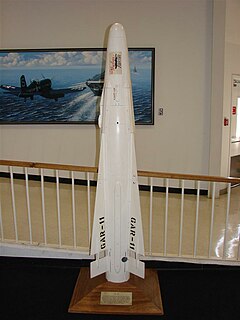
The AIM-26 Falcon was a larger, more powerful version of the AIM-4 Falcon air-to-air missile built by Hughes. It is the only guided American air-to-air missile with a nuclear warhead to be produced, although the unguided AIR-2 Genie rocket was also nuclear-armed.

The alligator gar is a ray-finned euryhaline fish related to the bowfin in the infraclass Holostei. It is the largest species in the gar family, and among the largest freshwater fishes in North America. The fossil record traces its groups existence back to the Early Cretaceous over 100 million years ago. Gars are often referred to as "primitive fishes", or "living fossils" because they have retained some morphological characteristics of their earliest ancestors, such as a spiral valve intestine, which is also common to the digestive system of sharks, and the ability to breathe both air and water. Their common name was derived from their resemblance to the American alligator, particularly their broad snouts and long, sharp teeth. Anecdotal evidence suggests that an alligator gar can grow up to 10 ft (3.0 m) in length.

The King of Braves GaoGaiGar is a Japanese anime television series animated by Sunrise's internal "Studio 7" division. It is the eighth and final installment in Takara's Yūsha franchise. It aired on Nagoya TV in Japan from February 1, 1997 to January 31, 1998.

As of 26 December 2019, there are 193 member states of the United Nations (UN), each of which is a member of the United Nations General Assembly.

William E. "Bill" Garity was an American inventor and audio engineer who attended the Pratt Institute before going to work for Lee De Forest around 1921. Garity worked with DeForest on the Phonofilm sound-on-film system until 1927, when Pat Powers hired Garity to develop a sound system that Powers called Powers Cinephone.

Bardeh Gar-e Yek Vark is a village in Keshvar Rural District, Papi District, Khorramabad County, Lorestan Province, Iran. At the 2006 census, its existence was noted, but its population was not reported.
Zarin-e Olya is a village in Aliabad Rural District, in the Central District of Hashtrud County, East Azerbaijan Province, Iran. At the 2006 census, its population was 36, in 10 families.
Zarin-e Sofla is a village in Aliabad Rural District, in the Central District of Hashtrud County, East Azerbaijan Province, Iran. At the 2006 census, its population was 85, in 18 families.
Zardeyn is a village in Zardeyn Rural District, Nir District, Taft County, Yazd Province, Iran. At the 2006 census, its population was 767, in 236 families.
Gar Kud is a village in Doshman Ziari Rural District, Doshman Ziari District, Mamasani County, Fars Province, Iran. At the 2006 census, its population was 161, in 47 families.
Qaleh Gar-e Fahlian is a village in Fahlian Rural District, in the Central District of Mamasani County, Fars Province, Iran. At the 2006 census, its population was 412, in 97 families.
Gar Kandi is a village in Polan Rural District, Polan District, Chabahar County, Sistan and Baluchestan Province, Iran. At the 2006 census, its population was 311, in 69 families.
Gar Kandi Rasul Bakhsh Bazar is a village in Polan Rural District, Polan District, Chabahar County, Sistan and Baluchestan Province, Iran. At the 2006 census, its population was 418, in 78 families.
Zardin Gar is a village in Kahnuk Rural District, Irandegan District, Khash County, Sistan and Baluchestan Province, Iran. At the 2006 census, its population was 34, in 8 families.
Zardin Kahir is a village in Zarabad-e Sharqi Rural District, Zarabad District, Konarak County, Sistan and Baluchestan Province, Iran. At the 2006 census, its population was 70, in 13 families.
