Buyantu Khan, born Ayurbarwada, also known by the temple name Renzong (Emperor Renzong of Yuan, was the fourth emperor of the Yuan dynasty. Apart from Emperor of China, he is regarded as the eighth Great Khan of the Mongol Empire or Mongols, although it was only nominal due to the division of the empire. His name means "blessed/good Khan" in the Mongolian language. His name "Ayurbarwada" was from a Sanskrit compound "Āyur-parvata", which means "the mountain of longevity", in contrast with Emperor Wuzong's name Qaišan.

Temür Öljeytü Khan, born Temür, also known by the temple name Chengzong was the second emperor of the Yuan dynasty, ruling from May 10, 1294 to February 10, 1307. Apart from Emperor of China, he is considered as the sixth Great Khan of the Mongol Empire or Mongols, although it was only nominal due to the division of the empire. He was an able ruler of the Yuan, and his reign established the patterns of power for the next few decades. His name means "blessed iron Khan" in the Mongolian language.

Wuxi County is a county of Chongqing Municipality, People's Republic of China. Sitting at the upper reaches of Daning River and the southern slopes of the central Daba Mountains. It is best known for its scenic views and its preserved witchcraft culture.
This is a family tree of Chinese emperors from the Mongol conquest of 1279 to the end of the Qing dynasty in 1912.
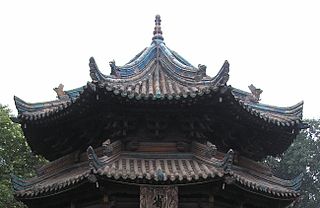
Yeheidie'erding, also known as Amir al-Din, was a Muslim architect who helped design and led the construction of the capital of the Yuan Dynasty, Khanbaliq, located in present-day Beijing, the current capital of the People's Republic of China.

The Yuan dynasty, officially the Great Yuan, was the empire or ruling dynasty of China established by Kublai Khan, leader of the Mongolian Borjigin clan. It followed the Song dynasty and preceded the Ming dynasty. Although the Mongols had ruled territories including modern-day North China for decades, it was not until 1271 that Kublai Khan officially proclaimed the dynasty in the traditional Chinese style, and the conquest was not complete until 1279 when the Southern Song dynasty was defeated in the Battle of Yamen. His realm was, by this point, isolated from the other Mongol khanates and controlled most of modern-day China and its surrounding areas, including modern Mongolia. It was the first non-Han Chinese dynasty to rule all of China and lasted until 1368 when the Ming dynasty defeated the Yuan forces. Following that, the rebuked Genghisid rulers retreated to their Mongolian homeland and continued to rule as the Northern Yuan dynasty. Some of the Mongolian Emperors of the Yuan mastered the Chinese language, while others only used their native language and the 'Phags-pa script.
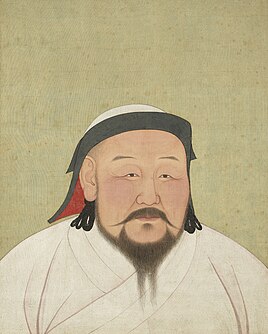
Kublai was the fifth Khagan of the Mongol Empire, reigning from 1260 to 1294. He also founded the Yuan dynasty in China as a conquest dynasty in 1271, and ruled as the first Yuan emperor until his death in 1294.

The Khatso people, commonly known as the "Mongols in Yunnan", is a group of Mongols, mainly distributed in Tonghai County in the Yunnan Province of southwestern China. The Khatso people are descendants of the Yuan army during the era of the Mongol Empire.
The Yuan dynasty was the ruling dynasty of China and Mongolia established by Kublai Khan and a khanate of the Mongol Empire.

This article discusses the political divisions and vassals of the Mongol Empire. Through invasions and conquests the Mongols established a vast empire that included many political divisions, vassals and tributary states. It was the largest contiguous land empire in history. However, after the death of Möngke Khan, the Toluid Civil War and subsequent wars had led to the fragmentation of the Mongol Empire. By 1294, the empire had fractured into four autonomous khanates, including the Golden Horde in the northwest, the Chagatai Khanate in the middle, the Ilkhanate in the southwest, and the Yuan dynasty in the east based in modern-day Beijing, although the Yuan emperors held the nominal title of Khagan of the empire.

The division of the Mongol Empire began when Möngke Khan died in 1259 in the siege of Diaoyu castle with no declared successor, precipitating infighting between members of the Tolui family line for the title of Great Khan that escalated to the Toluid Civil War. This civil war, along with the Berke–Hulagu war and the subsequent Kaidu–Kublai war greatly weakened the authority of the Great Khan over the entirety of the Mongol Empire and the empire fractured into autonomous khanates, including the Golden Horde in the northwest, the Chagatai Khanate in the middle, the Ilkhanate in the southwest, and the Yuan dynasty in the east based in modern-day Beijing, although the Yuan emperors held the nominal title of Khagan of the empire. The four khanates each pursued their own separate interests and objectives, and fell at different times.
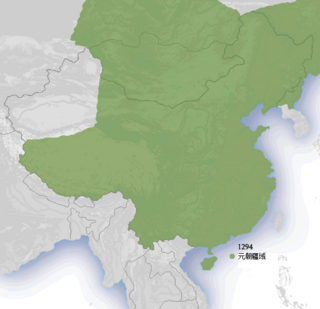
The Yuan dynasty in Inner Asia was the domination of the Yuan dynasty in Inner Asia in the 13th and the 14th centuries. The Genghisid rulers of the Yuan came from the Mongolian steppe, and the Mongols under Kublai Khan established the Yuan dynasty (1271-1368) based in Khanbaliq, a Chinese-style dynasty that incorporated many aspects of Mongolian and Inner Asian political and military institutions. Actual Yuan rule extended to Manchuria, Mongolia, the Tibetan Plateau and parts of Xinjiang. People from these Inner Asian regions other than the Mongols usually belonged to the Semu class. In addition, the Yuan emperors held nominal suzerainty over the three western Mongol khanates, but they were essentially autonomous and ruled separately due to the division of the Mongol Empire since the Toluid Civil War in the 1260s.

Manchuria under Yuan rule refers to the Yuan dynasty's rule over Manchuria, including modern Northeast China and Outer Manchuria from the beginning to the end of the dynasty. Mongol rule over Manchuria was established during the Mongol Empire's conquest of the Jurchen Jin dynasty in the early 13th century. It became a part of the Yuan dynasty, division of the Mongol Empire, when the dynasty was founded by the Mongol leader Kublai Khan. Even after the overthrown of the Mongol Yuan dynasty by the Ming dynasty founded by native Chinese in 1368, Manchuria was still controlled by the Northern Yuan dynasty based in Mongolia for almost 20 years, until it was conquered by the Ming during the Ming military campaign against Naghachu and put under Ming rule.
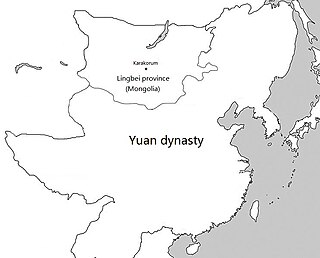
The Yuan dynasty ruled over the Mongolian steppe, including both Inner and Outer Mongolia as well as part of southern Siberia, for roughly a century between 1271 and 1368. The Mongolian Plateau is where the ruling Mongols of the Yuan dynasty as founded by Kublai Khan came from, thus it enjoyed a somewhat special status during the Mongol Yuan dynasty, division of the Mongol Empire, although the capital of the dynasty had been moved from Karakorum to Khanbaliq since the beginning of Kublai Khan's reign, and Mongolia had been turned into a province by the early 14th century.

Liu Guandao or Liu Kuan-tao, courtesy name Zhong Xian (仲贤), was a Chinese court artist active during the Yuan dynasty. A native of Zhongshan, Hebei, much of his work is in a realist style, and in 1279 he rose to prominence with a well-received painting of Kublai Khan's son Zhenjin.

The Yuan dynasty was a Mongol khanate that ruled over China from 1271 to 1368, after the Mongols conquered the Western Xia, Western Liao, and Jin dynasties they allowed for the continuation of locally minted copper currency, as well as allowing for the continued use of previously created and older forms of currency, while they immediately abolished the Jin dynasty’s paper money as it suffered heavily from inflation due to the wars with the Mongols. After the conquest of the Song dynasty was completed the Mongols started issuing their own copper coins largely based on older Jin dynasty models, though eventually the preferred Mongol currency became the Jiaochao and silver sycees, as coins would eventually fall largely into disuse. Although the Mongols at first preferred to have every banknote backed up by gold and silver, high government expenditures forced the Yuan to create fiat money in order to sustain government spending.

The Da Ming Baochao was a series of banknotes issued during the Ming dynasty in China. They were first issued in 1375 under the Hongwu Emperor. Although initially the Da Ming Baochao paper money was successful, the fact that it was a fiat currency and that the government largely stopped accepting these notes caused the people to lose faith in them as a valid currency causing the price of silver relative to paper money to increase. The negative experiences with inflation that the Ming dynasty had witnessed signaled the Manchus to not repeat this mistake until the first Chinese banknotes after almost 400 years were issued again in response to the Taiping Rebellion under the Qing dynasty's Xianfeng Emperor during the mid-19th century.