
Zhou Enlai, also known as Zhou Xiangyu, was the first Premier of the People's Republic of China. Zhou was China's head of government, serving from October 1949 until his death in January 1976. Zhou served under Chairman Mao Zedong and was instrumental in the Communist Party's rise to power, and later in consolidating its control, forming foreign policy, and developing the Chinese economy.
Chinese surnames are used by Han Chinese and Sinicized ethnic groups in China, Taiwan, Korea, Vietnam and among overseas Chinese communities around the world. Chinese surnames are given first for names written in Chinese, which is the opposite of Western naming convention where surnames come last. Around 2,000 Han Chinese surnames are currently in use, but the great proportion of Han Chinese people use only a relatively small number of these surnames; 19 surnames are used by around half of the Han Chinese people, while 100 surnames are used by around 87% of the population. A report in 2019 gives the most common Chinese surnames as Wang and Li, each shared by over 100 million people in China, with Zhang, Liu, Chen, Yang, Huang, Zhao, Wu and Zhou making up the rest of the ten most common Chinese names.

Around the World in 80 Days is a 2004 American action adventure comedy film based on Jules Verne's novel of the same name and remake of same of movie of 1956. It stars Jackie Chan, Steve Coogan and Cécile de France. The film is set the nineteenth century and centers on Phileas Fogg, here reimagined as an eccentric inventor, and his efforts to circumnavigate the globe in 80 days. During the trip, he is accompanied by his Chinese valet, Passepartout. For comedic reasons, the film intentionally deviated wildly from the novel and included a number of anachronistic elements. With production costs of about $110 million and estimated marketing costs of $30 million, it earned $24 million at the U.S. box office and $72 million worldwide, making it a box office flop. It was Arnold Schwarzenegger's last film before he took a hiatus from acting to become Governor of California until 2010's The Expendables.

King Zhou was the pejorative posthumous name given to Di Xin, the last king of the Shang dynasty of ancient China. He is also called Zhou Xin. He may also be referred to by adding "Shang" in front of any of his names. In Chinese, his name Zhòu (紂) also refers to a horse crupper, the part of a saddle or harness that is most likely to be soiled by the horse. It is not to be confused with the name of the succeeding dynasty which has a different character and pronunciation.
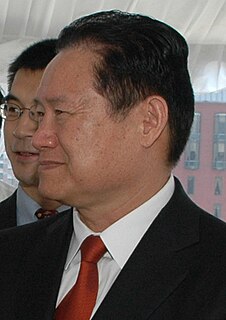
Zhou Yongkang is a former senior leader of the Communist Party of China (CPC). He was a member of the 17th Politburo Standing Committee (PSC), China's highest decision-making body, and the Secretary of the Central Political and Legal Affairs Commission (Zhengfawei) between 2007 and 2012, making him one of the most powerful leaders in China. In that position, Zhou oversaw China's security apparatus and law enforcement institutions, with power stretching into courts, prosecution agencies, police forces, paramilitary forces, and intelligence organs. He was convicted of corruption-related charges in 2014 and expelled from the CPC.

Jī (姬) was the ancestral name of the Zhou dynasty which ruled China between the 11th and 3rd centuries BC. Thirty-nine members of the family ruled China during this period while many others ruled as local lords, lords who eventually gained great autonomy during the Spring and Autumn and Warring States periods. Ji is a relatively uncommon surname in modern China, largely because its bearers often adopted the names of their states as new surnames.

Xing is a Chinese surname. There are two hypothesized sources for the extant catalogue of surnames:

Gaocheng Astronomical Observatory, also known as the Dengfeng Observatory, is a World Heritage Site in Duke of Zhou's shrine, Gaocheng Town, near Dengfeng in Henan province, China. This site has a long tradition of astronomical observations, from the time of the Western Zhou up to the early Yuan dynasty. There is also a gnomon used for the Da Yan calendar in 729 AD and the great observatory of the Yuan Dynasty.
Wei Xuantong (魏玄同), courtesy name Hechu (和初), was an official of the Chinese Tang dynasty, serving as chancellor during the reign of Emperor Gaozong and the regency of his wife Empress Wu over their sons Emperor Zhongzong and Emperor Ruizong. During Emperor Gaozong's reign, he had drawn hatred from the official Zhou Xing as the conveyor of the bad news that Zhou was not getting promoted, and in 689, Zhou, having by that point become one of Empress Dowager Wu's trusted secret police officials, falsely accused Wei of opposing Empress Dowager Wu. She forced Wei to commit suicide.
Lai Junchen was a secret police official during the Chinese dynasty Tang Dynasty and Wu Zetian's Zhou Dynasty, whose ability to interrogate and falsely implicate officials of crimes made him a subject of fear and hatred. In 697, he was accused of plotting to falsely accuse Wu Zetian's sons and other family members of treason, and he was executed.
Zhou Xing was a secret police official of the Tang Dynasty and Wu Zetian's Zhou Dynasty of Chinese history. He was largely responsible for carrying out her actions to wipe out senior members of Tang's Li imperial clan, but, in a turnabout, was in 691 himself accused of crimes and, under threats of a torture technique himself developed, confessed. Wu Zetian spared his life and exiled him, but he was killed by his enemies on the way to exile.

The I Ching or Yi Jing, also known as Classic of Changes or Book of Changes, is an ancient Chinese divination text and the oldest of the Chinese classics. Possessing a history of more than two and a half millennia of commentary and interpretation, the I Ching is an influential text read throughout the world, providing inspiration to the worlds of religion, psychoanalysis, literature, and art. Originally a divination manual in the Western Zhou period (1000–750 BC), over the course of the Warring States period and early imperial period (500–200 BC) it was transformed into a cosmological text with a series of philosophical commentaries known as the "Ten Wings". After becoming part of the Five Classics in the 2nd century BC, the I Ching was the subject of scholarly commentary and the basis for divination practice for centuries across the Far East, and eventually took on an influential role in Western understanding of Eastern thought.
The State of Xíng (Xingguo) was a vassal state of ancient China during the Zhou Dynasty and Spring and Autumn period, ruled by descendants of the Jí family (姬). Its original location was on the plain east of the Shanxi plateau and north of most of the other states.

A Wedding Invitation is a 2013 Chinese romantic comedy film directed by Ki Hwan Oh and starring Bai Baihe and Eddie Peng.

Wukang Road, originally Route Ferguson (福开森路), is a historic road in the Xuhui District of Shanghai, China, located in the western part of the former French Concession area of the city. In 2011 Wukang Road was recognized as one of the National Historic and Cultural Streets of China.
The Girl in Blue is a 2010 Chinese television series starring Joe Chen, Roy Chiu and Feng Shaofeng. It is based on the novel of the same name by Fei Wo Si Cun. The series aired on Hunan Television from 4 June to 17 June 2010 for 32 episodes.

Brotherhood of Blades is a 2014 Chinese wuxia film directed by Lu Yang.
Zhou Xing (1905–1975) birth name Liu Jiubang, also known as Liu Weixin was a People's Republic of China politician born in Yongfeng County, Jiangxi Province. He was twice governor of Yunnan and Communist Party of China Committee Secretary of Yunnan.
Soul Buster is a Chinese manhua written and illustrated by Bai Mao and based on Romance of the Three Kingdoms by Luo Guanzhong. A Japanese-Chinese animated series adaptation by Studio Pierrot and co-produced with Youku Tudou which aired from October 4 to December 11, 2016.
