
A national park is a park in use for conservation purposes, created and protected by national governments. Often it is a reserve of natural, semi-natural, or developed land that a sovereign state declares or owns. Although individual nations designate their own national parks differently, there is a common idea: the conservation of 'wild nature' for posterity and as a symbol of national pride.
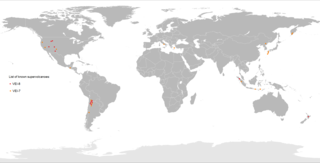
A supervolcano is a large volcano that has had an eruption with a Volcanic Explosivity Index (VEI) of 8, the largest recorded value on the index. This means the volume of deposits for that eruption is greater than 1,000 cubic kilometers.

Yellowstone National Park is an American national park located in the western United States, largely in the northwest corner of Wyoming and extending into Montana and Idaho. It was established by the U.S. Congress and signed into law by President Ulysses S. Grant on March 1, 1872. Yellowstone was the first national park in the U.S. and is also widely held to be the first national park in the world. The park is known for its wildlife and its many geothermal features, especially Old Faithful geyser, one of its most popular. While it represents many types of biomes, the subalpine forest is the most abundant. It is part of the South Central Rockies forests ecoregion.

Grand Teton National Park is an American national park in northwestern Wyoming. At approximately 310,000 acres, the park includes the major peaks of the 40-mile-long (64 km) Teton Range as well as most of the northern sections of the valley known as Jackson Hole. Grand Teton National Park is only 10 miles (16 km) south of Yellowstone National Park, to which it is connected by the National Park Service–managed John D. Rockefeller Jr. Memorial Parkway. Along with surrounding national forests, these three protected areas constitute the almost 18,000,000-acre (7,300,000 ha) Greater Yellowstone Ecosystem, one of the world's largest intact mid-latitude temperate ecosystems.
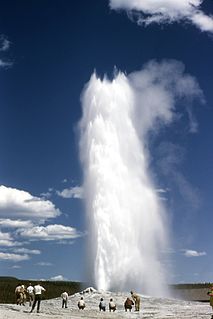
Old Faithful is a cone geyser in Yellowstone National Park in Wyoming, United States. It was named in 1870 during the Washburn–Langford–Doane Expedition and was the first geyser in the park to be named. It is a highly predictable geothermal feature and has erupted every 44 minutes to two hours since 2000. The geyser and the nearby Old Faithful Inn are part of the Old Faithful Historic District.

The geothermal areas of Yellowstone include several geyser basins in Yellowstone National Park as well as other geothermal features such as hot springs, mud pots, and fumaroles. The number of thermal features in Yellowstone is estimated at 10,000. A study that was completed in 2011 found that a total of 1,283 geysers have erupted in Yellowstone, 465 of which are active during an average year. These are distributed among nine geyser basins, with a few geysers found in smaller thermal areas throughout the Park. The number of geysers in each geyser basin are as follows: Upper Geyser Basin (410), Midway Geyser Basin (59), Lower Geyser Basin (283), Norris Geyser Basin (193), West Thumb Geyser Basin (84), Gibbon Geyser Basin (24), Lone Star Geyser Basin (21), Shoshone Geyser Basin (107), Heart Lake Geyser Basin (69), other areas (33). Although famous large geysers like Old Faithful are part of the total, most of Yellowstone's geysers are small, erupting to only a foot or two. The hydrothermal system that supplies the geysers with hot water sits within an ancient active caldera. Many of the thermal features in Yellowstone build up sinter, geyserite, or travertine deposits around and within them.

Yellowstone Lake is the largest body of water in Yellowstone National Park. The lake is 7,732 feet (2,357 m) above sea level and covers 136 square miles (350 km2) with 110 miles (180 km) of shoreline. While the average depth of the lake is 139 ft (42 m), its greatest depth is at least 394 ft (120 m). Yellowstone Lake is the largest freshwater lake above 7,000 ft (2,100 m) in North America.

The Yellowstone Caldera, sometimes referred to as the Yellowstone Supervolcano, is a volcanic caldera and supervolcano in Yellowstone National Park in the Western United States. The caldera and most of the park are located in the northwest corner of Wyoming. The caldera measures 70 by 45 kilometers, and postcaldera lavas spill out a significant distance beyond the caldera proper.
The Yellowstone River is a tributary of the Missouri River, approximately 692 miles (1,114 km) long, in the Western United States. Considered the principal tributary of upper Missouri, via its tributaries, it drains a area stretching from the Rocky Mountains in the vicinity of Yellowstone National Park, across the mountains and high plains of southern Montana and northern Wyoming.

The North American Plate is a tectonic plate covering most of North America, Cuba, the Bahamas, extreme northeastern Asia, and parts of Iceland and the Azores. With an area of 76 million km2 (29 million sq mi), it is the Earth's second largest tectonic plate, behind the Pacific Plate.

The Greater Yellowstone Ecosystem (GYE) is one of the last remaining large, nearly intact ecosystems in the northern temperate zone of the Earth. It is located within the northern Rocky Mountains, in areas of northwestern Wyoming, southwestern Montana, and eastern Idaho, and is about 22 million acres. Yellowstone National Park and the Yellowstone Caldera 'hotspot' are within it.
Yellowstone to Yukon Conservation Initiative or Y2Y is a transboundary Canada–United States not-for-profit organization that aims to connect and protect the 2,000 mile Yellowstone-to-Yukon region. Its mission proposes to maintain and restore habitat integrity and connectivity along the spine of North America's Rocky Mountains stretching from the Greater Yellowstone ecosystem to Canada’s Yukon Territory. It is the only organization dedicated to securing the long-term ecological health of the region.
Wolf reintroduction involves the reintroduction of a portion of grey wolves in areas where native wolves have been extirpated. More than 30 subspecies of Canis lupus have been recognized, and grey wolves, as colloquially understood, comprise nondomestic/feral subspecies. Reintroduction is only considered where large tracts of suitable wilderness still exist and where certain prey species are abundant enough to support a predetermined wolf population.

The Yellowstone fires of 1988 collectively formed the largest wildfire in the recorded history of Yellowstone National Park in the United States. Starting as many smaller individual fires, the flames quickly spread out of control due to drought conditions and increasing winds, combining into one large conflagration which burned for several months. The fires almost destroyed two major visitor destinations and, on September 8, 1988, the entire park closed to all non-emergency personnel for the first time in its history. Only the arrival of cool and moist weather in the late autumn brought the fires to an end. A total of 793,880 acres (3,213 km2), or 36 percent of the park, was affected by the wildfires.

A volcanic belt is a large volcanically active region. Other terms are used for smaller areas of activity, such as volcanic fields. Volcanic belts are found above zones of unusually high temperature where magma is created by partial melting of solid material in the Earth's crust and upper mantle. These areas usually form along tectonic plate boundaries at depths of 10 to 50 kilometres. For example, volcanoes in Mexico and western North America are mostly in volcanic belts, such as the Trans-Mexican Volcanic Belt that extends 900 kilometres (560 mi) from west to east across central-southern Mexico and the Northern Cordilleran Volcanic Province in western Canada.
The Muskwa-Kechika Management Area is a provincially run tract of land in the far north of British Columbia. It has an advisory board that advises the government on land-use decisions. Established by provincial government legislation in 1998, the area is meant to be preserved as a wild area, but development is not forbidden. The land is divided into different zones, with varying levels of protection, although the whole area is supposed to be used according to an overall plan. The original plan called for 25% of the land to be turned into provincial parks, 60% to become "special management zones" where mining and oil and gas drilling was to be allowed, and 15% to become "special wildland zones" where logging is prohibited. The original size of the M-KMA was 4,450,000 hectares however in 2000 with the approval of the Mackenzie Land and Resource Management Plan (LRMP) over 1,900,000 hectares were added to the M-KMA creating a total area of 6,400,000 hectares, which is approximately the size of the US state of Maine, or the island of Ireland, or seven times the size of Yellowstone National Park in the United States.

The ecology of the Rocky Mountains is diverse due to the effects of a variety of environmental factors. The Rocky Mountains are the major mountain range in western North America, running from the far north of British Columbia in Canada to New Mexico in the southwestern United States, climbing from the Great Plains at or below 1,800 feet (550 m) to peaks of over 14,000 feet (4,300 m). Temperature and rainfall varies greatly also and thus the Rockies are home to a mixture of habitats including the alpine, subalpine and boreal habitats of the Northern Rocky Mountains in British Columbia and Alberta, the coniferous forests of Montana and Idaho, the wetlands and prairie where the Rockies meet the plains, a different mix of conifers on the Yellowstone Plateau in Wyoming and in the high Rockies of Colorado and New Mexico, and finally the alpine tundra of the highest elevations.

Population Zero is a 2016 found footage crime thriller film directed by Adam Levins that premiered at the Newport Beach International Film Festival on April 26, 2016.

The Zone of Death is the name given to the 50 sq mi (129.50 km2) Idaho section of Yellowstone National Park in which, as a result of a purported loophole in the Constitution of the United States, a criminal could theoretically avoid prosecution for any major crime, up to and including murder.

The COVID-19 pandemic was confirmed to have reached the U.S. state of Wyoming in March 2020. On April 13, 2020, Wyoming became the last state in the U.S. to report its first death from COVID-19.
