Apocynaceae is a family of flowering plants that includes trees, shrubs, herbs, stem succulents, and vines, commonly known as the dogbane family, because some taxa were used as dog poison. Members of the family are native to the European, Asian, African, Australian, and American tropics or subtropics, with some temperate members. The former family Asclepiadaceae is considered a subfamily of Apocynaceae and contains 348 genera. A list of Apocynaceae genera may be found here.

Apocynum, commonly known as dogbane or Indian hemp, is a small genus of the flowering plant family Apocynaceae. Its name comes from Ancient Greek ἀπόκυνονapókunon, from ἀπο-apo- "away" and κύωνkúōn "dog", referring to dogbane, which was used to poison dogs. The genus is native to North America, temperate Asia, and southeastern Europe.

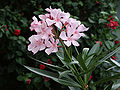
Nerium oleander, commonly known as oleander or rosebay, is a shrub or small tree cultivated worldwide in temperate and subtropical areas as an ornamental and landscaping plant. It is the only species currently classified in the genus Nerium, belonging to subfamily Apocynoideae of the dogbane family Apocynaceae. It is so widely cultivated that no precise region of origin has been identified, though it is usually associated with the Mediterranean Basin.

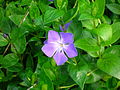
Vinca is a genus of flowering plants in the family Apocynaceae, native to Europe, northwest Africa and southwest Asia. The English name periwinkle is shared with the related genus Catharanthus.
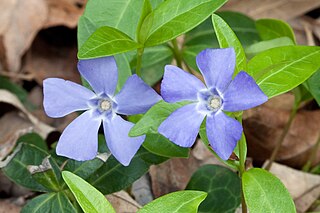
Vinca minor is a species of flowering plant in the dogbane family, native to central and southern Europe, from Portugal and France north to the Netherlands and the Baltic States, east to the Caucasus, and also southwestern Asia in Turkey. Other vernacular names used in cultivation include small periwinkle, common periwinkle, and sometimes in the United States, myrtle or creeping myrtle.

Daphnis nerii, the oleander hawk-moth or army green moth, is a moth of the family Sphingidae. It was described by Carl Linnaeus in his 1758 10th edition of Systema Naturae.

Apocynum androsaemifolium, the fly-trap dogbane or spreading dogbane, is a flowering plant in the Gentianales order. It is common across Canada and much of the United States excepting the deep southeast.

Vinca major, with the common names bigleaf periwinkle, large periwinkle, greater periwinkle and blue periwinkle, is a species of flowering plant in the family Apocynaceae, native to the western Mediterranean. Growing to 25 cm (10 in) tall and spreading indefinitely, it is an evergreen perennial, frequently used in cultivation as groundcover.

Apocynoideae is a subfamily of the flowering plant family Apocynaceae, also called the 'dogbane' or milkweed family, containing about 860 species across 78 genera. Several are of pharmacological interest; Strophanthus has furnished highly effective arrow poisons, due to their cardiac glycoside content. Apocynoideae also includes many popular landscaping and ornamental species, one of the best-known, and most infamous, being the oleander ; the subfamily also contains remarkable pachycaul genera like Adenium and Pachypodium.
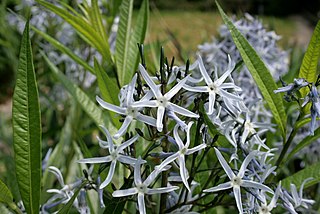
Amsonia is a genus of flowering plants in the dogbane family, Apocynaceae, first described as a genus in 1788. It is native primarily to North America with one species in East Asia and another in the eastern Mediterranean. It was named in honor of the American physician John Amson. Members of the genus are commonly known as bluestars.
- Amsonia ciliataWalter – fringed bluestar – SE US, S Great Plains
- Amsonia elliptica(Thunb. ex Murray) Roem. & Schult. – Japanese bluestar – China, Japan, Korea
- Amsonia fugateiS.P.McLaughlin – San Antonio bluestar – New Mexico
- Amsonia grandifloraAlexander – Arizona bluestar – Arizona, Sonora, Durango
- Amsonia hubrichtiiWoodson – Hubricht's bluestar – Arkansas, Oklahoma
- Amsonia illustrisWoodson – Ozark bluestar – Mississippi Valley, also Nevada
- Amsonia jonesiiWoodson – Jones' bluestar – Arizona, New Mexico, Utah, Colorado
- Amsonia kearneyanaWoodson – Kearney's bluestar – Baboquivari in Pima Co. in Arizona
- Amsonia longifloraTorr. – tubular bluestar – Arizona, New Mexico, Texas, Coahuila
- Amsonia ludovicianaVail – Louisiana bluestar – Louisiana, Mississippi, Georgia
- Amsonia orientalisDecne. – European bluestar – Greece, Turkey
- Amsonia palmeriA.Gray – Palmer's bluestar – Arizona, New Mexico, Texas, Sonora, Chihuahua
- Amsonia peeblesiiWoodson – Peebles' bluestar – Arizona
- Amsonia repensShinners – creeping bluestar – E Texas, SW Louisiana
- Amsonia rigidaShuttlw. ex Small – stiff bluestar – from Georgia to Louisiana
- Amsonia tabernaemontanaWalter – eastern bluestar – S + C + E United States
- Amsonia tharpiiWoodson – feltleaf bluestar – W Texas, SE New Mexico
- Amsonia tomentosaTorr. & Frém. – woolly bluestar – SW US; Chihuahua

Adenium obesum, more commonly known as a desert rose, is a poisonous species of flowering plant belonging to the tribe Nerieae of the subfamily Apocynoideae of the dogbane family, Apocynaceae. It is native to the Sahel regions south of the Sahara, tropical and subtropical eastern and southern Africa, as well as the Arabian Peninsula. Other names for the flower include Sabi star, kudu, mock azalea, and impala lily. Adenium obesum is a popular houseplant and bonsai in temperate regions.

Chrysochus auratus, more commonly known as the dogbane beetle, is a leaf beetle primarily found in the eastern United States. The beetle is approximately 8 to 11 mm in length, and possesses an oblong and convex shape. This beetle has two pairs of wings, one of which is a pair of copper colored elytra. The beetle is typically found to have a blue-green hue, and its color is often used to ward away potential predators.

Spilostethus pandurus is a species of "seed bugs" belonging to the family Lygaeidae, subfamily Lygaeinae.

Rauvolfioideae is a subfamily of the flowering plant family Apocynaceae. Many species are woody lianas, others are shrubs or perennial herbs.
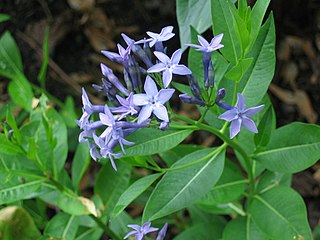
Amsonia orientalis, the European bluestar, is a species of flower in the dogbane family. It is found in European Turkey, and may be extirpated from Greece. Other historical populations appear to be lost. It is threatened by habitat loss, collection for ornamental use, and over-harvesting for research. It contains many glycosides and glycoalkaloids, and also has broad antimicrobial activity.

Aphis nerii is an aphid of the family Aphididae. Its common names include oleander aphid, milkweed aphid, sweet pepper aphid, and nerium aphid.
Apocynum venetum, commonly known as sword-leaf dogbane, is a plant species in the dogbane family that is poisonous but used as a source of fiber, medicine, and nectar for production of honey.