Gloster E.1/44

Last updated

Gloster E.1/44
Gloster E1-44 2.jpg
TX148, the third prototype on a test flight, c.1949
General information
TypeFighter
Manufacturer Gloster Aircraft Company
Designer
Primary user Royal Air Force (intended)
Number built3 (4th prototype not completed)
History
First flight9 March 1948
RetiredCancelled

The Gloster E.1/44 was a British single-engined jet fighter design of the Second World War, developed and produced by the British aviation firm Gloster Aircraft Company. It was amongst the first jet-propelled aircraft to be developed and was produced on an experimental basis.

Contents

Following favourable testing of Britain's first jet propelled aircraft, the turbojet-powered Gloster E.28/39 in 1941, there was considerable interest in the application of the new propulsion technology to fighter aircraft. During 1942, work commenced upon a development of a larger twin-engined fighter aircraft, which became the Gloster Meteor, the first Allied jet fighter. British industrial manufacturer Rover, who had already been contracted to produce the Power Jets W.2 jet engine, had considerable difficulty in achieving sufficient engine production during the war. Concerned by the wider production consequences of this shortage, the Air Ministry recognised the potential value of adopting a single-engined aircraft over the twin-engine configuration of the Meteor, leading to the issuing of Specification E.5/42, calling for the design and manufacture of such a fighter.

Gloster was amongst those companies to receive the specification and produced a single-engine fighter design with a low-wing monoplane configuration, which was to be equipped with a highly tapered wing and a T-tail, as well as being alternatively powered by either a single Halford H.1 or Rolls-Royce Nene engine, fed by air intakes in the wing roots. During late 1943, work on a pair of prototypes, as the GA.1, commenced. Engine manufacturing problems were mostly rectified following the reassignment of production activity to Rolls-Royce Limited. Gloster decided to refine the GA.1 independently, until the Air Ministry issued Specification E.1/44 during 1944, which sought an experimental jet-powered aircraft powered by the Rolls-Royce Nene, leading to the revised GA.2. Progress on the new fighter was slow, Gloster having concentrated on the development and production of the Meteor. On 9 March 1948, the second E.1/44 performed its maiden flight at RAF Boscombe Down. Testing revealed unpromising performance and characteristics and Gloster recognised the Meteor as having more development potential and the aircraft never entered production.

Development

Background

The development of the turbojet-powered E.1/44 was the product of a collaboration between the Gloster Aircraft Company and Sir Frank Whittle's firm, Power Jets Ltd. Whittle had formed Power Jets in March 1936 to develop his ideas of jet propulsion, with Whittle as the company's chief engineer. [1] For several years, attracting financial backers and aviation firms prepared to take on Whittle's radical ideas was difficult; in 1931, Armstrong-Siddeley had evaluated and rejected Whittle's proposal, finding it to be technically sound but at the limits of engineering capability. [2] Securing funding was a persistently worrying issue throughout the early development of the engine. [3] The first Whittle prototype jet engine, the Power Jets WU, began running trials in early 1937; shortly afterwards, Sir Henry Tizard, chairman of the Aeronautical Research Committee and the Air Ministry gave the project their support. [4]

On 28 April 1939, Whittle made a visit to the premises of the Gloster Aircraft Company, where he met several key figures, such as George Carter, Gloster's chief designer. [5] Carter took a keen interest in Whittle's project, particularly when he saw the operational Power Jets W.1 engine; Carter quickly made several rough proposals of various aircraft designs powered by the engine. Independently, Whittle had also been producing proposals for a high-altitude jet-powered bomber; following the start of the Second World War and the Battle for France, a greater national emphasis on fighter aircraft arose. [6] Power Jets and Gloster quickly formed a mutual understanding around mid-1939. [7]

In September 1939, the Air Ministry issued a specification to Gloster for an aircraft to test one of Whittle's turbojet designs in flight, resulting in the development of the Gloster E.28/39, the first British jet aircraft. The name adopted for this initial proof of concept aircraft, E.28/39, originated from the aircraft having been developed in conformance with the 28th "Experimental" specification issued by the Air Ministry in 1939. [8] While the specification had included provisions for armaments, these were not initially included and the aircraft was principally intended to demonstrate the viability, qualities, and potential value of jet propulsion in broad terms, not to immediately produce a combat aircraft. [9] On 15 May 1941, Gloster's Chief Test Pilot, Flight Lieutenant Gerry Sayer flew the aircraft under jet power for the first time from RAF Cranwell, near Sleaford in Lincolnshire, in a flight lasting 17 minutes. [10] [11]

Proposals

The successful testing of the E.28/39 had directly led to the design of the twin-engined Gloster Meteor jet fighter from 1940. During 1942, engine manufacturer Rover, who had already been contracted to produce the Power Jets W.2 jet engine, had experienced production problems and the Air Ministry decided to issue Specification E.5/42 for an aircraft which would only be powered by one engine. Gloster produced a design which developed into a low-wing monoplane equipped with a highly tapered wing and a T-tail arrangement, along with a tailwheel undercarriage. It was to be powered by a Halford H.1 or Rolls-Royce Nene engine fed by intakes in the wing roots. During late 1943, construction activity on a pair of prototype GA.1s, commenced. [12] [13]

The difficulties of manufacture were resolved by Rolls-Royce Limited exchanging jet engine production (as such, the W2 engine would become known as the Welland) for Meteor tank engine production with Rover, Rolls-Royce overcoming the production problems. Demand for a single-engined design dissipated and the fledgling GA.1 was no longer required. Gloster continued to work on the design privately, intending to adopt a Halford H.1 engine to power the type instead of the W2/Welland.

During 1944, the Air Ministry issued Specification E.1/44 for an experimental jet-powered aircraft that would be powered the new Rolls-Royce Nene engine. Gloster's design team decided to approach the specified requirements of this new specification by developing a new design, GA.2. It was not based on the earlier E.5/42, being a significantly larger aeroplane. [14] During 1944, after reviewing submissions, the Air Ministry issued a contract to Gloster for a prototype; this order was joined during late 1945 by additional orders for the completion of a further three aircraft. [15]

Design

Gloster E.1/44 SM809, fitted with the original tail unit, circa 1944 E1-44.jpg
Gloster E.1/44 SM809, fitted with the original tail unit, circa 1944

The Gloster E.1/44 was a stressed-skin mid-winged monoplane design, featuring a relatively broad fuselage and a wide-track undercarriage. The design bore little resemblance to the twin-jet Meteor and only superficial similarities to the earlier pioneering E.28/39, being a larger and significantly heavier aircraft. Unlike the E.28/39, which had a central air intake in the nose into a straight-through duct to reach its turbojet engine, the E.1/44's Nene received air via a pair of semi-circular air intakes ahead of the wing roots. [16] The tailplane was mounted midway up the rear fuselage, set beneath the single fin and rudder. Unlike the earlier E.5/42, a widely spaced tricycle landing gear arrangement was adopted for the E.1/44. [17] [18]

The unusually wide fuselage of the E.1/44 was made in sections, the front of which being attached to the central section via four longerons. [19] The centre fuselage, composed of reinforced Z-section frames and heavy double-channel section frames, accommodated the Nene and attachment points for the centre-section of the wing. Set into the sides of the central section were the air intakes, which featured boundary-layer bleeds and were readily detachable. [19] The rear fuselage section used semi-monocoque construction, reinforced by several Z-section frames and top-hat stringers; the detachable tail section featured a similar structure. Apart from the upper portion of the fin, which was composed of wood for its insulating properties, the tail unit was an all-metal, stressed-skin unit. Rivets were used to attach the sections. [19]

Gloster E.1/44, equipped with the revised tail unit, circa 1949 Gloster e1-44.jpg
Gloster E.1/44, equipped with the revised tail unit, circa 1949

The centre-section of the wing, which accommodated the flaps, inboard air brakes and main undercarriage, was a single-spar stressed-skin structure, with an auxiliary rear spar. [19] Both spars use a plate web design; the main spar's booms were composed from high-tensile steel, the rear spar of light-alloy booms. The outer portions of the wing, which had similar construction, were fixed at the spars and at the leading edge. An unusual feature of the aircraft was the skin of the wings, which was composed of relatively difficult-to-work stainless-steel. [17] [20]

The flying controls of the E.1/44 were relatively conventional, employing an array of push-rods and spring-torque shafts (the latter being primarily used for actuation of the spring tabs) to feed control inputs to the flight control surfaces. [19] Power for the undercarriage and the flaps was provided by a Dowty hydraulic pump, driven via a gear box from the Nene engine. For emergencies, there was a hand-pump for the flight surfaces and a compressed-air system for the undercarriage. [21] Electrical power was provided by a 1,500-watt HX2 generator, also driven via the gear box, which charged a pair of series-connected 12-volt accumulators. Equipment included a two-way radio set, IFF, oxygen tanks, windscreen de-icing system, fire detectors and fire extinguishers and a drogue parachute in the tail. [21]

Construction and testing

Progress on the new fighter was slow, Gloster having chosen to concentrate on the twin-engined Meteor and the first prototype was not completed until July 1947. The project received a considerable setback when the prototype was destroyed in a road accident while being transported to RAF Boscombe Down for flight testing. [22] [23]

The first E.1/44 to fly was the second prototype. On 9 March 1948, it performed its maiden flight at RAF Boscombe Down, flown by Gloster Chief Test Pilot Bill Waterton. Reportedly, Waterton was not impressed with the aircraft, commenting on its lack of power and its unfavourable flying characteristics, unflatteringly referring to it as the "Gormless". While this unofficial name never stuck, the prototype never received an official name, although "Ace" was proposed at one point. [24] Shortly after its first flight, the second prototype was dispatched to RAF Moreton Valence, Gloucestershire for further test flights. [22]

Initial flight testing confirmed the aircraft's poor handling and a revised tail unit with a high mounted tailplane was installed. While this change has been credited with resolving the handling problems, performance remained little better than that of the existing Meteor. This comparison was a major factor in the termination of the test programme during 1949 as the design did not possess the development potential of the Meteor. The fourth prototype (TX150) was never completed. [25]

Some elements of the design were used in other aircraft. The revised tail design developed for the E.1/44 was carried over to the Meteor, being employed on the Meteor F 8 and later models. [26] Following the end of the programme, the two aircraft to achieve flight continued in use as aerial test beds for some time before being scrapped; reportedly, at least one of these prototypes remained in existence as late as 1951. [27]

Variants

GA.1
Single-engined version of the design to meet Air Ministry Specification E.5/42 – two aircraft serial numbers SM801 and SM805, construction abandoned.
GA.2 Ace
Improved variant to meet E.1/44, three built, SM809 was destroyed during transit to Boscombe Down by road and never flew. TX145 was first to fly on 9 March 1948. TX148 with a modified tail first flew in 1949, the tail design was later used on the Gloster Meteor F.8.
GA.3
Pre-production aircraft, serial number TX150, not built.
GA.4
Forty early production aircraft were ordered in two batches in April and July 1946, cancelled and not built.

Specifications (E.1/44)

Data from Jane's all the World's Aircraft 1949-50, [28] The British Fighter since 1912 [29]

General characteristics

Performance

Armament

See also

Aircraft of comparable role, configuration, and era

Related Research Articles

<span class="mw-page-title-main">Gloster Meteor</span> Britains first jet fighter, 1943–1980s

The Gloster Meteor was the first British jet fighter and the Allies' only jet aircraft to engage in combat operations during the Second World War. The Meteor's development was heavily reliant on its ground-breaking turbojet engines, pioneered by Frank Whittle and his company, Power Jets Ltd. Development of the aircraft began in 1940, although work on the engines had been under way since 1936.

<span class="mw-page-title-main">Frank Whittle</span> British Royal Air Force engineer and air officer (1907–1996)

Air Commodore Sir Frank Whittle, was an English engineer, inventor and Royal Air Force (RAF) air officer. He is credited with having invented the turbojet engine. A patent was submitted by Maxime Guillaume in 1921 for a similar invention which was technically unfeasible at the time. Whittle's jet engines were developed some years earlier than those of Germany's Hans von Ohain, who designed the first-to-fly turbojet engine.

de Havilland Vampire Fighter aircraft; first single-engine jet in RAF service

The de Havilland Vampire is a British jet fighter which was developed and manufactured by the de Havilland Aircraft Company. It was the second jet fighter to be operated by the RAF, after the Gloster Meteor, and the first to be powered by a single jet engine.

<span class="mw-page-title-main">Gloster E.28/39</span> British jet-engined aircraft, first flown in 1941

The Gloster E.28/39, was the first British turbojet-engined aircraft first flying in 1941. It was the third turbojet aircraft to fly after the German Heinkel He 178 (1939) and Heinkel He 280 (1941), the Italian Caproni Campini N.1 of 1940 being a motor jet and not a true turbojet.

<span class="mw-page-title-main">Gloster Javelin</span> British interceptor aircraft

The Gloster Javelin is a twin-engined all-weather interceptor aircraft that served with Britain's Royal Air Force from the mid-1950s until the late 1960s. It was a T-tailed delta-wing aircraft designed for night and all-weather operations and was the last aircraft design to bear the Gloster name. Introduced in 1956 after a lengthy development period, the aircraft received several upgrades during production to its engines, radar and weapons, including support for the De Havilland Firestreak air-to-air missile.

<span class="mw-page-title-main">Supermarine Attacker</span> Carrier-based fighter aircraft; first jet fighter in Royal Navy service

The Supermarine Attacker is a British single-seat naval jet fighter designed and produced by aircraft manufacturer Supermarine for the Royal Navy's Fleet Air Arm (FAA). It was the first jet fighter to enter operational service with the FAA.

<span class="mw-page-title-main">Hawker Sea Hawk</span> 1947 fighter aircraft family by Hawker

The Hawker Sea Hawk is a British single-seat jet day fighter formerly of the Fleet Air Arm (FAA), the air branch of the Royal Navy (RN), built by Hawker Aircraft and its sister company, Armstrong Whitworth Aircraft. Although its design originated from earlier Hawker piston-engined fighters, the Sea Hawk was the company's first jet aircraft.

<span class="mw-page-title-main">Rolls-Royce Nene</span> 1940s British turbojet aircraft engine

The Rolls-Royce RB.41 Nene is a 1940s British centrifugal compressor turbojet engine. The Nene was a complete redesign, rather than a scaled-up Rolls-Royce Derwent, with a design target of 5,000 lbf (22 kN), making it the most powerful engine of its era. First run in 1944, it was Rolls-Royce's third jet engine to enter production, and first ran less than 6 months from the start of design. It was named after the River Nene in keeping with the company's tradition of naming its jet engines after rivers.

<span class="mw-page-title-main">Rolls-Royce Derwent</span> 1940s British turbojet aircraft engine

The Rolls-Royce RB.37 Derwent is a 1940s British centrifugal compressor turbojet engine, the second Rolls-Royce jet engine to enter production. It was an improved version of the Rolls-Royce Welland, which itself was a renamed version of Frank Whittle's Power Jets W.2B. Rolls-Royce inherited the Derwent design from Rover when they took over their jet engine development in 1943.

<span class="mw-page-title-main">Rolls-Royce Welland</span> Turbojet aircraft engine, Britains first production jet

The Rolls-Royce RB.23 Welland was Britain's first production jet engine. It entered production in 1943 for the Gloster Meteor. The name Welland is taken from the River Welland, in keeping with the Rolls-Royce policy of naming early jet engines after rivers based on the idea of continuous flow, air through the engine and water in a river.

This article outlines the important developments in the history of the development of the air-breathing (duct) jet engine. Although the most common type, the gas turbine powered jet engine, was certainly a 20th-century invention, many of the needed advances in theory and technology leading to this invention were made well before this time.
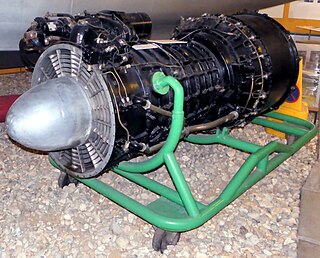
<span class="mw-page-title-main">Metropolitan-Vickers F.2</span> Early turbojet engine

The Metropolitan-Vickers F.2 is an early turbojet engine and the first British design to be based on an axial-flow compressor. It was an extremely advanced design for the era, using a nine-stage axial compressor, annular combustor, and a two-stage turbine.

<span class="mw-page-title-main">Supermarine Spiteful</span> 1944 British fighter aircraft

The Supermarine Spiteful was a British fighter aircraft designed by Supermarine during the Second World War as a successor to the Spitfire. Powered by a Rolls-Royce Griffon engine, it had a radical new wing design to allow safe operations at higher speeds and incorporating inwards-retracting undercarriage. Other changes included a larger fin to improve the marginal stability of Griffon Spitfires. Development of the wing was formalised by Air Ministry specification F.1/43; as well as a new aircraft, there was an expectation the wing could be used as a replacement for the elliptical wing on Spitfire production.

<span class="mw-page-title-main">Hawker P.1081</span> Prototype British fighter aircraft

The Hawker P.1081, also known as the "Australian Fighter" was a prototype British jet aircraft from the mid-twentieth century. The single example built was destroyed in a crash in 1951.

<span class="mw-page-title-main">Fokker S.14 Machtrainer</span> 1955 military training aircraft

The Fokker S.14 Machtrainer is a two-seater military training jet aircraft designed and manufactured by the Dutch aircraft manufacturer Fokker for the Royal Netherlands Air Force (RNLAF). It has the distinction of being one of the first dedicated jet-powered training aircraft to be produced in the world.

<span class="mw-page-title-main">Arsenal VG 90</span> French prototype jet airplane

The Arsenal VG 90 was a French carrier-based jet-engined interceptor developed in the late 1940s. It was intended to compete for an Aéronavale contract and first flew in 1949. It set a speed record for a French aircraft the following year, but both of the completed prototypes were destroyed in fatal crashes and the program was cancelled in 1952 before the third prototype was finished. The Aéronavale contract was eventually awarded to a license-built British aircraft. The remains of the last VG 90 were scrapped in 1978.
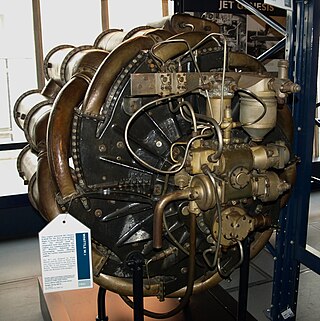
<span class="mw-page-title-main">Power Jets</span> Defunct British jet engine manufacturer

Power Jets was a British company set up by Frank Whittle for the purpose of designing and manufacturing jet engines. The company was nationalised in 1944, and evolved into the National Gas Turbine Establishment.
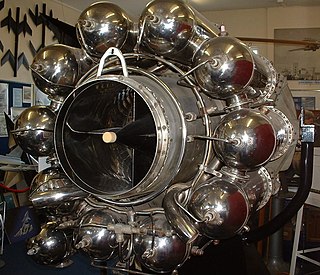
<span class="mw-page-title-main">Power Jets W.2</span> British turbojet engine

The Power Jets W.2 was a British turbojet engine designed by Frank Whittle and Power Jets Ltd. Like the earlier Power Jets W.1, the reverse-flow combustion configuration included a double-sided centrifugal compressor, 10 combustion chambers and an axial-flow turbine with air-cooled disc. It entered production as the Rolls-Royce Welland and was the first UK jet engine to power operational aircraft, the Gloster Meteor.
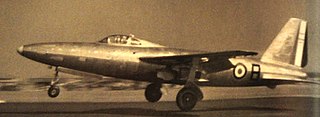
<span class="mw-page-title-main">Sud-Ouest Espadon</span> French post-war prototype interceptor

The Sud-Ouest SO.6020 Espadon (Swordfish) was a French post-war prototype interceptor designed and built by SNCASO during the late 1940s. The French Air Force judged the design a failure despite some records being set and cancelled plans to put it into service in 1951. Only four aircraft were built and they were later modified to serve as testbeds for the mixed rocket and turbojet-powered SNCASO SO.9000 Trident program. Only one badly damaged aircraft survives.

The General Electric I-A was the first working jet engine in the United States, manufactured by General Electric (GE) and achieving its first run on April 18, 1942.

References

Citations

  1. Pavelec 2007, pp. 45–46.
  2. Pavelec 2007, pp. 43–44.
  3. Golley and Gunston 2010, pp. 92–94.
  4. Pavelec 2007, pp. 48–50.
  5. Golley and Gunston 2010, p. 139.
  6. Golley and Gunston 2010, pp. 156, 165.
  7. Golley and Gunston 2010, p. 127.
  8. Flight International 13 May 1971, p. 677.
  9. Grierson, John. Jet Flight. London: Sampson Low, Marston and Co. Ltd, 1946.
  10. T.N.A. AIR62/42/198
  11. Flight International 13 May 1971, p. 678.
  12. Goulding 1986, p. 146.
  13. James 1971, pp. 306–307.
  14. Goulding 1986, p.151.
  15. Mason 1992, pp. 356–357.
  16. Flight 1948, pp. 429–430.
  17. 1 2 Goulding 1986, pp. 151–152.
  18. Flight 1948, pp. 430, 432.
  19. 1 2 3 4 5 Flight 1948, p. 430.
  20. James 1971, pp. 307–308.
  21. 1 2 Flight 1948, p. 432.
  22. 1 2 Flight 1948, p. 429.
  23. Goulding 1986, p. 152.
  24. Waterton 1956, p. 12.
  25. James 1971, pp. 309–310.
  26. Goulding 1986, p. 155.
  27. James 1971, p. 310.
  28. Bridgman, Leonard, ed. (1949). Jane's all the World's Aircraft 1949–50. London: Sampson Low, Marston & Co. pp. 20c–21c.
  29. Mason, Francis K. (1992). The British fighter since 1912. London: Putnam. pp. 356–357. ISBN   0851778526.

Bibliography