
Wang Anshi, courtesy name Jiefu, was a Chinese economist, philosopher, poet, and politician during the Song dynasty. He served as chancellor and attempted major and controversial socioeconomic reforms known as the New Policies. These reforms constituted the core concepts of the Song-dynasty Reformists, in contrast to their rivals, the Conservatives, led by the Chancellor Sima Guang.

A multi-national corporation is a corporate organization that owns and controls the production of goods or services in at least one country other than its home country. Control is considered an important aspect of an MNC to distinguish it from international portfolio investment organizations, such as some international mutual funds that invest in corporations abroad solely to diversify financial risks. Black's Law Dictionary suggests that a company or group should be considered a multi-national corporation "if it derives 25% or more of its revenue from out-of-home-country operations".
Outsourcing is a business practice in which companies use external providers to carry out business processes, that would otherwise be handled internally. Outsourcing sometimes involves transferring employees and assets from one firm to another.
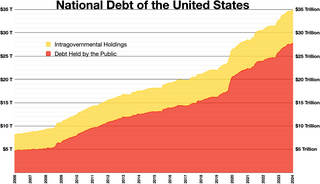
The national debt of the United States is the total national debt owed by the federal government of the United States to Treasury security holders. The national debt at any point in time is the face value of the then-outstanding Treasury securities that have been issued by the Treasury and other federal agencies. The terms "national deficit" and "national surplus" usually refer to the federal government budget balance from year to year, not the cumulative amount of debt. In a deficit year the national debt increases as the government needs to borrow funds to finance the deficit, while in a surplus year the debt decreases as more money is received than spent, enabling the government to reduce the debt by buying back some Treasury securities. In general, government debt increases as a result of government spending and decreases from tax or other receipts, both of which fluctuate during the course of a fiscal year. There are two components of gross national debt:

The expressway network of China, with the national-level expressway system officially known as the National Trunk Highway System, is an integrated system of national and provincial-level expressways in China.
A national identification number, national identity number, or national insurance number or JMBG/EMBG is used by the governments of many countries as a means of tracking their citizens, permanent residents, and temporary residents for the purposes of work, taxation, government benefits, health care, and other governmentally-related functions.
A government budget is a projection of the government's revenues and expenditure for a particular period, often referred to as a financial or fiscal year, which may or may not correspond with the calendar year. Government revenues mostly include taxes while expenditures consist of government spending. A government budget is prepared by the Central government or other political entity. In most parliamentary systems, the budget is presented to the legislature and often requires approval of the legislature. The government implements economic policy through this budget and realizes its program priorities. Once the budget is approved, the use of funds from individual chapters is in the hands of government ministries and other institutions. Revenues of the state budget consist mainly of taxes, customs duties, fees, and other revenues. State budget expenditures cover the activities of the state, which are either given by law or the constitution. The budget in itself does not appropriate funds for government programs, hence the need for additional legislative measures. The word budget comes from the Old French brunette.

Tax policy refers to the guidelines and principles established by a government for the imposition and collection of taxes. It encompasses both microeconomic and macroeconomic aspects, with the former focusing on issues of fairness and efficiency in tax collection, and the latter focusing on the overall quantity of taxes to be collected and its impact on economic activity. The tax framework of a country is considered a crucial instrument for influencing the country's economy.
China's banking sector had CN¥417 trillion in assets at the end of 2023. The "Big Four" state-owned commercial banks are the Bank of China, the China Construction Bank, the Industrial and Commercial Bank of China, and the Agricultural Bank of China, all of which are among the largest banks in the world as of 2018. Other notable big and also the largest banks in the world are China Merchants Bank and Ping An Bank.
The history of banking in China includes the business of dealing with money and credit transactions in China.
Taxes provide the most important revenue source for the Government of the People's Republic of China. Value-added tax (VAT) produces the largest share of tax revenue in China and corporate income tax producing the next largest share.
A vehicle miles traveled tax, also frequently referred to as a VMT tax, VMT fee, mileage-based fee, or road user charge, is a policy of charging motorists based on how many miles they have traveled.
All European countries show eGovernment initiatives, mainly related to the improvement of governance at the national level. Significant eGovernment activities also take place at the European Commission level as well. There is an extensive list of eGovernment Fact Sheets maintained by the European Commission.
Immigrant investor programs are programs that allow individuals to more quickly obtain residence or citizenship of a country in return for making qualifying investments.
The Golden Shield Project, also named National Public Security Work Informational Project, is the Chinese nationwide network-security fundamental constructional project by the e-government of the People's Republic of China. This project includes a security management information system, a criminal information system, an exit and entry administration information system, a supervisor information system, a traffic management information system, among others.
Fiscal policy are "measures employed by governments to stabilize the economy, specifically by manipulating the levels and allocations of taxes and government expenditures". In the Philippines, this is characterized by continuous and increasing levels of debt and budget deficits, though there were improvements in the last few years of the first decade of the 21st century.
Biometrics refers to the automated recognition of individuals based on their biological and behavioral characteristics, not to be confused with statistical biometrics; which is used to analyse data in the biological sciences. Biometrics for the purposes of identification may involve DNA matching, facial recognition, fingerprints, retina and iris scanning, voice analysis, handwriting, gait, and even body odor.

Corruption is a problem in Greece. Transparency International stated in 2012 that corruption had played a major role in causing the Greek financial crisis. Tax evasion was described by Greek politicians as "a national sport"—with up to €30 billion per year going uncollected, according to a 2012 estimate. A 2016 estimate indicated that between €11 billion and €16 billion per annum were not collectable. Other significant amounts were uncollected due to VAT fraud and smuggling. In 2016, the OECD, Greece and the European Commission launched a project to increase integrity and reduce corruption in Greece through technical empowerment of the Greek authorities for the implementation of Greece's National Anti-Corruption Action Plan (NACAP).

Mass surveillance in the People's Republic of China (PRC) is the network of monitoring systems used by the Chinese central government to monitor Chinese citizens. It is primarily conducted through the government, although corporate surveillance in connection with the Chinese government has been reported to occur. China monitors its citizens through Internet surveillance, camera surveillance, and through other digital technologies. It has become increasingly widespread and grown in sophistication under General Secretary of the Chinese Communist Party (CCP) Xi Jinping's administration.
The Social Credit System is a national credit rating and blacklist being developed by the government of China. The social credit initiative calls for the establishment of a record system so that businesses, individuals and government institutions can be tracked and evaluated for trustworthiness. There are multiple forms of the social credit system being experimented with, while the national regulatory method is based on whitelisting and blacklisting. There is no universal social credit score or system.


