
Jean Louis Xavier François Darlan was a French admiral and political figure. Born in Nérac, Darlan graduated from the École navale in 1902 and quickly advanced through the ranks following his service during World War I. He was promoted to rear admiral in 1929, vice admiral in 1932, lieutenant admiral in 1937 before finally being made admiral and Chief of the Naval Staff in 1937. In 1939, Darlan was promoted to admiral of the fleet, a rank created specifically for him.
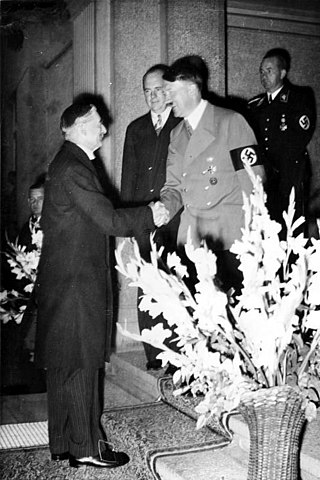
Appeasement, in an international context, is a diplomatic negotiation policy of making political, material, or territorial concessions to an aggressive power with intention to avoid conflict. The term is most often applied to the foreign policy of the British governments of Prime Ministers Ramsay MacDonald, Stanley Baldwin and Neville Chamberlain towards Nazi Germany and Fascist Italy between 1935 and 1939. Under British pressure, appeasement of Nazism and Fascism also played a role in French foreign policy of the period but was always much less popular there than in the United Kingdom.
Europe first, also known as Germany first, was the key element of the grand strategy agreed upon by the United States and the United Kingdom during World War II after the United States joined the war in December 1941. According to this policy, the United States and the United Kingdom would use the preponderance of their resources to subdue Nazi Germany in Europe first. Simultaneously, they would fight a holding action against Japan in the Pacific, using fewer resources. After the defeat of Germany—considered the greatest threat to the UK and the Soviet Union—all Allied forces could be concentrated against Japan.

The Anglo-German Naval Agreement (AGNA) of 18 June 1935 was a naval agreement between the United Kingdom and Germany regulating the size of the Kriegsmarine in relation to the Royal Navy.
Gilbert Andrew Hugh Gordon is a British academic maritime war historian, who wrote the First World War history The Rules of the Game (1996).

Sir Reginald Aylmer Ranfurly Plunkett-Ernle-Erle-Drax, KCB, DSO, JP, DL, commonly known as Reginald Plunkett or Reginald Drax, was an Anglo-Irish admiral. The younger son of the 17th Baron of Dunsany, he was Director of the Royal Naval Staff College, President of the Naval Inter-Allied Commission of Control in (Berlin), commander-in-chief of successive Royal Navy bases. His brother Edward, who became the 18th Baron of Dunsany, was best known as the famous playwright and author Lord Dunsany. Edward inherited the paternal estates in Ireland, while Reginald was bequeathed most of his mother's inheritance across portions of the West Indies, Kent, Surrey, Dorset, Wiltshire and Yorkshire. He extended his surname by special Royal licence in 1916, and was noted for the quadruple-name result, Plunkett-Ernle-Erle-Drax.

Admiral of the Fleet Sir Alfred Dudley Pickman Rogers Pound, was a British senior officer of the Royal Navy. He served in the First World War as a battleship commander, taking part in the Battle of Jutland with notable success, contributing to the sinking of the German cruiser Wiesbaden. He served as First Sea Lord, the professional head of the Royal Navy, for the first four years of the Second World War. In that role his greatest achievement was his successful campaign against the German U-boats and the winning of the Battle of the Atlantic but his judgment has been questioned over the failed Norwegian Campaign in 1940, and his dismissal of Admiral Dudley North in 1940. His order in July 1942 to disperse Convoy PQ 17 and withdraw its covering forces, to counter a threat from heavy German surface ships, led to its destruction by submarines and aircraft. His health failed in 1943 and he resigned, dying shortly thereafter.
George C. Peden is an emeritus professor of history at Stirling University, Scotland.

British re-armament was a period in British history, between 1934 and 1939, when a substantial programme of re-arming the United Kingdom was undertaken. Re-armament was deemed necessary, because defence spending had gone down from £766 million in 1919–20, to £189 million in 1921–22, to £102 million in 1932.

The 9th (Highland) Infantry Division was an infantry division of the British Army, formed just prior to the start of the Second World War. In March 1939, after the re-emergence of Germany as a significant military power and its occupation of Czechoslovakia, the British Army increased the number of divisions in the Territorial Army (TA) by duplicating existing units. The 9th (Highland) was formed in August 1939, as a second-line duplicate of the 51st (Highland) Infantry Division. The division's battalions were all raised in the Scottish Highlands.
Roger Sarty is among Canada's leading historians, specializing in the history of Canada's Navy and coastal defence.
Captain Stephen Wentworth Roskill, was a senior career officer of the Royal Navy, serving during the Second World War and, after his enforced medical retirement, served as the official historian of the Royal Navy from 1949 to 1960. He is now chiefly remembered as a prodigious author of books on British maritime history.

The Royal Naval Patrol Service (RNPS) was a branch of the Royal Navy active during both the First and Second World Wars. The RNPS operated many small auxiliary vessels such as naval trawlers for anti-submarine and minesweeping operations to protect coastal Britain and convoys.

When the United Kingdom declared war on Nazi Germany in September 1939 at the start of World War II, it controlled to varying degrees numerous crown colonies, protectorates, and India. It also maintained strong political ties to four of the five independent Dominions—Australia, Canada, South Africa, and New Zealand—as co-members of the British Commonwealth. In 1939 the British Empire and the Commonwealth together comprised a global power, with direct or de facto political and economic control of 25% of the world's population, and of 30% of its land mass.

The European foreign policy of the Chamberlain ministry from 1937 to 1940 was based on British Prime Minister Neville Chamberlain's commitment to "peace for our time" by pursuing a policy of appeasement and containment towards Nazi Germany and by increasing the strength of Britain's armed forces until, in September 1939, he delivered an ultimatum over the invasion of Poland, which was followed by a declaration of war against Germany.
The arms race between Great Britain and Germany that occurred from the last decade of the nineteenth century until the advent of World War I in 1914 was one of the intertwined causes of that conflict. While based in a bilateral relationship that had worsened over many decades, the arms race began with a plan by German Admiral Alfred von Tirpitz in 1897 to create a fleet in being to force Britain to make diplomatic concessions; Tirpitz did not expect the Imperial German Navy to defeat the Royal Navy.
Vincent P. O’Hara is a naval author and historian, residing in California.

The Singapore strategy was a naval defence policy of the United Kingdom that evolved in a series of war plans from 1919 to 1941. It aimed to deter aggression by Japan by providing a base for a fleet of the Royal Navy in the Far East, able to intercept and defeat a Japanese force heading south towards India or Australia. To be effective it required a well-equipped base. Singapore, at the eastern end of the Strait of Malacca, was chosen in 1919 as the location of this base; work continued on this naval base and its defences over the next two decades.
At the beginning of World War II, the Royal Navy was the strongest navy in the world, with the largest number of warships built and with naval bases across the globe. It had over 15 battleships and battlecruisers, 7 aircraft carriers, 66 cruisers, 164 destroyers and 66 submarines. With a massive merchant navy, about a third of the world total, it also dominated shipping. The Royal Navy fought in every theatre from the Atlantic, Mediterranean, freezing Northern routes to Russia and the Pacific ocean.
Peter G Hore FRHistS naval officer, historian and obituarist, served a full career in the Royal Navy (1962-2000), spent ten years working in the cinema and television industry (2000-2009) and is a successful biographer and obituarist. One of his books, Habit of Victory, was the Daily Telegraph reader's choice and another book, Sydney, Cipher and Search was praised for its literary quality and depth of research and shortlisted for the Mountbatten Media Awards. His reasons for becoming an historian are published at British Naval History.


