
Diwali, also called Deepavali or Deepawali, is the Hindu festival of lights, with variations celebrated in other Indian religions such as Jainism and Sikhism. It symbolises the spiritual victory of Dharma over Adharma, light over darkness, good over evil, and knowledge over ignorance. Diwali is celebrated during the Hindu lunisolar months of Ashvin and Kārtika—between around mid-September and mid-November. The celebrations generally last five or six days.

Mhow, officially Dr. Ambedkar Nagar, is a town in the Indore district in Madhya Pradesh state of India. It is located 23 kilometres (14 mi) south-west of Indore city, towards Mumbai on the old Mumbai-Agra Road. In 2003, the Government of Madhya Pradesh renamed the town Dr. Ambedkar Nagar, after political reformer and town native B. R. Ambedkar.
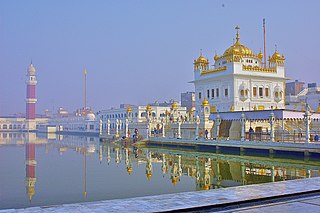
Gurdwara Sri Tarn Taran Sahib, officially Gurdwara Sri Darbar Sahib, is a gurdwara established by the fifth guru, Guru Arjan Dev, in the city of Tarn Taran Sahib, Punjab, India. The site has the distinction of having the largest sarovar of all the gurdwaras. It is famous for the monthly gathering of pilgrims on the day of Amavas. It is near Harmandir Sahib, Amritsar.

Udasis, also spelt as Udasins, also known as Nanak Putras, are a religious sect of ascetic sadhus centred in northern India who follow a tradition known as Udasipanth. Becoming custodians of Sikh shrines in the 18th century, they were notable interpreters and spreaders of the Sikh philosophy during that time. However, their religious practices border on a syncretism of Sikhism and Hinduism, and they did not conform to the Khalsa standards as ordained by Guru Gobind Singh. When the Lahore Singh Sabha reformers, dominated by Tat Khalsa Sikhs, would hold them responsible for indulging in ritual practices antithetical to Sikhism, as well as personal vices and corruption, the Udasi mahants were expelled from the Sikh shrines.
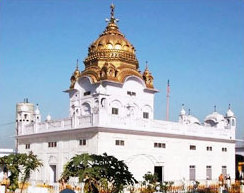
Dera Baba Nanak is a town and a municipal council in Gurdaspur district, in the state of Punjab, India. It is the sub-district headquarters of Dera Baba Nanak tehsil. It is 36 km away from Gurdaspur city, the capital of the district. Since November 2019, a corridor between India and Pakistan has been established at its shrine.
A Gurmata, alternatively romanized as Gurumatta, is an order upon a subject that affects the fundamental principles of Sikh religion and is binding upon all Sikhs.

Lodhikheda is a town and a nagar parishad in Pandhurna district in the Indian state of Madhya Pradesh. It is famous for its oranges. More than 90 per cent of farmers produce oranges. Cotton is grown in large quantities in the local area.
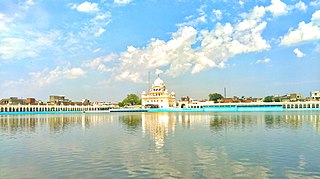
Sri Muktsar Sahib, often referred to as simply Muktsar, is a historical city and district headquarters in Punjab, India. The 2011 census of India put the total population of Sri Muktsar Sahib municipality at 117,085, making it the 14th largest city of Punjab, in terms of population. The second Guru of the Sikhs, Guru Angad was born in the village Matte-di-Sarai (Sarainaga) in the same district. Earlier the city was called Khidrana/Khidrane di dhab, the city was named Muktsar after the Battle of Muktsar in 1705 and the district headquarters in 1995. The government officially changed the name of the city to Sri Muktsar Sahib in 2012, though the city is still primarily referred to by its unofficial name – Muktsar.
Savarkundla is a city and a municipality in Amreli district in the Indian state of Gujarat. It is a twin city formed when the cities of Savar and Kundla merged.

German Sikhs are a growing religious minority in Germany. The majority of German Sikhs have their roots from the Punjab, India with the remaining coming from the Afghan Sikh community or through conversion. The number of Sikhs is estimated to be between 25,000. Germany had the fifth highest Sikh population in Europe after United Kingdom (524,000), Italy (220,000), Portugal (35,000) and Spain (26,000).

Gurdwara Darbar Sahib Kartarpur, also called Kartarpur Sahib, is a gurdwara in Kartarpur, located in Shakargarh, Narowal District, in the Punjab province of Pakistan. It is built on the historic site where the founder of Sikhism, Guru Nanak, settled and assembled the Sikh community after his missionary travels and lived for 18 years until his death in 1539. It is one of the holiest sites in Sikhism, alongside the Golden Temple in Amritsar and Gurdwara Janam Asthan in Nankana Sahib.
Mukandpur is a village near Banga, Nawanshahr district in Punjab, India.

Mela Maghi (Punjabi: ਮੇਲਾ ਮਾਘੀ ), held at the holy city of Sri Muktsar Sahib each year in January or the month of Magh according to Nanakshahi calendar and it is one of the most important melas or fairs of India and the most important of all religiously significant gatherings of the Sikhs.

Shri Guru Kottureshwara Shrine at Kotturu is an ancient shrine located at Kotturu taluk, Vijayanagara District, North Karnataka, India, 583134. This temple is 19 km from Kudligi, 28 km from Harapanahalli, 70 km from Davanagere and 253 km from Bengaluru.
Punjabi festivals are various festive celebrations observed by the Punjabis, originating in the Punjab region. The Punjabis are religiously a diverse and that affects the festivals they observe. According to a 2007 estimate, a total of ∼75% percent of the Punjabi population is Muslim, accounting about 90 million people, with 97% of Punjabis who live in Pakistan following Islam, in contrast to the remaining 30 million Punjabi Sikhs and Hindus who predominantly live in India.
Abadi Jallowal (New Abadi Jallowal) is in the Jalandhar City in the state of Punjab. The region code that it is situated in is 144003. The ward number is 39.
Rauza Sharif Mandhali Darbar is a Sufiyana Darbar shrine located in Mandhali village, nearby Phagwara, Punjab, India.

Guru Ram Rai Darbar Sahib is a Sikh place of worship in Dehradun, India, dedicated to Baba Ram Rai, eldest son of Guru Har Rai, the seventh of the ten Sikh Gurus. Baba Ram Rai settled here with his followers in the mid-17th century, after he was banished by the Sikh orthodoxy for mistranslating scripture in front of the Mughal emperor Aurangzeb, so as to not cause offence. It is believed the city, Dehradun, gets its name from the religious camp established by him: a "dera", or camp, in the "doon" valley.


