Phosphatidic acids are anionic phospholipids important to cell signaling and direct activation of lipid-gated ion channels. Hydrolysis of phosphatidic acid gives rise to one molecule each of glycerol and phosphoric acid and two molecules of fatty acids. They constitute about 0.25% of phospholipids in the bilayer.

Nils Kristian Lysø was a Norwegian politician for the Labour Party.
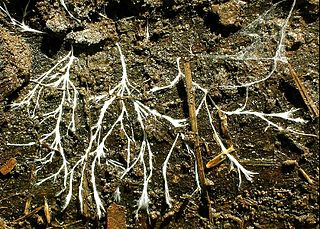
Saprotrophic nutrition or lysotrophic nutrition is a process of chemoheterotrophic extracellular digestion involved in the processing of decayed organic matter. It occurs in saprotrophs, and is most often associated with fungi and with soil bacteria. Saprotrophic microscopic fungi are sometimes called saprobes. Saprotrophic plants or bacterial flora are called saprophytes, although it is now believed that all plants previously thought to be saprotrophic are in fact parasites of microscopic fungi or of other plants. In fungi, the saprotrophic process is most often facilitated through the active transport of such materials through endocytosis within the internal mycelium and its constituent hyphae.
In enzymology, a 1-alkylglycerophosphocholine O-acetyltransferase is an enzyme that catalyzes the chemical reaction
In the field of enzymology, a glycerophospholipid arachidonoyl-transferase (CoA-independent) is an enzyme that catalyzes the chemical reaction:
In enzymology, a platelet-activating factor acetyltransferase is an enzyme that catalyzes the chemical reaction

Lussault-sur-Loire is a commune in the Indre-et-Loire department in central France.

Luceau is a commune in the Sarthe department in the region of Pays de la Loire in north-western France.
Lussagnet-Lusson is a commune in the Pyrénées-Atlantiques department in south-western France.

Lysos is a village in Cyprus, about 36 kilometres from Paphos. The population was 160 in 2001. Being the largest in area of the villages of Cyprus, Lysos covers an area of approximately 10,000 acres in the province of Paphos. Built at an average altitude of 560 meters, the peak of Tripylos, located near the location Stavros tis Psokas, is considered to be the highest point of the settlement, which borders eastwards with Nicosia. Most of the village's area is covered by the Paphos forest, an important biotope of wild and endemic birds, while the wider area is crossed by many nature trails. Lysos is located in the outskirts of Paphos. The name itself has archaic origins and originates from the Greek word "liono" as it was an industrial area for the melting of metals. The archaeological findings here indicate settlements of Greeks from Asia Minor. Lysos receives approximately 615 mm of rainfall annually. The average yearly temperature is around 16.9 °C (62.4 °F).
Peristerona(Greek: Περιστερώνα) is a small village located in the Paphos District of Cyprus, 9 km south of Polis. Hidden among the mountains of the area, the settlement of Peristerona Paphou maintains the traditional elements of Cypriot architecture, while there are plenty of those who build their country houses or hotel units in the area, encouraging foreigners and locals to visit the settlement. The village overlooks from above the vast peninsula of Akamas and the dam of Evretos.
Istinjon is a deserted Turkish Cypriot village in the Paphos District of Cyprus, located 5 km south of Lysos. Most of its inhabitants fled during an attack and siege by Greek Cypriot forces that began on 25 July 1974. The village remains a ghost village in ruins.
Melandra is an abandoned Turkish Cypriot village in the Paphos District of Cyprus, located 2 kilometres (1.2 mi) southeast of Lysos. Prior to 1974, the village was inhabited by Turkish Cypriots. The village is destroyed, apparently by shelling.
Meladeia is a village in the Paphos District of Cyprus, located 2 km southwest of Lysos.

Tremithousa Chrysochous is an abandoned village in the Paphos District of Cyprus, located 6 km southwest of Lysos and about 11 kilometers southeast of Polis Chrysochous.
Zacharia is an abandoned Turkish Cypriot village in the Paphos District of Cyprus, located 4 km south of Lysos.
Ole Lysø is a Norwegian labourer, trade unionist and politician for the Labour Party. He was the mayor of Austrheim.

1-Lysophosphatidylcholines are a class of phospholipids that are intermediates in the metabolism of lipids. They result from the hydrolysis of an acyl group from the sn-1 position of phosphatidylcholine. They are also called 2-acyl-sn-glycero-3-phosphocholines. The synthesis of phosphatidylcholines with specific fatty acids occurs through the synthesis of 1-lysoPC. The formation of various other lipids generates 1-lysoPC as a by-product.

alpha/beta-Hydrolase domain containing 12 (ABHD12) is a serine hydrolase encoded by the ABHD12 gene that participates in the breakdown of the endocannabinoid neurotransmitter 2-arachidonylglycerol (2-AG) in the central nervous system. It is responsible for about 9% of brain 2-AG hydrolysis. Together, ABHD12 along with two other enzymes, monoacylglycerol lipase (MAGL) and ABHD6, control 99% of 2-AG hydrolysis in the brain. ABHD12 also serves as a lysophospholipase and metabolizes lysophosphatidylserine (LPS).


