
Ink wash painting ; is a type of Chinese ink brush painting which uses washes of black ink, such as that used in East Asian calligraphy, in different concentrations. It emerged during the Tang dynasty of China (618–907), and overturned earlier, more realistic techniques. It is typically monochrome, using only shades of black, with a great emphasis on virtuoso brushwork and conveying the perceived "spirit" or "essence" of a subject over direct imitation. Ink wash painting flourished from the Song dynasty in China (960–1279) onwards, as well as in Japan after it was introduced by Zen Buddhist monks in the 14th century. Some Western scholars divide Chinese painting into three periods: times of representation, times of expression, and historical Oriental art. Chinese scholars have their own views which may be different; they believe that contemporary Chinese ink wash paintings are the pluralistic continuation of multiple historical traditions.
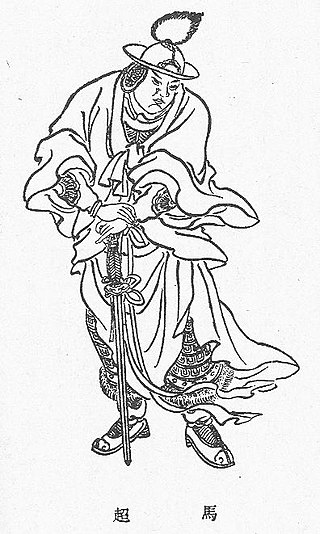
Ma Chao (176–222), courtesy name Mengqi, was a Chinese military general and warlord who lived in the late Eastern Han dynasty and early Three Kingdoms period of China. A descendant of the general Ma Yuan, Ma Chao was the eldest son of Ma Teng, a prominent warlord in Liang Province. In 211, he formed a coalition with Han Sui and other northwestern warlords and revolted against the Han central government, which was led by the warlord Cao Cao. The coalition broke up after losing the Battle of Tong Pass against Cao Cao's forces. Ma Chao initially retreated, but later returned to attack and seize control of Liang Province by killing the provincial inspector Wei Kang and forcing Wei Kang's subordinates to submit to him. About a year after Ma Chao started his uprising, Emperor Xian issued an imperial decree ordering the execution of Ma Chao's family members, who were in Ye city at the time. In the meantime, Wei Kang's subordinates, led by Zhao Ang, Yang Fu and others, rebelled against Ma Chao and forced him out of Liang Province. Ma Chao retreated to Hanzhong Commandery, where he borrowed troops from the warlord Zhang Lu, and returned to attack Liang Province but was ultimately defeated and driven back. Ma Chao took shelter under Zhang Lu for a while until around 214, when he heard that the warlord Liu Bei was fighting for control over Yi Province with Yi Province's governor, Liu Zhang. He defected to Liu Bei's side and assisted Liu Bei in capturing Yi Province from Liu Zhang. Ma Chao had served as a general under Liu Bei since then and participated in the Hanzhong Campaign in 219. He died in 222.

Huang Zhong, courtesy name Hansheng, was a Chinese military general serving under the warlord Liu Bei during the late Eastern Han dynasty of China. He is best known for his victory at the Battle of Mount Dingjun in 219, in which his force routed that of an enemy general, Xiahou Yuan, who was killed in action during the raid.

Ma Teng, courtesy name Shoucheng, was a Chinese military general and warlord who lived during the late Eastern Han dynasty of China. He controlled Liang Province with another warlord, Han Sui. Ma Teng and Han Sui were involved in efforts to gain autonomy from the Han central government.

The Red Hare or Chi Tu was a famous horse owned by the warlord Lü Bu, who lived during the late Eastern Han dynasty of China.

Ma Yuan, courtesy name Wenyuan, also known by his official title Fubo Jiangjun, was a Chinese military general and politician of the Eastern Han dynasty. He played a prominent role in defeating the Trung sisters' rebellion.
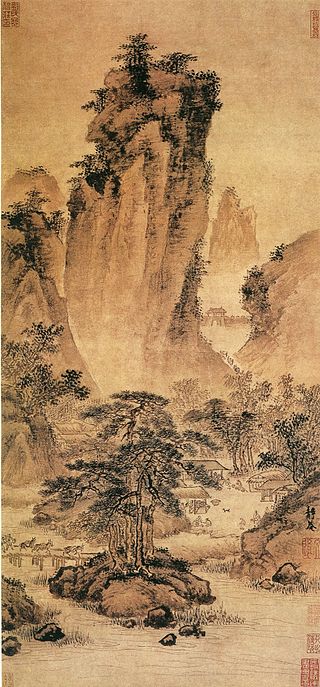
The Zhe school (浙派) was a school of painters and was part of the Southern School, which thrived during the Ming dynasty. The school was led by Dai Jin, traditionally considered its founder. The "Zhe" of the name refers to Dai Jin's home province – Zhejiang. The school was not a school in the proper sense of the word in that the painters did not formulate a new distinctive style, preferring instead to further the style of the Southern Song, specializing in decorative and large paintings. Instead, the school was identified by the formal, academic and conservative outlook, being a revival in the early Ming dynasty of the Ma-Xia, 'academic', style of painting landscapes of the Southern Song.
Ma Yin, courtesy name Batu (霸圖), also known by his posthumous name as the King Wumu of Chu (楚武穆王), was a Chinese military general and politician who became the founding ruler of the Chinese Ma Chu dynasty during the Five Dynasties and Ten Kingdoms period. He was the only monarch who carried the title of "king" in his dynasty. He initially took control of the Changsha region in 896 after the death of his predecessor Liu Jianfeng, and subsequently increased his territorial hold to roughly modern Hunan and northeastern Guangxi, which became the territory of Ma Chu.
Ma Rong, courtesy name Jichang (季長), was a Chinese essayist, poet, and politician of the Eastern Han dynasty. He was born in Youfufeng (右扶風) in the former Han capital region, in modern Xianyang, Shaanxi Province. His father Ma Yan (馬嚴) was a son of Ma Yu (馬余), an elder brother of the famed general Ma Yuan. He was known for his commentaries on the Five Classics. He was the first scholar known to have written commentaries on them, and he also developed the double column commentary for his project. His notable students were Lu Zhi and Zheng Xuan.

Han is a common Chinese surname. The spelling "Han" is based on China's pinyin system and so used throughout Mainland China. Spelling can vary from 'Hon' in Cantonese-speaking areas to 'Hang' in Hainan. It is the 15th name on the Hundred Family Surnames poem. In 2003, Han (韩) is ranked 25th in China in terms of the number of bearers at around 8 million persons. In 2019 it was the 28th most common surname in Mainland China.

Ma Yuan was a Chinese painter of the Song dynasty. His works, together with that of Xia Gui, formed the basis of the so-called Ma-Xia (馬夏) school of painting, and are considered among the finest from the period. His works has inspired both Chinese artists of the Zhe school, as well as the early Japanese painters Shūbun and Sesshū.

Ma is a Chinese family name. The surname literally means "horse". As of 2006, it ranks as the 14th most common Chinese surname in mainland China. In 2019 it was the 13th most common surname in mainland China. A 2013 study found it to be the 13th most common, shared by 17,200,000 people or 1.290% of the population, with the province with the most being Henan. It is the 52nd name on the Hundred Family Surnames poem.
Lu Zhi or Lu Chih may refer to:
Ma Xifan, courtesy name Baogui (寶規), also known by his posthumous name as the Prince Wenzhao of Chu (楚文昭王), was the third ruler of the Ma Chu dynasty of China during the Five Dynasties and Ten Kingdoms period.

Horse coins, alternatively dama qian (打馬錢), are a type of Chinese numismatic charm that originated in the Song dynasty and presumed to have been used as gambling tokens. Although many literary figures wrote about these coins their usage has always been failed to be mentioned by them. Most horse coins tend to be round coins, 3 centimetres (1.2 in) in diameter with a circular or square hole in the middle of the coin. The horses featured on horse coins are depicted in various positions such as lying asleep on the ground, turning their head while neighing, or galloping forward with their tails rising high. it is currently unknown how horse coins were actually used though it is speculated that Chinese horse coins were actually used as game board pieces or gambling counters. Horse coins are most often manufactured from copper or bronze, but in a few documented cases they may also be made from animal horns or ivory. The horse coins produced during the Song dynasty are considered to be those of the best quality and craftsmanship and tend be made from better metal than the horse coins produced after. Some horse coins would feature the name of the famous horses they depicted. It is estimated that there are over three hundred variants of the horse coin. Some horse coins contained only an image of a horse while others also included an image of the rider and others had inscriptions which identify the horse or rider. During the beginning of the year of the horse in 2002 Chinese researchers Jian Ning and Wang Liyan of the National Museum of Chinese History wrote articles on horse coins in the China Cultural Relics Newspaper, noting that they found it a pity that the holes in the coins covered the saddles of the horses as this could have revealed more about ancient horse culture. Horse coins from the Song dynasty are the horse coins that are produced at the highest quality while horse coins from subsequent dynasties tend to be inferior compared to them.

"One-Corner" or "Ma's One-Corner" (Chinese traditional: 馬一角; Chinese simplified: 马一角)is a particular type of composition in traditional Chinese painting. It was popular in the Southern Song dynasty Imperial Academy Painting, and the painters pushed the actual subjects of the painting to one corner and set them against the empty background suggestive of mist or snow. One good example is "Watching the Deer by a Pine Shaded Stream" in the Cleveland Museum of Art collection by the Southern Song dynasty master Ma Yuan 马远, after whom the term was named. Translating the term as "One-corner Ma" and considering it the nickname of Ma Yuan is not necessarily what the term originally meant in ancient China. Together with Xia Gui 夏圭, who was famous for "One-side" composition, Ma Yuan was a leader of the Ma-Xia school of painting.
