Related Research Articles

The Sillaginidae, commonly known as the smelt-whitings, whitings, sillaginids, sand borers and sand-smelts, are a family of benthic coastal marine fish historically classified in the order Perciformes, although the 5th edition of Fishes of the World places the family in the Spariformes. The smelt-whitings inhabit a wide region covering much of the Indo-Pacific, from the west coast of Africa east to Japan and south to Australia. The family comprises only five genera and 35 species, of which a number are dubious, with the last major revision of the family in 1992 unable to confirm the validity of a number of species. They are elongated, slightly compressed fish, often light brown to silver in colour, with a variety of markings and patterns on their upper bodies. The Sillaginidae are not related to a number of fishes commonly called 'whiting' in the Northern Hemisphere, including the fish originally called whiting, Merlangius merlangus.

The yellow-edged lyretail also known as the yellowedge coronation trout, fairy cod, lunar tail rock cod, lunartailed cod, lyre-tail cod or moontail seabass,, is a species of marine ray-finned fish, a grouper from the subfamily Epinephelinae which is part of the family Serranidae, which also includes the anthias and sea basses. It is found in the Indo-Pacific region and is more common than the congeneric white-edged lyretail.

Sillago is a genus of fish in the family Sillaginidae and the only non-monotypic genus in the family. Distinguishing the species can be difficult, with many similar in appearance and colour, forcing the use of swim bladder morphology as a definitive feature. All species are benthic in nature and generally coastal fish, living in shallow, protected waters although there are exceptions. Minor fisheries exist around various species of Sillago, making them of minor importance in most of their range. This genus has the widest distribution of any smelt-whiting genus, spanning much of the Indo-Pacific. The genus ranges from the east coast of Africa to Japan in the east and Southern Australia in the south, with most species concentrated around South East Asia, the Indonesian Archipelago and Australia. Many species have overlapping distribution, often making positive identification hard.
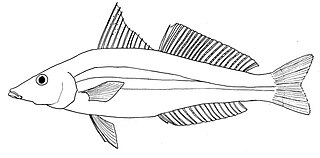
The golden lined whiting, also known as the Tin Can Bay whiting or rough-scale whiting, is a species of inshore marine fish of the smelt whiting family, Sillaginidae that inhabits the coastlines of northern Australia and lower Papua New Guinea. The golden lined whiting can be more readily distinguished by its colour than other whitings in the genus Sillago, although swim bladder morphology and spine and ray counts are the most precise method of identification. S. analis is an opportunistic predator, taking a variety of crustaceans, polychaetes and molluscs, with a transition of diet seen as the fish mature. One unusual aspect about the species diet is the large amounts of molluscan siphons it takes. The species spawns between January and March, with juvenile fish inhabiting the shallow protected coastal waters. Golden lined whiting is important to fisheries centered on Shark Bay in Western Australia and also in Queensland, although makes up a relatively minor component of the whiting fishery.

The silver-banded whiting is a narrowly distributed species of inshore marine fish of the smelt whiting family Sillaginidae that inhabits the coastline of a single province within the Philippines. The species' taxonomic status is still marginally uncertain, with the last major review of sillaginid fish by McKay proposing S. argentifasciata is a senior synonym of a related species, S. ingenuua. The species takes its name from a brilliant silvery strip running laterally across its body.

The Asian whiting is a species inshore marine fish in the smelt whiting family, Sillaginidae, distributed along the Asian coastline from the Gulf of Thailand to Taiwan. The Asian whiting's appearance is very similar to other closely related species in the genus Sillago, with swim bladder morphology and ray counts of fins the most reliable identifying features. The species inhabits slightly deeper water than many of the sillaginid species its distribution overlaps, forming an important part of the whiting fishery in the countries within its range.

The slender whiting is a poorly known species of inshore marine fish of the smelt whiting family, Sillaginidae that has a distribution limited to the Persian Gulf only. The Slender whiting, like most sillaginids requires careful study to determine its identity, with ray and vertebrae counts as well as swim bladder morphology distinguishing features. This inshore species of fish is commonly taken by fishermen using beach seines and is sold fresh in local markets.
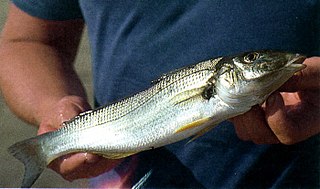
The sand whiting, also known as the summer whiting, yellowfin whiting or blue-nose whiting, is a common species of coastal marine fish of the family Sillaginidae, the smelt-whitings. It is a slender, slightly compressed fish that is very similar to other species of Sillago, with detailed spine, ray and lateral line scale counts needed to distinguish the species between its nearest relative Sillago analis. The sand whiting is distributed along the east coast of Australia from Cape York south to Tasmania, as well as Lord Howe Island and New Caledonia in the Pacific Ocean.

Sillago indica, the Indian sillago, is a poorly known species of coastal marine fish of the smelt-whiting family Sillaginidae. The species was named in 1985, having previously being misidentified as another species of Sillago, S. parvisquamis. The Indian sillago inhabits the coasts of the Indian subcontinent and Oman. Like all sillaginids, it is benthic in nature, living in depths to 30 m where it is caught by fishermen alongside other species of Sillago.

The bay whiting is a species of coastal marine fish of the smelt-whiting family, Sillaginidae. The bay whiting's range extends throughout the west Indian Ocean, including northern Australia, Thailand, India and Taiwan, where it inhabits protected waters. It is benthic in nature, preying on shrimps, polychaetes and molluscs, however little else is known of its biology. Bay whiting are an important part of some inshore fisheries around Australia and Asia, where subsistence and commercial fishermen regularly take the species.
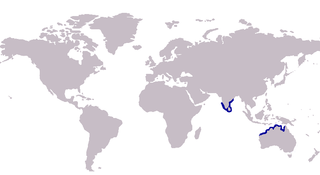
The mud whiting, or mud sillago, is a species of coastal marine fish in the smelt-whiting family Sillaginidae. The mud whiting was first described in 1985 and is currently known from the north west coast of Australia and the Indian coast.

The large-scale whiting the only member of the genus Sillaginops, is a poorly understood species of coastal marine fish of the smelt- whiting family Sillaginidae. First described in 1859, the large-scale whiting is known to inhabit shallow waters along the coasts of a number of Indo-Pacific countries including Japan, Indonesia, Philippines and the Solomon Islands. Little is known of the species biology, even though it is of minor importance to fisheries throughout its range.
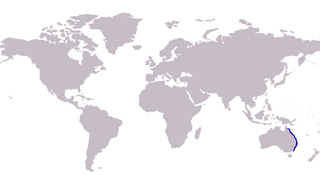
The trumpeter whiting, also known as the winter whiting or diver whiting, is a common species of coastal marine fish of the smelt-whiting family, Sillaginidae. The trumpeter whiting is endemic to Australia, inhabiting the eastern seaboard from southern New South Wales to northern Queensland. The species is found in bays, estuaries, coastal lakes and mangrove creeks on silty and muddy substrates in waters ranging from 0 to 30 m deep, occasionally inhabiting sandy and seagrass beds.

The small-eyed whiting is a poorly known species of coastal marine fish of the smelt-whiting family Sillaginidae. The species is known from only two specimens; the holotype collected by Roland McKay in 1985 from a Taipei market, both specimens of which were taken from the waters of Taiwan. Apart from a relatively small eye size, the species is hard to distinguish from other common species of sillaginid taken in the area, and may be a minor part of local fisheries.

The potato grouper, also called the potato cod or potato bass, is a species of marine ray-finned fish, a grouper from the subfamily Epinephelinae which is part of the family Serranidae, which also includes the anthias and sea basses. It has a wide Indo-Pacific distribution.
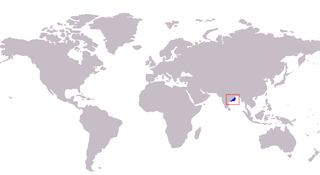
The soringa whiting, also known simply as soringa or soringa sillago, is a poorly known species of coastal marine fish of the smelt-whiting family, Sillaginidae. The Soringa whiting is known exclusively from the east coast of India, inhabiting shallow inshore environments, particularly sandy substrates. S. soringa was first described in 1982 by Dutt and Sujatha, with the taxonomic status of the species was questioned by Roland McKay in his review of the Sillaginidae, with similar features to S. asiatica suggesting it is a senior synonym of the latter.

The stout whiting, also known as the yellow-cheek whiting or school whiting, is a species of benthic marine fish in the smelt-whiting family Sillaginidae. Like other sillaginids, it is an elongate, slightly compressed fish, growing to a maximum known length of 30 cm. The stout whiting is endemic to Australia, with the species divided into western and eastern populations, with the western population ranging from Shark Bay to Fremantle and the eastern population from Bustard Head, Queensland to northern New South Wales. The species inhabits deep, sandy continental shelf regions to a depth of at least 70 m.

Plectropomus laevis, known commonly as the black-saddled coral grouper, cluespotted coral trout, blacksaddled coral trout, blue-spot trout, Chinese footballer, footballer cod, footballer coral trout, oceanic coral trout or tiger trout, is a species of marine ray-finned fish, a grouper from the subfamily Epinephelinae which is part of the family Serranidae, which also includes the anthias and sea basses. It is found in the Indo-Pacific region.
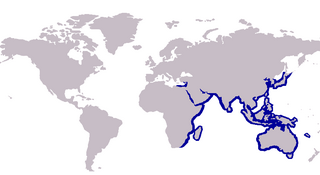
Smelt-whiting is the common name for various species of the family Sillaginidae. The Sillaginidae are distributed throughout the Indo-Pacific region, ranging from the west coast of Africa to Japan and Taiwan in the east, as well occupying as a number of small islands including New Caledonia in the Pacific Ocean. Well known members of this family include King George whiting, Japanese whiting, northern whiting, sand whiting and school whiting.

Lethrinus atkinsoni, the Pacific yellowtail emperor,, Atkinson's emperor, reticulated emperor, tricky snapper, Tuamotu emperor, yellow morwong or yellow-tailed emperor is a species of marine ray-finned fish benomging to the family Lethrinidae, the emperor breams and emperors. This fish is found in the Western Pacific Ocean.
References
- McKay, R.J., 1984. Introductions of exotic fishes in Australia. In Courtenay, W.R. Jr. and J.R. Stauffer, Jr. (Editors). Distribution, Biology and Management of Exotic fishes. The Johns Hopkins University Press, Baltimore, Maryland, USA., 1984, p. 177-199
- VOL. 17. PEARL PERCHES OF THE WORLD An annotated and illustrated catalogue of the pearl perches known to date ftp://ftp.fao.org/docrep/fao/009/w5263e/w5263e00.pdf
- Arthington, A.H., D.A. Milton and R.J. McKay (1983). Effects of urban development and habitat alterations on the distribution and abundance of native and fresh- water fish in the Brisbaneregion, Queensland.Austra1- ian Journal of Ecology 8.87-101
- FAO SPECIES IDENTIFICATION SHEETS-FOR FISHERY PURPOSES EASTERN INDIAN OCEAN Fishing Area and WESTERN CENTRAL PACIFIC ftp://ftp.fao.org/docrep/fao/009/e9163e/E9163e1a.pdf
- Arthington A.H., R.J. McKay and D.A. Milton, 1983. Effects of urban development and habitat alteration on the distribution and abundance of native and exotic fish in the Brisbane region, Queensland. Aust. J. Ecol. 8. 87-101.
