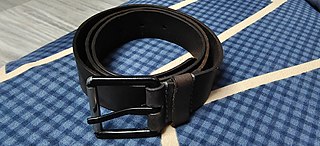
A belt is a flexible band or strap, typically made of leather, plastic, or heavy cloth, worn around the natural waist or near it. The ends of a belt are free; and a buckle forms the belt into a loop by securing one end to another part of the belt, at or near the other end. Often, the resulting loop is smaller than the hips. Belts come in many lengths because of the variety in waist sizes, and most belts can be adjusted at the buckle to suit the wearer's waist.

Bronc riding, either bareback bronc or saddle bronc competition, is a rodeo event that involves a rodeo participant riding a bucking horse that attempts to throw or buck off the rider. Originally based on the necessary buck breaking skills of a working cowboy, the event is now a highly stylized competition that utilizes horses that often are specially bred for strength, agility, and bucking ability. It is recognized by the main rodeo organizations such as the Professional Rodeo Cowboys Association (PRCA) and the International Professional Rodeo Association (IPRA).

Suspenders, or braces are fabric or leather straps worn over the shoulders to hold up skirts or trousers. The straps may be elasticated, either entirely or only at attachment ends, and most straps are of woven cloth forming an X or Y shape at the back. Suspenders are typically attached to skirts and trousers with clips or buttons using leather tabs at the ends.

Chaps are sturdy coverings for the legs consisting of leggings and a belt. They are buckled on over pants with the chaps' integrated belt, but unlike trousers, they have no seat and are not joined at the crotch. They are designed to provide protection for the legs and are usually made of leather or a leather-like material. Their name is a shortened version of the Spanish word chaparajos. Chaparajos were named after the chaparral, from which they were designed to protect the legs while riding on horseback. Like much of western American horse culture, the origin of chaparajos was in the south of Spain, from which it then passed on to the part of New Spain that later became Mexico, and has been assimilated into cowboy culture of the American West. They are a protective garment to be used when riding a horse through brushy terrain. In the modern world, they are worn for both practical work purposes and for exhibition or show use. Chaps have also been adopted for use on motorcycles, particularly by cruiser-style motorcycle riders.

A buckle or clasp is a device used for fastening two loose ends, with one end attached to it and the other held by a catch in a secure but adjustable manner. Often taken for granted, the invention of the buckle was indispensable in securing two ends before the invention of the zipper. The basic buckle frame comes in a variety of shapes and sizes depending on the intended use and fashion of the era. Buckles are as much in use today as they have been in the past: used for much more than just securing one's belt, instead they are one of the most dependable devices in securing a range of items.
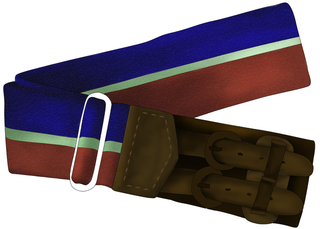
A stable belt is a striped coloured belt worn at times by the armed forces of the United Kingdom, other Commonwealth countries, and a few other countries including Denmark, Brazil and Lebanon. The stripes vary by regiment and corps, identifying the wearer's unit. In Brazil and Lebanon they are known as gymnastic belts.

A belt is a loop of flexible material used to link two or more rotating shafts mechanically, most often parallel. Belts may be used as a source of motion, to transmit power efficiently or to track relative movement. Belts are looped over pulleys and may have a twist between the pulleys, and the shafts need not be parallel.
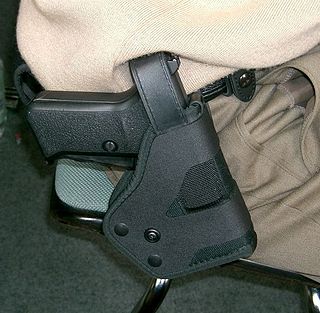
A handgun holster is a device used to hold or restrict the undesired movement of a handgun, most commonly in a location where it can be easily withdrawn for immediate use. Holsters are often attached to a belt or waistband, but they may be attached to other locations of the body. Holsters vary in the degree to which they secure or protect the firearm. Some holsters for law enforcement officers have a strap over the top of the holster to make the handgun less likely to fall out of the holster or harder for another person to grab the gun. Some holsters have a flap over the top to protect the gun from the elements.

Western wear is a category of men's and women's clothing which derives its unique style from the clothes worn in the 19th century Wild West. It ranges from accurate historical reproductions of American frontier clothing, to the stylized garments popularized by Western film and television or singing cowboys such as Gene Autry and Roy Rogers in the 1940s and 1950s. It continues to be a fashion choice in the West and Southwestern United States, as well as people associated with country music or Western lifestyles, for example the various Western or Regional Mexican music styles. Western wear typically incorporates one or more of the following: Western shirts with pearl snap fasteners and vaquero design accents, blue jeans, cowboy hat, a leather belt, and cowboy boots.

Equestrian vaulting, or simply vaulting, is most often described as gymnastics and dance on horseback, which can be practiced both competitively or non-competitively. Vaulting has a history as an equestrian act at circuses, but its origins stretch back at least two-thousand years. It is open to both men and women and is one of ten equestrian disciplines recognized by the International Federation for Equestrian Sports. Therapeutic or interactive vaulting is also used as an activity for children and adults who may have balance, attention, gross motor skill or social deficits.

A surcingle is a strap made of leather or leather-like synthetic materials such as nylon or neoprene, sometimes with elastic, that fastens around the horse's girth.
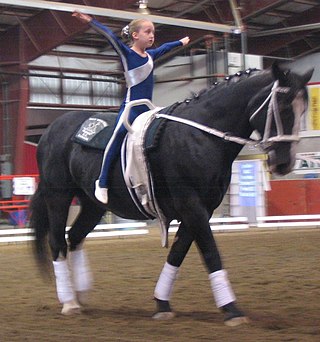
Side reins are equipment used when longeing a horse, running from the bit of the bridle to the saddle or surcingle. As a horse training tool, they encourage flexion and softness in the horse's mouth. For longe line work with a rider up who does not carry ordinary riding reins, they help calm and settle the animal. However, they are a tool best used by experienced handlers; used improperly they may unduly restrict the horse's movement or cause an accident.

Reins are items of horse tack used to direct a horse for riding or driving. They are long straps that can be made of leather, nylon, or other materials, and attach to a bridle via either its bit or its noseband.
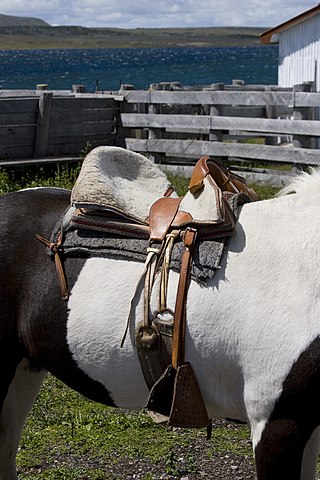
A girth, sometimes called a cinch, is a piece of equipment used to keep the saddle in place on a horse or other animal. It passes under the barrel of the equine, attached to the saddle on both sides by two or three leather straps called billets. Girths are used on Australian and English saddles, while western saddles and many pack saddles have a cinch, which is fastened to the saddle by a single wide leather strap on each side, called a latigo.

A saddle is a supportive structure for a rider of an animal, fastened to an animal's back by a girth. The most common type is equestrian. However, specialized saddles have been created for oxen, camels and other animals. It is not known precisely when riders first began to use some sort of padding or protection, but a blanket attached by some form of surcingle or girth was probably the first "saddle", followed later by more elaborate padded designs. The solid saddle tree was a later invention, and though early stirrup designs predated the invention of the solid tree, the paired stirrup, which attached to the tree, was the last element of the saddle to reach the basic form that is still used today. Today, modern saddles come in a wide variety of styles, each designed for a specific equestrianism discipline, and require careful fit to both the rider and the horse. Proper saddle care can extend the useful life of a saddle, often for decades. The saddle was a crucial step in the increased use of domesticated animals, during the Classical Era.

The Australian stock saddle is a saddle in popular use all over the world for activities that require long hours in the saddle and a secure seat. The saddle is suitable for cattle work, starting young horses, everyday pleasure riding, trail riding, endurance riding, polocrosse and is also used in Australian campdrafting competitions and stockman challenges.
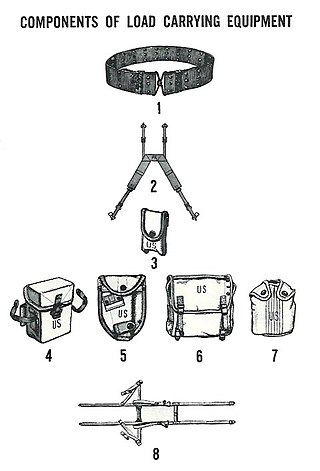
The M-1956 load-carrying equipment (LCE), also known as the individual load-carrying equipment (ILCE), was developed by the U.S. Army and first issued in the early 1960s. The M-1956 LCE was designed to replace the M-1945 Combat Pack, the M-1923 cartridge belt, the M-1936 pistol belt and the M-1937 BAR magazine belt. The M-1956 LCE was designed to be quickly configured, using no tools, to accommodate various mission and ammunition loads. The M-1956 LCE remained in service through the 1980s and set the standard for future United States military load-carrying equipment.
Nokona Athletic Goods Company is an American manufacturing company of sports equipment and clothing products, specialized in baseball gloves. The company, headquartered in Nocona, Texas, is the last major baseball glove manufacturer in the United States.

The TNA Knockouts World Championship is a women's professional wrestling world championship owned by Total Nonstop Action Wrestling (TNA). The championship debuted on October 14, 2007, at the Bound for Glory pay-per-view (PPV) event and the inaugural champion was Gail Kim. The current champion is Masha Slamovich, who is in her first reign.
A bitting rig or bitting harness is a training tool for horses that can teach a horse to accept a bridle and bit, and later assist a horse in developing the necessary musculature for a given equestrianism discipline. Generally used in conjunction with training on a longe line, it is most often seen in the training of Saddle seat horses, but also is used by some dressage trainers and as a tool to start horses in driving.

