Palliative care is an interdisciplinary medical caregiving approach aimed at optimizing quality of life and mitigating suffering among people with serious, complex, and often terminal illnesses. Within the published literature, many definitions of palliative care exist. The World Health Organization (WHO) describes palliative care as "an approach that improves the quality of life of patients and their families facing the problems associated with life-threatening illness, through the prevention and relief of suffering by means of early identification and impeccable assessment and treatment of pain, illnesses including other problems whether physical, psychosocial, and spiritual". In the past, palliative care was a disease specific approach, but today the WHO takes a broader patient-centered approach that suggests that the principles of palliative care should be applied as early as possible to any chronic and ultimately fatal illness. This shift was important because if a disease-oriented approach is followed, the needs and preferences of the patient are not fully met and aspects of care, such as pain, quality of life, and social support, as well as spiritual and emotional needs, fail to be addressed. Rather, a patient-centered model prioritizes relief of suffering and tailors care to increase the quality of life for terminally ill patients.
Terminal illness or end-stage disease is a disease that cannot be cured or adequately treated and is expected to result in the death of the patient. This term is more commonly used for progressive diseases such as cancer, dementia or advanced heart disease than for injury. In popular use, it indicates a disease that will progress until death with near absolute certainty, regardless of treatment. A patient who has such an illness may be referred to as a terminal patient, terminally ill or simply as being terminal. There is no standardized life expectancy for a patient to be considered terminal, although it is generally months or less. Life expectancy for terminal patients is a rough estimate given by the physician based on previous data and does not always reflect true longevity. An illness which is lifelong but not fatal is a chronic condition.

The John Fitzgerald Kennedy National Historic Site is the birthplace and childhood home of John F. Kennedy, the 35th president of the United States. The house is at 83 Beals Street in the Coolidge Corner neighborhood of Brookline, Massachusetts. Kennedy is one of four U.S. presidents born in Norfolk County, Massachusetts. The property is now owned by the National Park Service; tours of the house are offered, and a film is presented.

Milford Regional Medical Center, is a full-service, community and regional non-profit, teaching hospital located in Milford, Massachusetts. Milford Regional has 149 beds in the main hospital and runs a comprehensive healthcare system that includes the VNA and Hospice of Greater Milford and Tri-County Medical Associates, a physician practice group. The service area for hospital covers 20-plus towns in Worcester, Middlesex, and Norfolk counties.

Massachusetts College of Pharmacy and Health Sciences (MCPHS) is a private university focused on health- and life-sciences education, with campuses in Boston, Massachusetts, Worcester, Massachusetts, and Manchester, New Hampshire, as well as online programs. The university provides traditional and accelerated programs of study focused on professional education in pharmacy and the health sciences.

The Boston University housing system is the 2nd-largest of any private university in the United States, with 76% of the undergraduate population living on campus. On-campus housing at BU is an unusually diverse melange, ranging from individual 19th-century brownstone town houses and apartment buildings acquired by the school to large-scale high-rises built in the 60s and 2000s.

British Columbia Children's Hospital is a medical facility located in Vancouver, British Columbia, and is an agency of the Provincial Health Services Authority. It specializes in health care for patients from birth to 16 years of age. It is also a teaching and research facility for children's medicine. The hospital includes the Sunny Hill Health Centre, which provides specialized services to children and youth with developmental disabilities aged birth to 16 years.
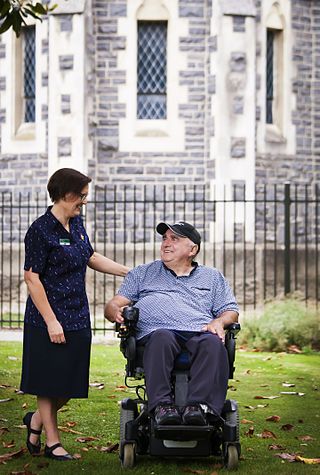
A caregiver, carer or support worker is a paid or unpaid person who helps an individual with activities of daily living. Caregivers who are members of a care recipient's family or social network, and who may have no specific professional training, are often described as informal caregivers. Caregivers most commonly assist with impairments related to old age, disability, a disease, or a mental disorder.

In a building or ship, a room is any enclosed space within a number of walls to which entry is possible only via a door or other dividing structure. The entrance connects it to either a passageway, another room, or the outdoors. The space is typically large enough for several people to move about. The size, fixtures, furnishings, and sometimes placement of the room within the building or ship support the activity to be conducted in it.

East Tennessee Children's Hospital is a private, independent, not-for-profit, 152-bed pediatric medical center in Knoxville, Tennessee. The hospital's primary service area includes 16 counties in East Tennessee, and its secondary service area includes counties in southwest Virginia, southeast Kentucky and western North Carolina.

The Suntop Homes, also known under the early name of The Ardmore Experiment, were quadruple residences located in Ardmore, Pennsylvania, and based largely upon the 1935 conceptual Broadacre City model of the minimum houses. The design was commissioned by Otto Tod Mallery of the Tod Company in 1938 in an attempt to set a new standard for the entry-level housing market in the United States and to increase single-family dwelling density in the suburbs. In cooperation with Frank Lloyd Wright, the Tod Company secured a patent for the unique design, intending to sell development rights for Suntops across the country.
The Tom Coughlin Jay Fund Foundation, also known simply as the Jay Fund, is a 501(c)(3) non-profit organization established in 1996 and "helps families tackle childhood cancer by providing comprehensive financial, emotional and practical support", according to the foundation's mission statement. Charity Navigator currently rates The Tom Coughlin Jay Fund Foundation as a 4-star organization, its highest rating.
Chai Lifeline is a chesed organization founded in 1987 by Rabbi Simcha Scholar to help families with "children battling a deadly disease."

UMass Memorial Health (UMM Health) is the clinical partner of the University of Massachusetts Medical School and the largest healthcare system in Central Massachusetts. It is a not-for-profit/nonprofit healthcare network providing all levels of primary to quartenary healthcare.

Toufoula is a Lebanese voluntary health organization dedicated to improve the quality of life of children suffering from cancer and blood diseases by designing and creating a unique and colorful environments aimed at offering a safe haven throughout their treatment. Toufoula was co-founded in 2006 by a group of young volunteers in Beirut, Lebanon.
Shine On! Kids, formerly the Tyler Foundation, is a charitable organization located in Tokyo, Japan, which offers psychosocial support to children with cancer in Japan and their families.

The HAYIM Association for Children with Cancer in Israel is a non-governmental organization that works on a voluntary basis to provide relief and support for pediatric oncology patients in Israel.

Childhood cancer is cancer in a child. About 80% of childhood cancer cases in high-income countries can be successfully treated via modern medical treatments and optimal patient care. However, only about 10% of children diagnosed with cancer reside in high-income countries where the necessary treatments and care is available. Childhood cancer represents only about 1% of all types of cancers diagnosed in children and adults, It is often more complex than adult cancers with unique biological characteristics and research and treatment is yet very challenging and limited. For this reason, childhood cancer is often ignored in control planning, contributing to the burden of missed opportunities for its diagnoses and management in countries that are low- and mid-income.

Penrose Hospital is a 364-bed hospital located in Colorado Springs, Colorado and owned by Penrose-Saint Francis Health Services. The campus includes Penrose Hospital, the Penrose Cancer Center, the E Tower building, the Penrose Pavilion, and the John Zay House. The hospital is a Level II trauma center.

Sherry Pagoto is a professor in the Department of Allied Health Sciences at the University of Connecticut and director of the UConn Center for mHealth and Social Media. A behavioural scientist and licensed clinical psychologist, she is an expert in leveraging technology, especially social media, to promote health behavior change with extensive research on the topics of obesity management and cancer prevention. She is the President of the Society of Behavioral Medicine.


