
Microsoft DirectX is a collection of application programming interfaces (APIs) for handling tasks related to multimedia, especially game programming and video, on Microsoft platforms. Originally, the names of these APIs all began with "Direct", such as Direct3D, DirectDraw, DirectMusic, DirectPlay, DirectSound, and so forth. The name DirectX was coined as a shorthand term for all of these APIs and soon became the name of the collection. When Microsoft later set out to develop a gaming console, the X was used as the basis of the name Xbox to indicate that the console was based on DirectX technology. The X initial has been carried forward in the naming of APIs designed for the Xbox such as XInput and the Cross-platform Audio Creation Tool (XACT), while the DirectX pattern has been continued for Windows APIs such as Direct2D and DirectWrite.

Microsoft Excel is a spreadsheet editor developed by Microsoft for Windows, macOS, Android, iOS and iPadOS. It features calculation or computation capabilities, graphing tools, pivot tables, and a macro programming language called Visual Basic for Applications (VBA). Excel forms part of the Microsoft 365 and Microsoft Office suites of software and has been developed since 1985.

Windows 95 is a consumer-oriented operating system developed by Microsoft and the first of its Windows 9x family of operating systems, released to manufacturing on July 14, 1995, and generally to retail on August 24, 1995. Windows 95 merged Microsoft's formerly separate MS-DOS and Microsoft Windows products, and featured significant improvements over its predecessor, most notably in the graphical user interface (GUI) and in its simplified "plug-and-play" features. There were also major changes made to the core components of the operating system, such as moving from a mainly cooperatively multitasked 16-bit architecture of its predecessor Windows 3.1 to a 32-bit preemptive multitasking architecture.

Microsoft Visual C++ (MSVC) is a compiler for the C, C++, C++/CLI and C++/CX programming languages by Microsoft. MSVC is proprietary software; it was originally a standalone product but later became a part of Visual Studio and made available in both trialware and freeware forms. It features tools for developing and debugging C++ code, especially code written for the Windows API, DirectX and .NET.
X.org is a single-letter second-level internet domain name.

ipconfig is a console application program of some computer operating systems that displays all current TCP/IP network configuration values refreshes Dynamic Host Configuration Protocol (DHCP) and Domain Name System (DNS) settings.
Windows Services for UNIX (SFU) is a discontinued software package produced by Microsoft which provided a Unix environment on Windows NT and some of its immediate successor operating-systems.

Windows 3.x means either of, or all of the following versions of Microsoft Windows:
The domain name .local is a special-use domain name reserved by the Internet Engineering Task Force (IETF) so that it may not be installed as a top-level domain in the Domain Name System (DNS) of the Internet. As such it is similar to the other special domain names, such as .localhost. However, .local has since been designated for use in link-local networking, in applications of multicast DNS (mDNS) and zero-configuration networking (zeroconf) so that DNS service may be established without local installations of conventional DNS infrastructure on local area networks.
Windows 3.x means either of, or all of the following versions of Microsoft Windows:

Visual Basic (VB) before .NET, sometimes referred to as Classic Visual Basic, is a third-generation programming language, based on BASIC, and an integrated development environment (IDE), from Microsoft for Windows known for supporting rapid application development (RAD) of graphical user interface (GUI) applications, event-driven programming and both consumption and development of components via the Component Object Model (COM) technology.
NTFS links are the abstraction used in the NTFS file system—the default file system for all Microsoft Windows versions belonging to the Windows NT family—to associate pathnames and certain kinds of metadata, with entries in the NTFS Master File Table (MFT). NTFS broadly adopts a pattern akin to typical Unix file systems in the way it stores and references file data and metadata; the most significant difference is that in NTFS, the MFT "takes the place of" inodes, fulfilling most of the functions which inodes fulfill in a typical Unix filesystem.
Microsoft Windows is an operating system developed by Microsoft.
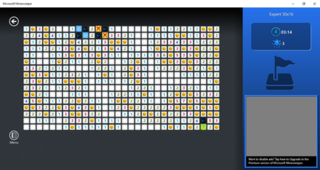
Microsoft Minesweeper is a minesweeper-type video game created by Curt Johnson, originally for IBM's OS/2, that was ported to Microsoft Windows by Robert Donner, both Microsoft employees at the time. First released as part of the Microsoft Entertainment Pack 1 in 1990, it was first included in the standard install of Windows 3.1 in 1992, replacing Reversi from Windows 3.0. Microsoft Minesweeper was included without major changes in all subsequent Windows releases until Windows Vista, at which time an updated version by Oberon Media replaced it. In Windows 8 and later the game is not included with a fresh Windows install, but Microsoft Studios has published an updated version of it, developed by Arkadium, on Microsoft Store.
Windows NT 3.x may refer to either of, or all of the following versions of Microsoft Windows:

MSN Messenger, later rebranded as Windows Live Messenger, was a cross-platform instant-messaging client developed by Microsoft. It connected to the now-discontinued Microsoft Messenger service and, in later versions, was compatible with Yahoo! Messenger and Facebook Messenger. The service was discontinued in 2013 and was replaced by Skype.
Windows Phone 8.x may refer to:
The Surface Laptop is a line of laptops marketed by Microsoft, as a sub-brand of their Surface devices. Several models have been produced:
Windows Embedded 8.x refers to the following versions of Windows Embedded operating systems:
This page is based on this
Wikipedia article Text is available under the
CC BY-SA 4.0 license; additional terms may apply.
Images, videos and audio are available under their respective licenses.
