
劉 / 刘 is an East Asian surname. pinyin: Liú in Mandarin Chinese, Lau4 in Cantonese. It is the family name of the Han dynasty emperors. The character 劉 originally meant 'battle axe', but is now used only as a surname. It is listed 252nd in the classic text Hundred Family Surnames. Today, it is the 4th most common surname in mainland China as well as one of the most common surnames in the world.

Luoyang is a city located in the confluence area of the Luo River and the Yellow River in the west of Henan province, China. Governed as a prefecture-level city, it borders the provincial capital of Zhengzhou to the east, Pingdingshan to the southeast, Nanyang to the south, Sanmenxia to the west, Jiyuan to the north, and Jiaozuo to the northeast. As of December 31, 2018, Luoyang had a population of 6,888,500 inhabitants with 2,751,400 people living in the built-up area made of the city's five out of six urban districts and Yanshi District, now being conurbated. By the end of 2022, Luoyang Municipality had jurisdiction over 7 municipal districts, 7 counties and 1 development zone. The permanent population is 7.079 million.

King Ping of Zhou, personal name Ji Yijiu, was the thirteenth king of China's Zhou dynasty and the first of the Eastern Zhou dynasty.
Sima is a Chinese family name. It is one of the rare two-character Chinese family names; most Chinese family names consist of only a single character. It is an occupational surname, literally meaning "control" (sī) "horses" (mǎ), or "horse officer". The family name originated from one of the offices of the Zhou dynasty.
For most of its history, China was organized into various dynastic states under the rule of hereditary monarchs. Beginning with the establishment of dynastic rule by Yu the Great c. 2070 BC, and ending with the abdication of the Xuantong Emperor in AD 1912, Chinese historiography came to organize itself around the succession of monarchical dynasties. Besides those established by the dominant Han ethnic group or its spiritual Huaxia predecessors, dynasties throughout Chinese history were also founded by non-Han peoples.

Zhou Fang, courtesy name Zhonglang (仲朗), was a Chinese painter during the Tang dynasty. Zhou lived in the Tang capital of Chang'an and painted for the emperor. Zhou Fang came from a wealthy and prominent family, so he was very familiar with the luxurious life of the aristocratic class. He successively served as the governor of Yuezhou and Xuanzhou.

The Historical Records of the Five Dynasties is a Chinese history book on the Five Dynasties period (907–960), written by the Song dynasty official Ouyang Xiu in private. It was drafted during Ouyang's exile from 1036 to 1039 but not published until 1073, a year after his death. An abridged English translation by Richard L. Davis was published in 2004.

Zhōu is a Chinese-language surname. In places which use the Wade–Giles romanization such as Taiwan, Zhou is usually spelled as Chou, and it may also be spelled as Chiau, Chau, Chao, Chew, Chow, Chiu, Cho, Chu, Jhou, Jou, Djou, Jue, Jow, Joe, or Tseu, depending on regional pronunciation.
Fàn is a Chinese family name. It is also one of the most common surnames in Vietnam, where it is written as Pham, and occurs in Korea as Beom. It is the 46th name on the Hundred Family Surnames poem in Chinese.

Li Xian, courtesy name Mingyun, formally Crown Prince Zhanghuai, named Li De from 675 to 680, was a crown prince of the Chinese Tang dynasty. He was the sixth son of Emperor Gaozong, and the second son of his second wife Empress Wu. He was known for writing commentaries for the Book of Later Han, the official history of the Eastern Han dynasty. He became crown prince in 675 after his older brother Li Hong's death, but soon fell out of favor and generosity with Empress Wu herself and that's what caused his downfall. In 680, Empress Wu had her associates accuse Li Xian of treason, and he was demoted to commoner rank and exiled. In 684, after Emperor Gaozong's death, Empress Wu, then empress dowager, had her associate Qiu Shenji (丘神勣) visit Li Xian to force him to commit suicide.
Wei Xuantong, courtesy name Hechu (和初), was a Chinese politician during the Tang dynasty, serving as chancellor during the reign of Emperor Gaozong dominated by Empress Wu, And later alone the regency of his wife Empress Wu over their sons Emperor Zhongzong and Emperor Ruizong. During Emperor Gaozong's reign, he had drawn hatred from the official Zhou Xing as the conveyor of the bad news that Zhou was not getting promoted, and in 689, Zhou, having by that point become one of Empress Dowager Wu's trusted secret police officials, falsely accused Wei of opposing Empress Dowager Wu. She forced Wei to commit suicide.
Duke Wu of Jin, personal name Ji Cheng, also known as Duke Wu of Quwo, was the last ruler of the Quwo (曲沃) state who later became a ruler of the Jin state.
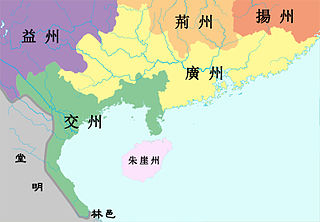
Jiaozhou was an imperial Chinese province under the Han and Jin dynasties. Under the Han, the area included Liangguang and northern Vietnam but Guangdong was later separated to form the province of Guangzhou by Sun Quan following the death of Shi Xie and lasted until the creation of the Annan Protectorate in 679.
Huángfŭ (皇甫), alternatively pronounced Huangpu, is a Chinese compound surname. It's also called as Hwangbo (황보) in Korea and Hoàng Phủ in Vietnam.

The Yi Zhou Shu is a compendium of Chinese historical documents about the Western Zhou period. Its textual history began with a text/compendium known as the Zhou Shu, which was possibly not differentiated from the corpus of the same name in the extant Book of Documents. Western Han dynasty editors listed 70 chapters of the Yi Zhou Shu, of which 59 are extant as texts, and the rest only as chapter titles. Such condition is described for the first time by Wang Shihan in 1669. Circulation ways of the individual chapters before that point are subject to scholarly debates.
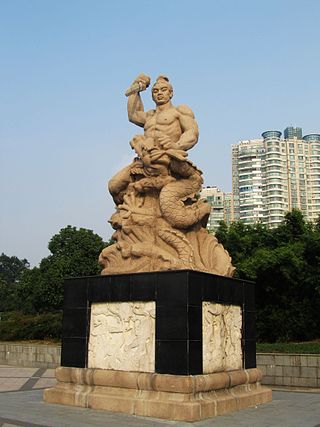
Zhou Chu, courtesy name Ziyin (子隱), was a Western Jin-era Chinese general. He was the son of Zhou Fang, a famous Eastern Wu general. He had a reputation for uprightness and integrity and is the protagonist of a famous Chinese legend, Zhou Chu Chu San Hai (周處除三害) or "Zhou Chu Eradicates the Three Scourges", in which he sought out to kill a tiger and dragon that were terrorizing his hometown. He participated in the campaign against Qi Wannian's Rebellion when he was forced by his superiors to fight the 70,000-strong enemy head-on with 5,000 soldiers and no supply. Zhou Chu died in a valiant last stand and was posthumously honoured by the Western and Eastern Jin courts.
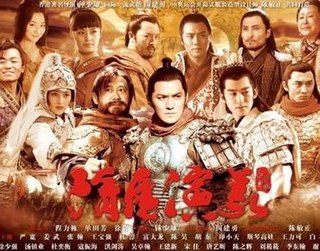
Heroes in Sui and Tang Dynasties is a Chinese television series based on Chu Renhuo's historical novel Sui Tang Yanyi, which romanticises the historical events leading to the fall of the Sui dynasty and the rise of the Tang dynasty. The series was first broadcast in mainland China on various television networks on 14 January 2013. It is not to be confused with Heroes of Sui and Tang Dynasties 1 & 2, a similar television series also based on the novel, but was released earlier in December 2012. Filming for the series started on 5 November 2011 at the Hengdian World Studios and wrapped up in May 2012.

The Wang clan of Langya was a Chinese clan which gained political prominence during the Han dynasty and became one of the most powerful non-imperial clans during the Eastern Jin period.

Tongtianguanfu is a form of court attire in hanfu which was worn by the emperor during the Song dynasty on very important occasions, such as grand court sessions and during major title-granting ceremonies. The attire traces its origin from the Han dynasty.It was also worn in the Jin dynasty emperors when the apparel system of the Song dynasty was imitated and formed their own carriages and apparel system, and in the Ming dynasty. The tongtianguanfu was composed of a red outer robe, a white inner robe, a bixi, and a guan called tongtianguan, and a neck accessory called fangxin quling.
