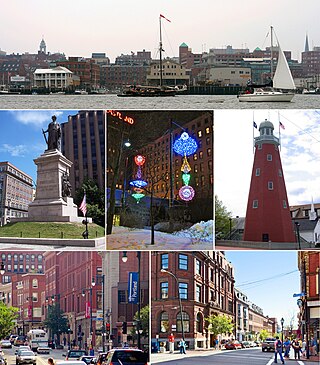
Portland is a port city and the most populous city in the U.S. state of Maine and the seat of Cumberland County. Portland's population was 68,408 in April 2020. The Greater Portland metropolitan area is home to over half a million people, the 104th-largest metropolitan area in the United States. Portland's economy relies mostly on the service sector and tourism. The Old Port is known for its nightlife and 19th-century architecture. The marine industry plays an important role in the city's economy, with an active waterfront that supports fishing and commercial shipping. The Port of Portland is the second-largest tonnage seaport in New England.

The railroad history of Portland, Maine, began in 1842 with the arrival of the Portland, Saco & Portsmouth Railway (PS&P). Most of the rail activity in Portland revolved around agricultural goods bound for export and import freight from Europe. Yet Maine's largest city also enjoyed 125 years of continuous passenger rail service, from 1842 until 1967, and Amtrak began serving the city in 2001. For most of Portland's history, passenger train schedules were designed with intercity travel rather than daily commuting in mind; passenger activities were mostly confined to intercity travel from Portland to Boston, Montreal, Nova Scotia, and points west.
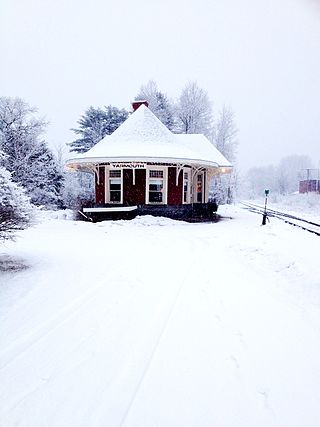
Yarmouth station of Yarmouth, Maine, is located on the east side of the railroad tracks, just south of Maine State Route 115, the town's Main Street. The railroad station was built in 1906 by the Grand Trunk Railroad, and is a well-preserved example of an early 20th-century passenger rail depot, an increasingly rare sight in the state. The building, which is now in commercial use, was added to the National Register of Historic Places on July 10, 1979.
Portland, Maine, is home to many neighborhoods.
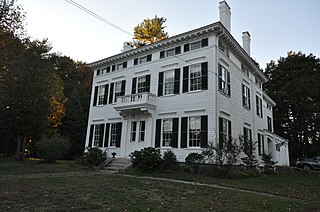
The Captain Reuben Merrill House is an historic house at 233 West Main Street in Yarmouth, Maine. Built in 1858, it is one of the town's largest and most elaborate 19th-century houses, and is one of three known surviving works of Portland architect Thomas J. Sparrow. It was placed on the National Register of Historic Places in 1974. It is now home to Maine Preservation, a statewide architectural preservation organization.

Yarmouth is a town in Cumberland County, Maine, United States, twelve miles north of the state's largest city, Portland. When originally settled in 1636, as North Yarmouth, it was part of the Massachusetts Bay Colony, and remained part of its subsequent incarnations for 213 years. In 1849, twenty-nine years after Maine's admittance to the Union as the twenty-third state, it was incorporated as the Town of Yarmouth.

The Captain S. C. Blanchard House is an historic house at 317 Main Street in Yarmouth, Maine. Built in 1855, it is one of Yarmouth's finest examples of Italianate architecture. It was built for Sylvanus Blanchard, a ship's captain and shipyard owner. The house was listed on the National Register of Historic Places in 1979. The building is now home to the 317 Main Community Music Center.
The historical buildings and structures of Yarmouth, Maine, represent a variety of building styles and usages, largely based on its past as home to almost sixty mills over a period of roughly 250 years. These mills include that of grain, lumber, pulp and cotton. Additionally, almost three hundred vessels were launched by Yarmouth's shipyards in the century between 1790 and 1890, and the homes of master shipwrights and ship captains can still be found throughout the town.

William Hutchinson Rowe was an American author and historian who lived in Yarmouth, Maine. The town's elementary school, built the year he died, is now named for him. In 1937, he published Ancient North Yarmouth and Yarmouth, Maine 1636–1936: A History, covering three centuries of the town's past. As of the early 21st century, it was still in print.
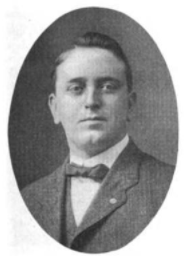
Frank William Bucknam was an American pharmacist from Yarmouth, Maine. He was appointed Maine's Commissioner of Pharmacy in 1906, and was a delegate to the United States Pharmacopeial Convention in Washington, D.C., on several occasions.
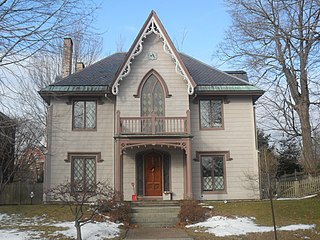
Henry Rowe was an Irish architect who practiced in nineteenth-century Massachusetts, New York and Maine. One of his most noted designs is The Gothic House, in the Spring Street Historic District of Portland, Maine, which was built in 1845. It is believed to be Rowe's first commission in the state, and is described in city promotional materials as the finest example of Gothic Revival architecture in Maine.
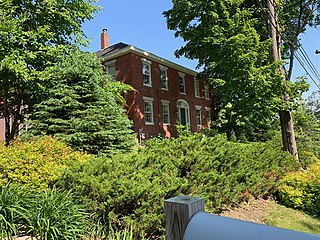
Pleasant Street is a historic street in Yarmouth, Maine, United States. It was formerly part of the Atlantic Highway, a precursor to U.S. Route 1. It connects to Lafayette Street, part of today's Maine State Route 88, at Pleasant Street’s southern and northern ends. It has existed since at least 1761, which is when a milestone was placed on the street, on the order of Benjamin Franklin, due to its being on the King's Highway, to denote its distance from Boston, Massachusetts. As part of his duties, Franklin conducted inspections of the roads that were used for delivering mail. One method of charging for mail service was by mileage, so Franklin invented an odometer to measure mileage more accurately. The King's Highway, as a result, morphed into the Post Road.

Main Street is a historic street in Yarmouth, Maine, United States. It is part of the 18-mile-long (29 km) State Route 115 (SR 115), the eastern terminus of which is in Yarmouth at the intersection of Marina Road and Lafayette Street (SR 88), at Yarmouth Harbor in the Lower Falls area. Its western end is a merging with Walnut Hill Road in North Yarmouth, at which point SR 115 continues west.
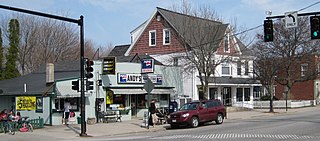
Andy's Handy Store, colloquially known as Handy Andy's, is a historic building in Yarmouth, Maine, United States. Located at 367 Main Street, at its junction with Elm Street in the town's Upper Village, part of the building dates to 1891. It has been the home to over thirty businesses. As of early 2022, Thoroughfare occupies the entire building.
Charles Albert Alexander was an American architect active in the second half of the 19th century. He designed notable buildings in Boston, Portland (Maine), New York City and Chicago.
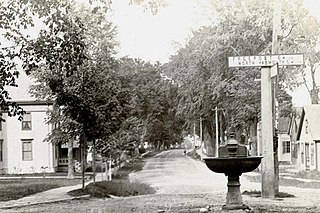
Elm Street is a prominent street in Yarmouth, Maine, United States. It runs for about 2.7 miles (4.3 km) from North Road in the north to Portland Street in the south. The street's addresses are split between "West Elm Street" and "East Elm Street", the transition occurring at Main Street in the Upper Village. Several of its buildings are homes dating to the late 18th and early 19th centuries.

Portland Street is a historic street in Yarmouth, Maine, United States. It runs for about 1.25 miles (2.01 km) from the town's Main Street, State Route 115, in the north to its merge with Middle Road in the south. It is so named because it leads to Portland, the state's largest city, after linking up with State Route 9 in Falmouth, Maine.
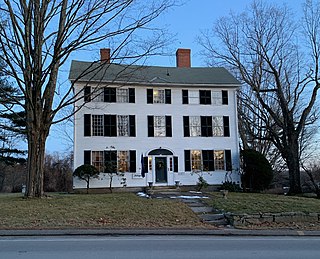
51 East Main Street, also known as the William R. Stockbridge House, is a historic home in Yarmouth, Maine. It was built in 1810, on today's State Route 88, before Yarmouth's secession from North Yarmouth. Its original owner was merchant William Stockbridge.
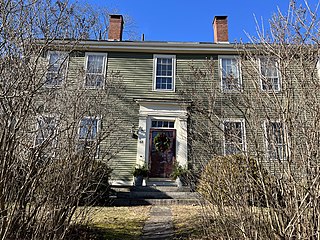
68 East Main Street is a historic home in Yarmouth, Maine, United States. It was built in 1785, when the town was part of North Yarmouth, around seventy years after the "third, and earliest permanent, settlement" of the town.
Ammi Storer was an American merchant. He was prominent in today's Yarmouth, Maine, where a street is now named for him. He also worked in Boston, Massachusetts.

