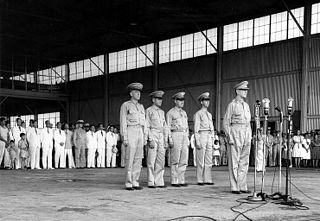
United States Army Forces in the Far East (USAFFE) was a military formation of the United States Army active from 1941 to 1946. The new command's headquarters was created on 26 July 1941, at No. 1, Calle Victoria, Manila, Luzon, the Philippines, with General Douglas MacArthur as commander. The Chief of Staff was Brigadier General Richard K. Sutherland and the Deputy Chief of Staff was Lieutenant Colonel Richard J. Marshall. The core of this command was drawn from the Office of the Military Advisor to the Commonwealth Government of the Philippines.

Philippine Division, or from 1944–1947 the 12th Infantry Division, was the core U.S. infantry division of the United States Army's Philippine Department during World War II.

The Philippines campaign, also known as the Battle of the Philippines or the Fall of the Philippines, was the invasion of the American territory of the Philippines by the Empire of Japan and the defense of the islands by United States and the Philippine Armies during World War II.

The Battle of Bataan was fought by the United States and the Philippine Commonwealth against Imperial Japan during World War II. The battle represented the most intense phase of the Japanese invasion of the Philippines during World War II. In January 1942, forces of the Imperial Japanese Army and Navy invaded Luzon along with several islands in the Philippine Archipelago after the bombing of the American naval base at Pearl Harbor.

The Fourteenth Area Army was a field army of the Imperial Japanese Army (IJA) during World War II. It was originally the 14th Army, formed on November 6, 1941, for the upcoming invasion of the Philippines. It was reorganized in the Philippines on July 28, 1944, when Allied landings were considered imminent. The Fourteenth Area Army was formed by reinforcing and renaming the Fourteenth Army.

The 1st Infantry Division, Philippine Army, nicknamed Tabak Division, is the Philippine Army's primary infantry unit, and specializes in anti-guerrilla warfare. The division has been involved in combating terrorists in Southern Mindanao.

The 2nd Infantry Division, Philippine Army nicknamed Jungle Fighter, is the Philippine Army's primary infantry unit specializing in jungle warfare.

The 21st Infantry Division was one of the 10 reserve division of the Philippine Army mobilized under the United States Army Forces in the Far East (USAFFE). The unit was involved in the delaying action against the Japanese invasion in the plains of Central Luzon, and the Battle of Bataan in 1942.

The 11th Infantry Division was one the reserve division of the Philippine Army that was mobilized in September 1941 under the United States Army Forces in the Far East (USAFFE).

The 71st Infantry Division was a reserve division of the Philippine Army that fought under the United States Army Forces in the Far East (USAFFE). It was known for its fight with Japanese invading forces in Layac Junction, that was ordered to hold until all retreating Fil-American forces of crossed into Bataan Peninsula.
The 102nd Infantry Division was a division of the Philippine Army under the United States Army Forces in the Far East (USAFFE).
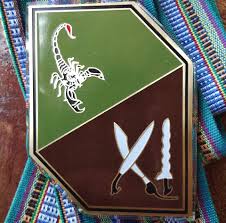
The 11th Infantry Division, Philippine Army, also called the Alakdan Division, is one of the Philippine Army's infantry units in Mindanao. Currently still forming, the Division is expected to complete its equipment and manpower requirements by 2022. It is the youngest of all the infantry divisions of the Army and will have 4,500 troops when fully formed.
The North Luzon Force was a corps-sized grouping of the U.S.-sponsored Philippine Army, defeated in battle against the Japanese in 1941–42.

Luzon Force or Bataan Defense Force is a short-lived Field Army size unit created in the Philippines after the restructure of command organized by General Douglas MacArthur commander of US Army Forces in the Far East (USAFFE). He wished to control the 4 Commands from Australia with its representative in Corregidor Island. Major General Jonathan M. Wainwright IV was selected to command as the senior general officer in Bataan peninsula.
Visayas-Mindanao Force was a military formation created in November 1941 to command all soldiers of US Army, US Philippine Scouts, Philippine Army, and Philippine Constabulary in the southern islands of the Philippines. Colonel William F. Sharp was appointed as commanding general and was promoted to Brigadier General in November 1941 and later Major General. His executive officer was Major Howard Edmands. He was just starting to organize his command and train his soldiers into a fighting unit when the war started on December 7, 1941.
United States Forces in the Philippines (USFIP) is a unified command in the Philippines during World War II. It was the successor to the United States Army Forces in the Far East (USAFFE) which General Douglas MacArthur commanded. He moved to Australia as he evacuated as ordered by President Roosevelt in March 1942. The command only lasted two months as it surrendered by Lieutenant General Jonathan M. Wainwright to Lieutenant General Homma Masaharu commander of 14th Army of the Imperial Japanese Army.
21st Field Artillery Regiment, a unit of the 21st Infantry Division of the Philippine Army under the USAFFE, was mobilized on 18-November-1941, and was in action from December 1941 to 09-April-1942. The Division's area of responsibility covered La Union, Nueva Ecija, Tarlac and Pangasinan.
301st Field Artillery Regiment, is a heavy artillery non-divisional unit of Philippine Commonwealth Army activated in November 1941 to be used as Corps Artillery. It was activated in Camp Del Pilar, Dau, Pampanga. It fought in Battle of Bataan inflicting heavy casualties to Japanese in Abucay-Mauban Line and Orion-Bagac Line.

41st Infantry Regiment, is a unit and formation activated and organization of Philippine Commonwealth Army. It was under 41st Infantry Division under Brigadier General Vicente Lim. It fought in during World War II in the Philippines, and fought valiantly and earned Presidential Unit Citation awarded by President Manuel Quezon.
72nd Infantry Regiment, is a reserve military unit and formation of Philippine Commonwealth Army who fought during World War II in Northern Luzon and in Bataan Peninsula. 72nd Infantry was under 71st Division and was first designated as reserve unit of North Luzon Force under Major General Jonathan M. Wainwright IV, USA that can only be committed if permitted from USAFFE Headquarters.


 Philippines
  United States Army
  Philippine Commonwealth Army