1840s Carrollton Inn

Last updated
1840s Carrollton Inn's Courtyard 1840s Carrollton Inn.jpg
1840s Carrollton Inn's Courtyard

The 1840s Carrollton Inn and Plaza, located in Baltimore, Maryland, consists of two historic buildings and their complementary 1980 additions built to resemble the previous federal style buildings. The oldest of the row house buildings dates back to the late 18th century, and anchors the east side of the block containing the Carroll Mansion, which was not part of the inn, but the winter home of Charles Carroll of Carrollton, signer of the Declaration of Independence. These buildings and others were assembled by the City of Baltimore in the 1980s and became the Baltimore City Life Museums until its closure in 1997 due to financial issues. The 1840s Carrollton Inn opened in July 2007. Each of the 13 boutique rooms has whirlpool baths, fireplaces, and antique furnishings.

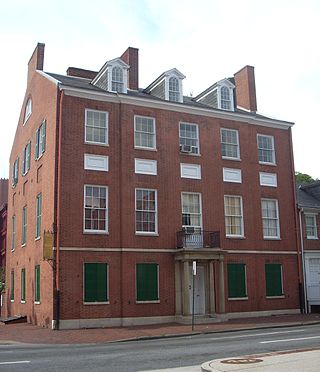
The main entrance to the building is through the historic doorway at 50 Albemarle. The home was bought by John Dalrymple from the heirs of George Davy in 1796 for $3,300 (equivalent to $56,264in 2023). Dalrymple was probably a principal in the construction of the remainder of the buildings on Lombard and Albemarle. Along with James Mosher, he was co-architect and builder of the First Presbyterian Church (1791) at Fayette and Guilford. The three-story brick house retains its Flemish bond brickwork and splayed brick lintels. One mantel is original to the house. A noteworthy feature is the huge fireplace in the basement, which was used for cooking. This building was sold to John Hutchinson, a wheelwright in the 1840s. Grocers and other businesses used the house until the last private owner, renting to a variety store, closed shop in 1983. After renovation by the Baltimore City Life Museums, the Hutchinson family's life was portrayed as living history during public programs, and through museum tours of what was known as "1840 House." The adjoining 1860 smaller house to the west features six over six wood windows and shuttered first-floor windows set in segmented arches and was also used for living history on the first floor.

Though the remaining buildings were demolished by the City Life Museums for public safety, the architects chose to construct buildings close to the originals in exterior appearance. The new addition adjacent to the Carroll Mansion closely resembled an early 1900 photograph and housed the Center for Urban Archaeology. The three buildings on Albemarle damaged by fire and demolished were rebuilt and housed the “Courtyard Gallery” and the museum offices.

In 1996, the Fava building, on the north side of the courtyard, was opened as the Morton K. Blaustein City Life Exhibition Center. Four floors of exhibits and galleries illustrated Baltimore's distinct history and culture over three centuries. Its signature feature was the reuse of the cast iron façade of the 1869 G. Fava Fruit Company. Over 100 cast-iron buildings existed in Baltimore before the Fire of 1904. Today, less than 12 remain. The Fava façade, Baltimore's largest, stood until 1976, when it was condemned to make way for the Convention Center. Its reuse in the Blaustein City Life Exhibition Center won numerous awards.

The buildings were retained as city property until 2003, when the space was bought by the Pomykala family, who combined the row homes into the 1840s Carrollton Inn and created the 1840s Plaza. The Pomykala Family turned the Fava Building's top floor into an event space with panoramic views of Baltimore and called it The Ballroom. They rented the three first floors to a local restaurateur, who opened Gardel's Restaurant and Supper Club. Gardel's was noted for Latin dancing and night life in the after hours. Its closure allowed the Pomykala family to remodel their three other levels within the Fava Building into distinct event spaces. Since that time, the 1840s Plaza has been the scene of numerous weddings, parties and conferences.

The gated courtyard gardens on the lower level create a promenade between the Fava Building and the Carroll Mansion. Designed to give a hint of the past, they include boxwood, flowers of the Carroll period, and a herb garden. Underneath the brick, where Charles Carroll of Carrollton's stable was sited, is a hypocaust. This, perhaps, was used to keep the water warm for the horses in the cold winters. The upper courtyard with its tall flowering trees and boxwood is enclosed by the 1840s Carrollton Inn.

In 2001, all of these buildings were added to the Baltimore City Landmark list as an expansion of the Carroll Mansion Landmark designation.
Related Research Articles

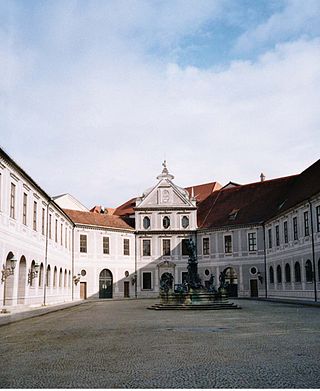
<span class="mw-page-title-main">Courtyard</span> Enclosed area, often by a building, that is open to the sky

A courtyard or court is a circumscribed area, often surrounded by a building or complex, that is open to the sky.

<span class="mw-page-title-main">Charles Carroll (barrister)</span> American politician (1723-1783)

Charles Carroll was an American statesman from Annapolis, Maryland. He was the builder of the Baltimore Colonial home Mount Clare (1760), and a delegate to the Second Continental Congress in 1776 and 1777.

<span class="mw-page-title-main">Doughoregan Manor</span> Historic house in Maryland, United States

Doughoregan Manor is a plantation house and estate located on Manor Lane west of Ellicott City, Maryland, United States. Established in the early 18th century as the seat of Maryland's prominent Carroll family, it was home to Founding Father Charles Carroll, a signer of the United States Declaration of Independence, during the late 18th century. A portion of the estate, including the main house, was designated a National Historic Landmark on November 11, 1971. It remains in the Carroll family and is not open to the public.

<span class="mw-page-title-main">Phoenix Shot Tower</span> United States historic place

The Phoenix Shot Tower, also known as the Old Baltimore Shot Tower, is a red brick shot tower, 234.25 feet (71.40 m) tall, located near the downtown, Jonestown, and Little Italy communities of East Baltimore, in Maryland. When it was completed in 1828 it was the tallest structure in the United States.

<span class="mw-page-title-main">Pigtown, Baltimore</span> Neighborhood in southwest Baltimore

Pigtown is a neighborhood in the southwest area of Baltimore, bordered by Martin Luther King Jr. Boulevard to the east, Monroe Street to the west, Russell Street to the south, and West Pratt Street to the north. The neighborhood acquired its name during the second half of the 19th century, when the area was the site of butcher shops and meat packing plants to process pigs transported from the Midwest on the B&O Railroad; they were herded across Ostend and Cross Streets to be slaughtered and processed.

<span class="mw-page-title-main">Union Square, Baltimore</span> United States historic place

Union Square is a neighborhood located in the Sowebo area of Baltimore. It dates to the 1830s and includes a historic district of houses and commerce buildings.

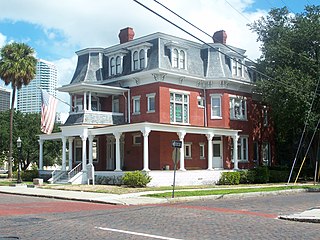
<span class="mw-page-title-main">Hutchinson House (Tampa, Florida)</span> Historic house in Florida, United States

The Hutchinson House is a historic home completed in 1908 in Tampa, Florida, United States. It is a three-story brick building in the Second Empire architecture. The building includes a high mansard roof and large porch with tall Corinthian columns.

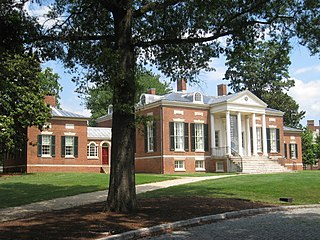
<span class="mw-page-title-main">Homewood Museum</span> Museum in Baltimore, Maryland, United States

The Homewood Museum is a historical museum located on the Johns Hopkins University campus in Baltimore, Maryland. It was listed as a National Historic Landmark in 1971, noted as a family home of Maryland's Carroll family. It, along with Evergreen Museum & Library, make up the Johns Hopkins University Museums.

Gramercy Mansion is a historic mansion in Stevenson, Maryland, United States, located on Greenspring Valley Road near Stevenson University. It was built in 1902 by Alexander J. Cassatt, president of the Pennsylvania Railroad and brother of the American Impressionist painter, Mary Cassatt. Gramercy Mansion was presented as a wedding gift to Cassatt's daughter, Eliza. Later owners included the prominent Brewster family, one of whom became a senator from Maryland. In the 1950s the estate became home to the Koinonia Foundation, a predecessor of the Peace Corps. Koinonia established the first organic farm in Maryland, which has been continuously operated since 1950.

<span class="mw-page-title-main">Carroll Mansion</span> Historic house in Maryland, United States

The Carroll Mansion is a historic building and museum located in Baltimore, Maryland.

<span class="mw-page-title-main">Boxwood Hall</span> Historic house in New Jersey, United States

Boxwood Hall State Historic Site, located at 1073 East Jersey Street in Elizabeth, New Jersey, is a historic house museum operated by the state of New Jersey. Boxwood Hall was built about 1750, and is a National Historic Landmark for its association with Founding Father Elias Boudinot (1740-1821), who lived here from 1772 to 1795. Boudinot, a lawyer, politician, and diplomat, was president of the Continental Congress 1782–83.

<span class="mw-page-title-main">Mount Clare (Maryland)</span> Historic house in Maryland, United States

Mount Clare, also known as Mount Clare Mansion and generally known today as the Mount Clare Museum House, is the oldest Colonial-era structure in the City of Baltimore, Maryland, U.S.A. The Georgian style of architecture plantation house exhibits a somewhat altered five-part plan. It was built on a Carroll family plantation beginning in 1763 by barrister Charles Carroll the Barrister, (1723–1783), a descendant of the last Gaelic Lords of Éile in Ireland and a distant relative of the much better-known Charles Carroll of Carrollton, (1737–1832), longest living signer of the Declaration of Independence and the richest man in America in his later years, also the layer of the First Stone of the new Baltimore and Ohio Railroad, just a short distance away in 1828.

<span class="mw-page-title-main">Shrine of St. Anthony (Maryland)</span> Franciscan shrine in Ellicott City, Maryland

The Shrine of St. Anthony is a Roman Catholic shrine honoring St. Anthony of Padua. The shrine is located within the St. Joseph Cupertino Friary in Ellicott City, Maryland, USA. The shrine is a ministry of the Conventual Franciscan Friars, Our Lady of the Angels Province, USA.

<span class="mw-page-title-main">Rose Hill Manor</span> Historic house in Maryland, United States

Rose Hill Manor, now known as Rose Hill Manor Park & Children's Museum, is a historic home located at Frederick, Frederick County, Maryland. It is a 2+12-story brick house. A notable feature is the large two-story pedimented portico supported by fluted Doric columns on the first floor and Ionic columns on the balustraded second floor. It was the retirement home of Thomas Johnson (1732–1819), the first elected governor of the State of Maryland and Associate Justice of the United States Supreme Court. It was built in the mid-1790s by his daughter and son-in-law.

The Baltimore City Heritage Walk is a heritage trail that links 20 historic sites and museums in downtown Baltimore, Maryland.

Lakeland is a neighborhood in south Baltimore, Maryland. Its borders are Annapolis Road on the east, the Baltimore city/county line to the south, a CSX/MARC Railroad line to the west, and the same railroad line to the north.

<span class="mw-page-title-main">Mirador (Greenwood, Virginia)</span> Historic house in Virginia, United States

Mirador is a historic home located near Greenwood, Albemarle County, Virginia. It was built in 1842 for James M. Bowen (1793–1880), and is a two-story, brick structure on a raised basement in the Federal style. It has a deck-on-hip roof capped by a Chinese Chippendale railing. The front facade features a portico with paired Tuscan order columns. The house was renovated in the 1920s by noted New York architect William Adams Delano (1874–1960), who transformed the house into a Georgian Revival mansion.

<span class="mw-page-title-main">Crossroads Tavern (Crossroads, Virginia)</span> Historic commercial building in Virginia, United States

Crossroads Tavern, also known as Crossroads Inn, is a historic inn and tavern located at North Garden, Albemarle County, Virginia. It was built about 1820. In the mid nineteenth century, Clifton G. Sutherland, son of Joseph Sutherland, owned and ran the tavern which was located on the Staunton and James River Turnpike. It served as a tavern and overnight lodging for farmers and travelers using the turnpike. In 1889, Daniel B. Landes bought the land at the public auction of the estate of Clifton Sutherland. The property continued to be conveyed to various owners over the years. The Crossroads Tavern is an early nineteenth century two- to three-story, three-bay, double pile brick structure. The building sits on top of a brick and stone foundation, is roofed with tin and has pairs of interior brick chimneys on either gable end. The brick is laid in five course American bond with Flemish variant. Windows on the basement level at the rear of the house are barred; other basement windows are nine-over-six sash. Put-holes are found at the west end of the building, formerly providing sockets for scaffold boards should repairs be necessary. The front facade is dominated by a porch on the second story extending the entire width of the south and east facades. It is supported by five rounded brick columns and the tin roof above is supported by simple square wooden pillars connected by horizontal rails. Doors of the front of the basement level open respectively into kitchen and dining room and into a spirits cellar with its original barrel racks as well as a laundry fireplace. Floors on this level were originally dirt but dining room and kitchen floors have been cemented. The main entrance door on the second level, with its multi-panes lights, opens onto a central stair hall with two main rooms on either side. This stair hall has an ascending stair at its front and both ascending and descending stairs toward its center. Formerly the ascending stairs led to upstairs areas which did not connect. There is no ridge pole in the three attic rooms. The interiors of windows and doors on the main entrance side have extremely long wooden lintels. With few exceptions, the interior woodwork is original, including floors, chair rails, mantels and built in cupboards. Also on the property is a two-story contributing summer kitchen, brick up to the second story and frame above, and with an exterior brick chimney at the rear gable with fireplaces on both floors. It is operated as a bed and breakfast.

<span class="mw-page-title-main">Samson's Cottage wall remains</span> Historic site in New South Wales, Australia

Samson's Cottage wall remains is a heritage-listed former residence and now retail building located at 8 Kendall Lane, in the inner city Sydney suburb of The Rocks in the City of Sydney local government area of New South Wales, Australia. It was built for William Samson in 1844. It is also known as Samson's Cottage (wall remains) and Puppet Cottage (Samsons). The property is owned by Property NSW, an agency of the Government of New South Wales. It was added to the New South Wales State Heritage Register on 10 May 2002.

References

39°17′19.2″N76°36′14.6″W / 39.288667°N 76.604056°W / 39.288667; -76.604056