Related Research Articles
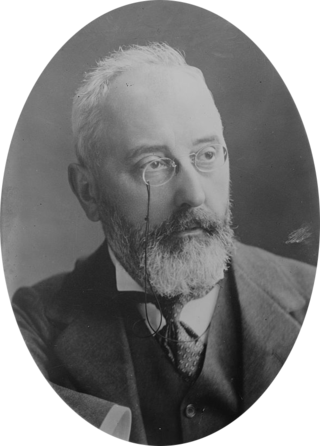
Timothy Michael Healy, KC was an Irish nationalist politician, journalist, author, barrister and a controversial Irish Member of Parliament (MP) in the House of Commons of the United Kingdom of Great Britain and Ireland. His political career began in the 1880s under Charles Stewart Parnell's leadership of the Irish Parliamentary Party (IPP) and continued into the 1920s, when he was the first governor-general of the Irish Free State.

Irish nationalism is a nationalist political movement which, in its broadest sense, asserts that the people of Ireland should govern Ireland as a sovereign state. Since the mid-19th century, Irish nationalism has largely taken the form of cultural nationalism based on the principles of national self-determination and popular sovereignty. Irish nationalists during the 18th, 19th, and 20th centuries such as the United Irishmen in the 1790s, Young Irelanders in the 1840s, the Fenian Brotherhood during the 1880s, Fianna Fáil in the 1920s, and Sinn Féin styled themselves in various ways after French left-wing radicalism and republicanism. Irish nationalism celebrates the culture of Ireland, especially the Irish language, literature, music, and sports. It grew more potent during the period in which all of Ireland was part of the United Kingdom, which led to most of the island gaining independence from the UK in 1922.
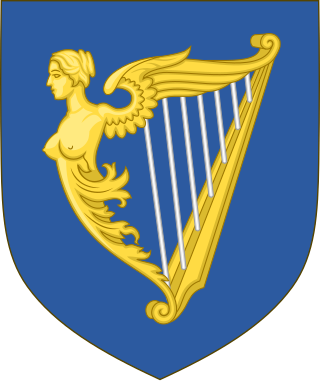
The Irish Parliamentary Party was formed in 1874 by Isaac Butt, the leader of the Nationalist Party, replacing the Home Rule League, as official parliamentary party for Irish nationalist Members of Parliament (MPs) elected to the House of Commons at Westminster within the United Kingdom of Great Britain and Ireland up until 1918. Its central objectives were legislative independence for Ireland and land reform. Its constitutional movement was instrumental in laying the groundwork for Irish self-government through three Irish Home Rule bills.

William O'Brien was an Irish nationalist, journalist, agrarian agitator, social revolutionary, politician, party leader, newspaper publisher, author and Member of Parliament (MP) in the House of Commons of the United Kingdom of Great Britain and Ireland. He was particularly associated with the campaigns for land reform in Ireland during the late 19th and early 20th centuries as well as his conciliatory approach to attaining Irish Home Rule.
Events from the year 1897 in Ireland.
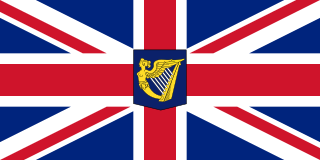
Ireland was part of the United Kingdom from 1801 to 1922. For almost all of this period, the island was governed by the UK Parliament in London through its Dublin Castle administration in Ireland. Ireland underwent considerable difficulties in the 19th century, especially the Great Famine of the 1840s which started a population decline that continued for almost a century. The late 19th and early 20th centuries saw a vigorous campaign for Irish Home Rule. While legislation enabling Irish Home Rule was eventually passed, militant and armed opposition from Irish unionists, particularly in Ulster, opposed it. Proclamation was shelved for the duration following the outbreak of World War I. By 1918, however, moderate Irish nationalism had been eclipsed by militant republican separatism. In 1919, war broke out between republican separatists and British Government forces. Subsequent negotiations between Sinn Féin, the major Irish party, and the UK government led to the signing of the Anglo-Irish Treaty, which resulted in five-sixths of the island seceding from the United Kingdom, becoming the Irish Free State, with only the six northeastern counties remaining within the United Kingdom.

Daniel Desmond Sheehan, usually known as D. D. Sheehan was an Irish nationalist, politician, labour leader, journalist, barrister and author. He served as Member of Parliament (MP) in the House of Commons of the United Kingdom of Great Britain and Ireland representing Mid-Cork from 1901 to 1918, a constituency comprising the districts of Ahadallane, Ballincollig, Ballyvourney, Blarney, Coachford, Farran, Inchigeelagh, Macroom, Millstreet and Shandangan. As co-founder and President of the Irish Land and Labour Association, he was credited with considerable success in land reform, labour reforms and in rural state housing. From 1909, he was General Secretary of the Central Executive of the All-for-Ireland League, favouring a policy of National reconciliation between all creeds and classes in Ireland. During World War I he served as Irish regiments officer with the 16th (Irish) Division in France, 1915–16. He resigned his parliamentary seat in 1918 and lived in England for several years, returning to Dublin following the ending of the civil war, when he was appointed editor of the Dublin Chronicle.

The All-for-Ireland League (AFIL) was an Irish, Munster-based political party (1909–1918). Founded by William O'Brien MP, it generated a new national movement to achieve agreement between the different parties concerned on the historically difficult aim of Home Rule for the whole of Ireland. The AFIL established itself as a separate non-sectarian party in the House of Commons of the United Kingdom of Great Britain and Ireland, binding a group of independent nationalists MPs to pursue a broader concept of Irish nationalism, a consensus of political brotherhood and reconciliation among all Irishmen, primarily to win Unionist consent to an All-Ireland parliamentary settlement.
Sinn Féin is the name of an Irish political party founded in 1905 by Arthur Griffith. It became a focus for various forms of Irish nationalism, especially Irish republicanism. After the Easter Rising in 1916, it grew in membership, with a reorganisation at its Ard Fheis in 1917. Its split in 1922 in response to the Anglo-Irish Treaty which led to the Irish Civil War and saw the origins of Fianna Fáil and Fine Gael, the two parties which have since dominated Irish politics. Another split in the remaining Sinn Féin organisation in the early years of the Troubles in 1970 led to the Sinn Féin of today, which is a republican, left-wing nationalist and secular party.
Cork City was a parliamentary constituency in Ireland, represented in the Parliament of the United Kingdom. From 1880 to 1922 it returned two members of parliament (MPs) to the House of Commons of the United Kingdom of Great Britain and Ireland. From 1922 it was not represented in the UK Parliament, as it was no longer in the UK.
Events from the year 1881 in Ireland.

The Irish Land and Labour Association (ILLA) was a progressive movement founded in the early 1890s in Munster, Ireland, to organise and pursue political agitation for small tenant farmers' and rural labourers' rights. Its branches also spread into Connacht. The ILLA was known under different names—Land and Labour Association (LLA) or League (LLL). Its branches were active for almost thirty years, and had considerable success in propagating labour ideals before their traditions became the basis for the new labour and trade unions movements, with which they gradually amalgamated.
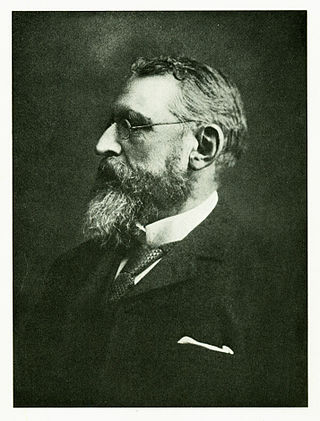
The United Irish League (UIL) was a nationalist political party in Ireland, launched 23 January 1898 with the motto "The Land for the People". Its objective to be achieved through agrarian agitation and land reform, compelling larger grazier farmers to surrender their lands for redistribution among the small tenant farmers. Founded and initiated at Westport, County Mayo by William O'Brien, it was supported by Michael Davitt MP, John Dillon MP, who worded its constitution, Timothy Harrington MP, John O'Connor Power MP and the Catholic clergy of the district. By 1900 it had expanded to be represented by 462 branches in twenty-five counties.
Eugene Crean (1854–1939) was an Irish nationalist politician and MP in the House of Commons of the United Kingdom of Great Britain and Ireland and member of the Irish Parliamentary Party 1892–1910, for the All-for Ireland Party 1910–1918.
Independent Nationalist is a political title frequently used by Irish nationalists when contesting elections to the House of Commons of the United Kingdom Great Britain and Ireland not as members of the Irish Parliamentary Party, in the late nineteenth and early twentieth centuries.

William Mackey Lomasney was a member of the Fenian Brotherhood and the Clan na Gael who, during the Fenian dynamite campaign organized by Jeremiah O'Donovan Rossa, was killed in a failed attempt to dynamite London Bridge.
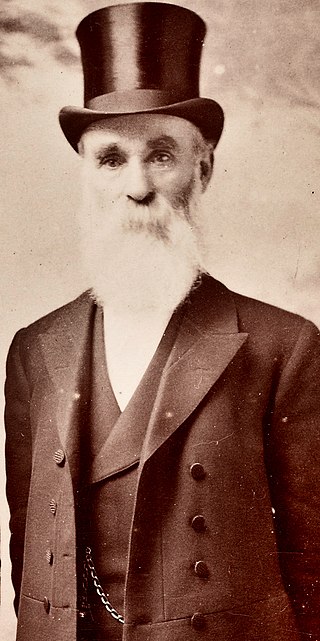
James Francis XavierO'Brien was an Irish nationalist Fenian revolutionary in the 1860s. He was later elected to the House of Commons of the United Kingdom of Great Britain and Ireland, as a Member of Parliament (MP) in the Irish Parliamentary Party.
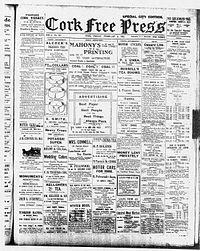
The Cork Free Press was a nationalist newspaper in Ireland, which circulated primarily in the Munster region surrounding its base in Cork, and was the newspaper of the dissident All-for-Ireland League party (1909–1918). Published daily from June 1910 until 1915, and weekly in 1915–16, it was the third of three newspapers founded and published within a decade by William O'Brien MP. It developed a unique approach to the national question and to the social issues of the day, with a pronounced conciliatory view to achieving Home Rule for the whole of Ireland. It displayed a favourable attitude towards the Sinn Féin movement. Its main rival newspapers were the Cork Examiner and the Freeman's Journal.

The word Fenian served as an umbrella term for the Irish Republican Brotherhood (IRB) and their affiliate in the United States, the Fenian Brotherhood. They were secret political organisations in the late 19th and early 20th centuries dedicated to the establishment of an independent Irish Republic. In 1867, they sought to coordinate raids into Canada from the United States with a rising in Ireland. In the 1916 Easter Rising and the 1919–1921 Irish War of Independence, the IRB led the republican struggle.
References
- ↑ MacDonagh, Michael. The Life of William O'Brien, the Irish Nationalist: A Biographical Study of Irish Nationalism. London: E. Benn Ltd., 1928.
- ↑ Beu, Paul. Conflict and Conciliation in Ireland, 1890-1910: Parnellites and Radical Agrarians. New York: Oxford University Press, 1987. ISBN 0-19-822758-2
- ↑ Wheatley, Michael. Nationalism and the Irish Party: Provincial Ireland, 1910-1916. New York: Oxford University Press, 2005. ISBN 0-19-927357-X
- ↑ Luddy, Maria. Women in Ireland, 1800-1918: a Documentary History. Cork: Cork University Press, 1995. ISBN 1-85918-038-8