
Uruguay, officially the Oriental Republic of Uruguay, is a country in South America. It shares borders with Argentina to its west and southwest and Brazil to its north and northeast, while bordering the Río de la Plata to the south and the Atlantic Ocean to the southeast. It is part of the Southern Cone region of South America. Uruguay covers an area of approximately 176,215 square kilometres (68,037 sq mi). It has a population of around 3.4 million, of whom nearly 2 million live in the metropolitan area of its capital and largest city, Montevideo.
The history of Uruguay comprises different periods: the pre-Columbian time or early history, the Colonial Period (1516–1811), the Period of Nation-Building (1811–1830), and the history of Uruguay as an independent country (1830–present).

The National Party also known as the White Party, is a major political party in Uruguay. Founded in 1836 by General Manuel Oribe, it is the country's oldest active political party, and along with the Colorado Party, its origin dates back to the establishment of Uruguay as an independent state.

The Río Negro is a river in southern Brazil and central Uruguay. It rises in the southern highlands of Brazil, just east of Bagé, and flows west across the entire width of Uruguay to the Uruguay River. The course of the Río Negro across Uruguay effectively divides the south and the north of the country. The Río Negro's principal tributaries are Yí River and Tacuarembó River.
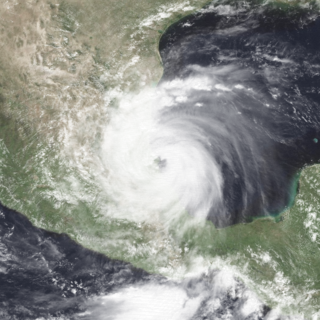
Hurricane Gert was a large and deadly tropical cyclone that caused extensive flooding and mudslides throughout Central America and Mexico in September 1993. The seventh named storm and third hurricane of the annual hurricane season, Gert originated as a tropical depression from a tropical wave over the southwestern Caribbean Sea on September 14. The next day, the cyclone briefly attained tropical storm strength before moving ashore in Nicaragua and proceeding through Honduras. It reorganized into a tropical storm over the Gulf of Honduras on September 17, but weakened back to a depression upon crossing the Yucatán Peninsula. Once over the warm waters of the Bay of Campeche, Gert quickly strengthened into a Category 2 hurricane by September 20. The hurricane made a final landfall on the Gulf Coast of Mexico near Tuxpan, Veracruz, with peak winds of 100 mph (160 km/h). The rugged terrain disrupted the cyclone's structure; Gert entered the Pacific Ocean as a depression near the state of Nayarit on September 21, where it briefly redeveloped a few strong thunderstorms before dissipating at sea five days later.
Uruguay is the only country in Latin America that has achieved quasi-universal coverage of access to safe drinking water supply and adequate sanitation. Water service quality is considered good, with practically all localities in Uruguay receiving disinfected water on a continuous basis. 70% of wastewater collected by the national utility was treated. Given these achievements, the government's priority is to improve the efficiency of services and to expand access to sewerage, where appropriate, in areas where on-site sanitation is used.
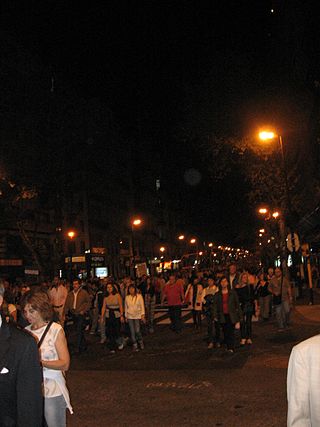
The 18A was an Argentine cacerolazo that took place on April 18, 2013. Attended by nearly two million people, it was the largest demonstration at the time against the president Cristina Fernández de Kirchner.
Calacoto or Qala Qutu is the third municipal section of the Pacajes Province in the La Paz Department, Bolivia. Its seat is Calacoto.
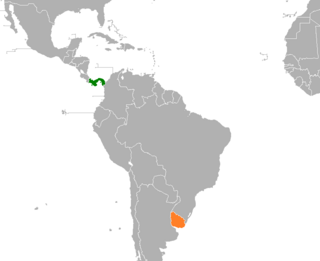
Panama – Uruguay relations are bilateral relations between Panama and Uruguay. Both countries are members of the Organization of American States.

The Rincón del BoneteLake is the largest body of fresh water in Uruguay. It is located in the middle of the country in the south part of Tacuarembó Department with a small part of it reaching into the north part of Durazno Department.

Cuba–Uruguay relations refers to the diplomatic relations between the Republic of Cuba and the Oriental Republic of Uruguay. Both nations are members of the Community of Latin American and Caribbean States, Group of 77, Organization of Ibero-American States and the United Nations.

Guarenas-Guatire conurbation or Guarenas-Guatire metropolitan area , also known as El Nuevo Este de Caracas, is a conurbation area in Miranda, Venezuela, that includes 2 municipalities, it is part of the Greater Caracas Area. It has a population of approximately 488,000 inhabitants.
Benjamín Nahum is a Uruguayan historian, professor, and researcher.

The Itaya River is a tributary of the Amazon River via the Nanay River in northern Peru. The Itaya flows alongside the city of Iquitos and the district of Belén.

Tropical Depression Nineteen-E was a weak yet costly tropical cyclone that caused significant flooding throughout Northwestern Mexico and several states within the United States in September 2018. The storm was also the first known tropical cyclone to form over the Gulf of California. Nineteen-E originated from a tropical wave that left the west coast of Africa on August 29 to 30. It continued westward, crossed over Central America, and entered the northeastern Pacific Ocean by September 7. It then meandered to the southwest of Mexico for the next several days as it interacted with a mid-to-upper level trough. The National Hurricane Center (NHC) continued to track the disturbance for the next several days as it traveled northward. A surface trough developed over the Baja California peninsula on September 18. Despite disorganization and having close proximity to land, the disturbance developed into a tropical depression in the Gulf of California on September 19, after having developed a circulation center and more concentrated convection. The system peaked with maximum sustained winds of 35 mph (55 km/h) and a minimum central pressure of 1002 mbar.
The COVID-19 pandemic in Uruguay has resulted in 1,042,609 confirmed cases of COVID-19 and 7,694 deaths.

Tropical Storm Hernan was a short-lived tropical cyclone that brought widespread flooding and destructive mudslides to southwestern Mexico in late August 2020. Hernan was the thirteenth tropical cyclone and eighth named storm of the 2020 Pacific hurricane season. The system developed from a low-pressure area to the southwest of Mexico on August 26, as a low-end tropical storm. Moving generally northward and paralleling the west coast of Mexico, Hernan was hindered by a high wind shear environment and only slightly strengthened. The cyclone achieved its peak intensity around 06:00 UTC on August 27 with maximum sustained winds of 70 km/h (45 mph) and a minimum barometric pressure of 1,001 mbar (29.6 inHg). Passing just offshore of the state of Jalisco, Hernan turned west and degenerated to a remnant low on August 28. The low passed near the southern tip of the Baja California Peninsula later that day and dissipated shortly thereafter.
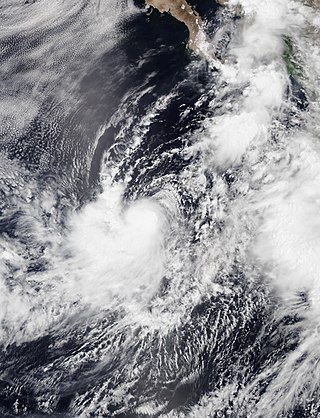
Tropical Storm Ivo was a tropical cyclone that brought heavy rainfall to five states in Mexico, causing severe flooding during August 2019. The tenth tropical cyclone and ninth named storm of the 2019 Pacific hurricane season, Ivo arose from a low-pressure area that spawned south of Guatemala on August 16. The low-pressure system gradually organized over the next several days as it tracked west-northwestward. The system coalesced into a tropical depression early on August 21 and strengthened into Tropical Storm Ivo several hours later. Located within a favorable environment of moist air and warm sea surface temperatures, the cyclone quickly intensified, peaking the next day with 1-minute maximum sustained winds of 70 mph (110 km/h) and a pressure of 990 mbar (29.23 inHg). Increasing wind shear caused the storm's intensification to level off later that day, as the system turned towards the north-northwest. Ivo passed by Clarion Island midday on August 23, generating winds of 60 mph (100 km/h) on the island. Wind shear caused Ivo to significantly degrade in structure and intensity during the next couple of days. Cold sea surface temperatures, as well as dry and stable air, caused the cyclone to degenerate into a remnant low early on August 25. The low meandered over the eastern Pacific before opening up into a trough of low pressure early on August 27.

The 1962 Vallès floods took place on 25 September 1962, mainly in the comarca of Vallès Occidental and to a less extent in Vallès Oriental and Barcelonès. The flood was caused by a cold drop with heavy rain, overflowing the Llobregat and Besòs rivers. The official death toll was 617, but estimates imply between 800 and 1000 deaths.


