Related Research Articles

Cesare Zavattini was an Italian screenwriter and one of the first theorists and proponents of the Neorealist movement in Italian cinema.

Erich Oswald Hans Carl Maria von Stroheim was an Austrian-American director, screenwriter, actor, and producer, most noted as a film star and avant-garde, visionary director of the silent era. His 1924 film Greed is considered one of the finest and most important films ever made. After clashes with Hollywood studio bosses over budget and workers' rights problems, Stroheim found it difficult to find work as a director and subsequently became a well-respected character actor, particularly in French cinema.
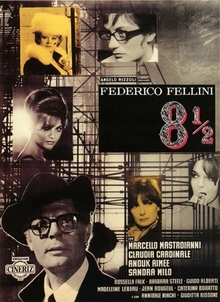
8½ is a 1963 comedy drama film co-written and directed by Federico Fellini. The metafictional narrative centers on Guido Anselmi, a famous Italian film director who suffers from stifled creativity as he attempts to direct an epic science fiction film. Claudia Cardinale, Anouk Aimée, Sandra Milo, Rossella Falk, Barbara Steele, and Eddra Gale portray the various women in Guido's life. The film was shot in black and white by cinematographer Gianni Di Venanzo and features a score by Nino Rota, with costume and set designs by Piero Gherardi.

Sympathy for the Devil is a 1968 avant-garde film shot mostly in color by director Jean-Luc Godard, his first British made, English language film. It is a composite film, juxtaposing documentary, fictional scenes and dramatised political readings. It is most notable for its scenes documenting the creative evolution of the song "Sympathy for the Devil" as the Rolling Stones developed it during recording sessions at Olympic Studios in London.

Telefoni Bianchi films, also called deco films, were made by the Italian film industry in the 1930s and the 1940s in imitation of American comedies of the time in a sharp contrast to the other important style of the era, calligrafismo, which was highly artistic. The cinema of Telefoni Bianchi was born from the success of the Italian film comedy of the early 1930s; it was a lighter version, cleansed of any intellectualism or veiled social criticism.

The Moon in the Gutter is a 1983 French drama film directed by Jean-Jacques Beineix. It was entered into the 1983 Cannes Film Festival.

Mario Soldati was an Italian writer and film director. In 1954, he won the Strega Prize for Lettere da Capri. He directed several works adapted from novels, and worked with leading Italian actresses, such as Sophia Loren and Gina Lollobrigida.

Furio Scarpelli, also called Scarpelli, was an Italian screenwriter, famous for his collaboration on numerous commedia all'italiana films with Agenore Incrocci, forming the duo Age & Scarpelli.
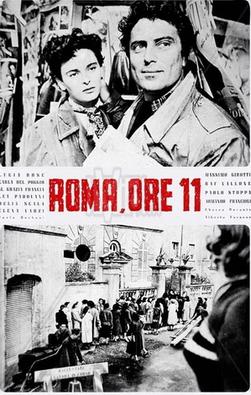
Rome 11:00, also known as Rome 11 o'clock, is a 1952 Italian neorealist film directed by Giuseppe De Santis. It is based on the real story of an accident that happened on 15 January 1951 on Via Savoia in Rome when a staircase collapsed because of the weight of two hundred women waiting for a job interview. One woman was killed and 76 were injured.
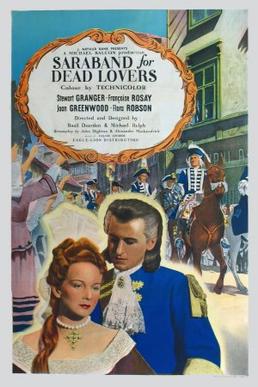
Saraband for Dead Lovers is a 1948 British adventure historical drama film directed by Basil Dearden and starring Stewart Granger and Joan Greenwood. It is based on the 1935 novel by Helen Simpson. Set in 17th-century Hanover, it depicts the doomed romance between Philip Christoph von Königsmarck and Sophia Dorothea of Celle, the wife of the electoral prince of Hanover. The saraband mentioned in the title is a type of Spanish dance.
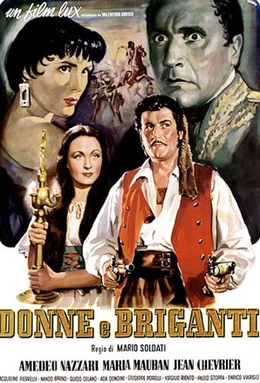
Women and Brigands is a 1950 French-Italian historical melodrama adventure film directed by Mario Soldati and starring Amedeo Nazzari, Maria Mauban and Jean Chevrier. It is based on the story of the legendary guerilla fighter Fra Diavolo, who led a major uprising against French forces in Naples during the Napoleonic Wars. In 1953 it was released in a dubbed version in the United States under the alternative title The King's Guerrillas.

Keoma is a 1976 Italian spaghetti Western film directed by Enzo G. Castellari and starring Franco Nero. It is frequently regarded as one of the better 'twilight' Spaghetti Westerns, being one of the last films of its genre, and is known for its incorporation of newer cinematic techniques of the time and its vocal soundtrack by Guido & Maurizio De Angelis.

Les Miserables is a 1948 Italian drama film directed by Riccardo Freda. It is based on the Victor Hugo's 1862 novel Les Misérables and stars Gino Cervi as Jean Valjean, Valentina Cortese as Fantine and Cosette, and Hans Hinrich as Javert. After the financial success of Freda's previous film The Black Eagle, Freda worked a deal with Lux Film and began developing an adaptation of Les Misérables with Mario Monicelli, Vittorio Nino Novarese and Stefano Vanzina. The film was shot entirely in Rome.
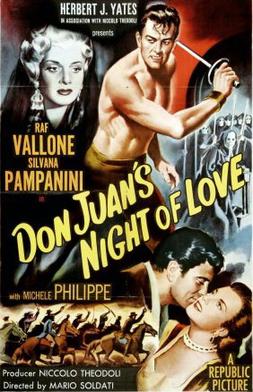
The Adventures of Mandrin is a 1952 French-Italian historical adventure film directed by Mario Soldati and starring Raf Vallone, Silvana Pampanini and Jacques Castelot. It was released under a variety of alternative titles including Don Juan's Night of Love in America and The Affair of Madame Pompadour in Britain.
Luigi Veronesi was an Italian photographer, painter, scenographer and film director born in Milan.

The Stranger's Hand is a 1954 British-Italian thriller drama film directed by Mario Soldati and starring Trevor Howard, Alida Valli and Richard Basehart. An international co-production, it is based on the draft novel with the same name written by Graham Greene. The plot follows the son of a British MI5 agent kidnapped in Venice by agents of Yugoslavia as he searches for his father.
Dora Nelson is a 1939 Italian comedy film directed by Mario Soldati and starring Assia Noris, Carlo Ninchi and Luigi Cimara. It is a remake of the 1935 French film of the same title, which was based on a play by Louis Verneuil. The film was shot at Cinecittà in Rome, with several real employees of the studio appearing as themselves. It belongs to the movies of the calligrafismo style.
Werner Schlichting (1904–1996) was a German art director who worked on over a hundred films during a lengthy career. He worked on a number of Austrian films including The Congress Dances and The Last Ten Days (1955).

The Woman of Monte Carlo is a 1938 Italian "white-telephones" drama film directed by André Berthomieu and Mario Soldati and starring Dita Parlo, Fosco Giachetti and Jules Berry. A separate French version Unknown of Monte Carlo was released the following year.

Two Million for a Smile is a 1939 Italian "white-telephones" comedy film directed by Carlo Borghesio and Mario Soldati and starring Enrico Viarisio, Giuseppe Porelli and Elsa De Giorgi.
References
- ↑ Mario Soldati, 24 ore in uno studio cinematografico. Palermo, Sellerio, 1985. p. 9
- ↑ Mario Soldati, p. 41
- ↑ Mario Soldati, p. 52
- ↑ Mario Soldati, p. 109
- ↑ Guido Davico Bonino, Nota, in Mario Soldati, op. cit., p. 151
- ↑ Guido Davico Bonino, op. cit., pp. 151-152
- 1 2 Mario Soldati, op. cit., pp. 51-52