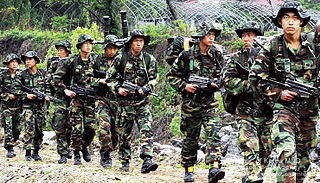
Infantry is a military specialization that engages in military combat on foot, distinguished from cavalry, artillery, and tank forces. Also known as foot soldiers or infanteers, infantry traditionally relies on moving by foot between combats as well, but may also use mounts, military vehicles, or other transport. Infantry make up a large portion of all armed forces in most nations, and typically bear the largest brunt in warfare, as measured by casualties, deprivation, or physical and psychological stress.
A regiment is a military unit. Their role and size varies markedly, depending on the country and the arm of service.
During the American Civil War, the Union Army referred to the United States Army, the land force that fought to preserve the Union of the collective states. Also known as the Federal Army, it proved essential to the preservation of the United States as a working, viable republic.
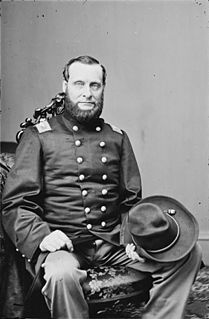
The 51st Ohio Infantry was organized at Camp Meigs in Dover, Ohio, beginning September 17, 1861, and mustered in for three years' service on October 26, 1861, under the command of ColonelThomas Stanley Matthews. The regiment was recruited in Coshocton, Darke, Madison, and Tuscarawas counties.
Dover is a city in Tuscarawas County, Ohio, United States, located approximately 68.75 miles S of Cleveland, and 2.60 miles NW of New Philadelphia. The largest nearby city outside Ohio is Pittsburgh, Pennsylvania, 77.21 miles away, almost directly east. The population of Dover was 12,286 at the 2010 census.
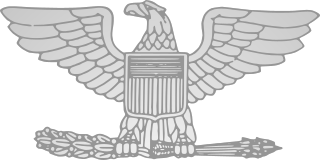
In the United States Army, Marine Corps, and Air Force, colonel is the most senior field grade military officer rank, immediately above the rank of lieutenant colonel and just below the rank of brigadier general. It is equivalent to the naval rank of captain in the other uniformed services. By law, a colonel must have at least 22 years of cumulative service and a minimum of three years as a lieutenant colonel before being promoted. The pay grade for colonel is O-6.
Coshocton County is a county located in the U.S. state of Ohio. As of the 2010 census, the population was 36,901. Its county seat is Coshocton. The county lies within the Appalachian region of the state. The county was formed on January 31, 1810 from portions of Muskingum and Tuscarawas Counties and later organized in 1811. Its name comes from the Delaware Indian language and has been translated as "union of waters" or "black bear crossing".
The regiment was attached to the 15th Brigade, Army of the Ohio, until December 1861 and to the 15th Brigade, 4th Division, Army of the Ohio, until March 1862. It was unattached in Nashville, Tennessee, until June 1862, when it went to the 10th Brigade, 4th Division, Army of the Ohio, until July 1862. It was with the 23rd Independent Brigade, Army of the Ohio, until August 1862, the 23rd Brigade, 5th Division, Army of the Ohio, until September 1862 and the 23rd Brigade, 5th Division, II Corps, Army of the Ohio, to November 1862. Afterward, it was attached to the 3rd Brigade, 3rd Division, Left Wing, XIV Corps, Army of the Cumberland, until January 1863, to the 3rd Brigade, 3rd Division, XXI Corps, Army of the Cumberland, until October 1863, the 2nd Brigade, 1st Division, IV Corps, until June 1865, the 1st Brigade, 1st Division, IV Corps, until August 1865 and the Department of Texas until October 1865.
The Army of the Ohio was the name of two Union armies in the American Civil War. The first army became the Army of the Cumberland and the second army was created in 1863.
There were five corps in the Union Army designated as II Corps during the American Civil War. These formations were the Army of the Cumberland II Corps commanded by Thomas L. Crittenden from October 24, 1862, to November 5, 1862, later renumbered XXI Corps; the Army of the Mississippi II corps led by William T. Sherman from January 4, 1863, to January 12, 1863, renumbered XV Corps; Army of the Ohio II Corps commanded by Thomas L. Crittenden from September 29, 1862, to October 24, 1862, transferred to Army of the Cumberland; Army of Virginia II Corps led by Nathaniel P. Banks from June 26, 1862, to September 4, 1862, and Alpheus S. Williams from September 4, 1862, to September 12, 1862, renumbered XII Corps; and the Army of the Potomac II Corps from March 13, 1862, to June 28, 1865.
XIV Corps was a corps of the Union Army during the American Civil War. It was one of the earliest corps formations in the Western Theater of the American Civil War.
The 51st Ohio Infantry mustered out of service at Victoria, Texas, on October 3, 1865. The regiment was discharged at Columbus, Ohio, on November 3, 1865.
Victoria is the largest city and county seat of Victoria County, Texas. The population was 62,592 as of the 2010 census. The three counties of the Victoria Metropolitan Statistical Area had a population of 111,163 as of the 2000 census. Its elevation is 95 ft (29 m).
Columbus is the state capital and the most populous city in the U.S. state of Ohio. With a population of 892,533 as of 2018 estimates, it is the 14th-most populous city in the United States and one of the fastest growing large cities in the nation. This makes Columbus the third-most populous state capital in the US and the second-most populous city in the Midwest. It is the core city of the Columbus, OH Metropolitan Statistical Area, which encompasses ten counties. With a population of 2,078,725, it is Ohio's second-largest metropolitan area.
Moved to Wellsville November 3, thence to Louisville, Ky., and duty there until December 10. Duty at Camp Wickliffe, Ky., until February 1862. Expedition down the Ohio River to reinforce General Grant, thence to Nashville, Tenn., February 14–25. Occupation of Nashville February 25. Provost duty there until July 9. Moved to Tullahoma, Tenn., and joined Nelson's Division. March to Louisville, Ky., in pursuit of Bragg August 21-September 26. Pursuit of Bragg into Kentucky October 1–22. Battle of Perryville, Ky., October 8. March to Nashville, Tenn., October 22-November 7, and duty there until December 26. Dobbins' Ferry, near Lawrence, December 9. Advance on Murfreesboro December 26–30. Battle of Stones River December 30–31, 1862 and January 1–3, 1863. Duty at Murfreesboro until June. Tullahoma Campaign June 23-July 7. At McMinnville until August 16. Passage of Cumberland Mountain and Tennessee River and Chickamauga Campaign August 16-September 22. Battle of Chickamauga September 19–20. Siege of Chattanooga, Tenn., September 24-November 23. Reopening Tennessee River October 26–29. Chattanooga-Ringgold Campaign November 23–27. Lookout Mountain November 23–24. Missionary Ridge November 25. Ringgold Gap, Taylor's Ridge November 27. Duty at Whiteside until January 1864. Reenlisted January 1, 1864. At Blue Springs, near Cleveland, until May. Atlanta Campaign May to September. Tunnel Hill May 6–7. Demonstration on Rocky Faced Ridge and Dalton May 8–13. Buzzard's Roost Gap May 8–9. Battle of Resaca May 14–15. Near Kingston May 18–19. Near Cassville May 19. Advance on Dallas May 22–25. Operations on line of Pumpkin Vine Creek and battles about Dallas, New Hope Church and Allatoona Hills May 25-June 5. Operations about Marietta and against Kennesaw Mountain June 10-July 2. Pine Hill June 11–14. Lost Mountain June 15–17. Assault on Kennesaw June 27. Ruff's Station, Smyrna Camp Ground, July 4. Chattahoochie River July 5–17. Peachtree Creek July 19–20. Siege of Atlanta July 22-August 25. Flank movement on Jonesboro August 25–30. Battle of Jonesboro August 31-September 1. Lovejoy's Station September 2–6. Operations against Hood in northern Georgia and northern Alabama September 29-November 3. Moved to Pulaski, Tenn. Nashville Campaign November–December. Columbia, Duck River, November 24–27. Battle of Franklin November 30. Battle of Nashville December 15–16. Pursuit of Hood to the Tennessee River December 17–28. Moved to Huntsville, Ala., and duty there until March 1865. Operations in eastern Tennessee March 15-April 22. Duty at Nashville, Tenn., until June. Ordered to New Orleans, La., June 16, thence to Texas. Duty at Indianola, Green Lake and Victoria, Texas, to October.
Casualties
The regiment lost a total of 346 men during service; 4 officers and 108 enlisted men killed or mortally wounded, 1 officer and 233 enlisted men died of disease.
Commanders
Colonel William P. N. Fitzgerald - appointed and resigned October 14, 1861
Colonel Thomas Stanley Matthews - commissioned October 23, 1863, and resigned April 14, 1863
Colonel Richard W. McClain - commanded at the battles of Perryville and Stones River as lieutenant colonel; promoted to colonel, May 25, 1863, and resigned September 30, 1864
Colonel Charles H. Wood - commanded at the battle of Nashville as lieutenant colonel
Colonel David W. Marshall - appointed regimental commander as lieutenant colonel January 21, 1865
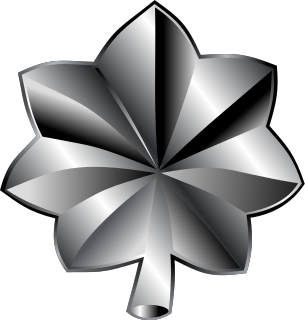
In the United States Army, U.S. Marine Corps, and U.S. Air Force, a lieutenant colonel is a field-grade military officer rank just above the rank of major and just below the rank of colonel. It is equivalent to the naval rank of commander in the other uniformed services.
Dyer, Frederick H. A Compendium of the War of the Rebellion (Des Moines, IA: Dyer Pub. Co.), 1908.
Helwig, Simon. The Capture and Prison Life in Rebeldom for Fourteen Months of Simon Helwig, late Private Co. F. 51st O.V.I. (Canal Dover, OH: Bixler Printing Company), n.d.
Ohio Roster Commission. Official Roster of the Soldiers of the State of Ohio in the War on the Rebellion, 1861–1865, Compiled Under the Direction of the Roster Commission (Akron, OH: Werner Co.), 1886-1895.
Reid, Whitelaw. Ohio in the War: Her Statesmen, Her Generals, and Soldiers (Cincinnati, OH: Moore, Wilstach, & Baldwin), 1868. ISBN9781154801965
Schaar, Nancy Boothe. Letters from the 51st OVI (New Philadelphia, OH: Tuscarawas County Genealogical Society), 2001.
The International Standard Book Number (ISBN) is a numeric commercial book identifier which is intended to be unique. Publishers purchase ISBNs from an affiliate of the International ISBN Agency.
Attribution
This article contains text from a text now in the public domain: Dyer, Frederick H. (1908). A Compendium of the War of the Rebellion. Des Moines, IA: Dyer Publishing Co.
The 13th Regiment Michigan Volunteer Infantry was an infantry regiment that served in the Union Army during the American Civil War.
The 51st Regiment Indiana Infantry was an infantry regiment that served in the Union Army during the American Civil War.
The 27th Kentucky Volunteer Infantry Regiment was an infantry regiment that served in the Union Army during the American Civil War.
The 26th Kentucky Volunteer Infantry Regiment was an infantry regiment that served in the Union Army during the American Civil War.
The 24th Kentucky Volunteer Infantry Regiment was an infantry regiment that served in the Union Army during the American Civil War.
The 17th Kentucky Volunteer Infantry Regiment was an infantry regiment that served in the Union Army during the American Civil War.
The 28th Kentucky Volunteer Infantry Regiment was an infantry regiment that served in the Union Army during the American Civil War.
The 79th Pennsylvania Volunteer Infantry was an infantry regiment that served in the Union Army during the American Civil War.
The 3rd Regiment Tennessee Volunteer Infantry was an infantry regiment that served in the Union Army during the American Civil War.
The 80th Regiment Indiana Infantry was an infantry regiment that served in the Union Army during the American Civil War.
The 24th Ohio Volunteer Infantry was an infantry regiment in the Union Army during the American Civil War.
The 90th Ohio Volunteer Infantry was an infantry regiment in the Union Army during the American Civil War.
The 79th Regiment Indiana Infantry was an infantry regiment that served in the Union Army during the American Civil War.
The 19th Ohio Volunteer Infantry was an infantry regiment in the Union Army during the American Civil War.
The 13th Ohio Volunteer Infantry was an infantry regiment in the Union Army during the American Civil War.
The 64th Ohio Volunteer Infantry was an infantry regiment in the Union Army during the American Civil War.
The 15th Ohio Volunteer Infantry was an infantry regiment in the Union Army during the American Civil War.
The 5th Regiment Tennessee Volunteer Infantry was an infantry regiment that served in the Union Army during the American Civil War.
The 102nd Ohio Volunteer Infantry was an infantry regiment in the Union Army during the American Civil War.
The 115th Illinois Volunteer Infantry was an infantry regiment in the Union Army during the American Civil War.
This page is based on this Wikipedia article Text is available under the CC BY-SA 4.0 license; additional terms may apply. Images, videos and audio are available under their respective licenses.