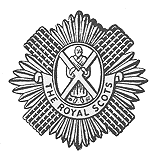
The Royal Scots, once known as the Royal Regiment of Foot, was the oldest and most senior infantry regiment of the line of the British Army, having been raised in 1633 during the reign of Charles I. The regiment existed continuously until 2006, when it amalgamated with the King's Own Scottish Borderers to become the Royal Scots Borderers, which merged with the Royal Highland Fusiliers, the Black Watch, the Highlanders and the Argyll and Sutherland Highlanders to form the Royal Regiment of Scotland.

The 52nd Lowland Volunteers is a battalion in the British Army's Army Reserve or reserve force in the Scottish Lowlands, forming the 6th Battalion of the Royal Regiment of Scotland, also known as 6 SCOTS. Due to its erstwhile association with the 1st Regiment of Foot, it is the senior Reserve line infantry battalion in the British Army. It is one of two Reserve battalions in the Royal Regiment of Scotland, along with 51st Highland, a similar unit located in the Scottish Highlands.

The 51st Highland Volunteers is a battalion in the British Army's Army Reserve or reserve force in the Scottish Highlands, forming the 7th Battalion of the Royal Regiment of Scotland, also known as 7 SCOTS. It is one of two Reserve battalions in the Royal Regiment of Scotland, along with 52nd Lowland, a similar unit located in the Scottish Lowlands.
The British Army is listed according to an order of precedence for the purposes of parading. This is the order in which the various corps of the army parade, from right to left, with the unit at the extreme right being highest. Under ordinary circumstances, the Household Cavalry parades at the extreme right of the line. Militia and Army Reserve units take precedence after Regular units with the exception of The Honourable Artillery Company and The Royal Monmouthshire Royal Engineers.
The Queen's Edinburgh Rifles was a brigade of Rifle Volunteers raised in the county of city of Edinburgh in 1859. It later formed two battalions of the Royal Scots, which fought in World War I at Gallipoli, in Palestine and on the Western Front. The two battalions combined between the world wars before being converted into an air defence regiment of the Royal Artillery (RA). This served in Anti-Aircraft Command during World War II and continued in the postwar Territorial Army (TA) until 1961, when its successors were converted into Royal Engineers (RE).
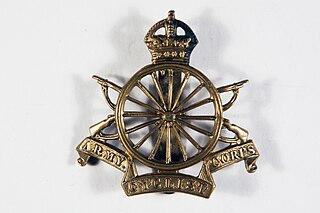
The Army Cyclist Corps was a corps of the British Army active during the First World War, and controlling the Army's bicycle infantry.
The 156th Brigade was an infantry brigade formation of the British Army. The brigade saw active service in both the First and the Second World Wars with the 52nd (Lowland) Infantry Division.
The 155th Brigade was an infantry brigade of the British Army that saw active service in both the First and the Second World Wars. Assigned to the 52nd (Lowland) Division, the brigade saw active service in the Middle East and on the Western Front during the First World War. During the Second World War, now the 155th Infantry Brigade, it continued to serve with the 52nd Division in Operation Dynamo, and later in North-western Europe from late 1944 until May 1945.
The Liverpool Brigade, later 165th (Liverpool) Brigade was an infantry brigade of Britain's Volunteer Force that served during World War I with the 55th Division of the British Army. During World War II, again as part of the 55th Infantry Division, the brigade remained in the United Kingdom.
221st Mixed Brigade was a Scottish Home Service formation of the British Army that served under various titles throughout World War I.

The Highland Cyclist Battalion was a bicycle infantry battalion of the Territorial Force, part of the British Army. Formed as part of the Volunteer Force in 1860, it became a Volunteer Battalion of the Black Watch in 1881. In 1909 it became an independent unit and served in the United Kingdom throughout the First World War. In 1920 it was converted as part of the Highland Divisional Signals.
The Glasgow Brigade was an infantry formation of Britain's Volunteer Force from 1890 to 1902. It was the forerunner of two formations of the Territorial Force that saw service in both World Wars.
The Forth Brigade was a Scottish infantry formation of Britain's Volunteer Force from 1888 to 1902.
The 1st Linlithgowshire Rifle Volunteers was a Scottish unit of Britain's Volunteer Force raised in Linlithgow in 1860. It later became a cyclist battalion of the Royal Scots, which served in Home Defence and saw action in the North Russia Intervention force during World War I. Between the wars it was reduced to company strength, but just before World War II it was converted into an anti-aircraft (AA) regiment of the Royal Artillery (RA). This served in Anti-Aircraft Command during the Blitz and later distinguished itself in the Siege of Tobruk. It fought through the Italian Campaign and its successors continued in the postwar Territorial Army (TA) until 1967.
The 6th Battalion, Royal Scots, was a unit of Britain's part-time Territorial Force. Beginning as a Volunteer unit formed from teetotallers in the city of Edinburgh in 1867, it later became affiliated to the Royal Scots. During World War I it served in the Senussi Campaign and on the Western Front. Postwar it was converted into a medium artillery battery.
The 7th Volunteer Battalion, Royal Scots was a Volunteer Force battalion of the Royal Scots in the British Army.
 United Kingdom
  British Army