79th Illinois Infantry Regiment

Last updated

79th Regiment Illinois Volunteer Infantry
Flag of Illinois.svg
Illinois flag
ActiveAugust 28, 1862, to June 12, 1865
Country United States
Allegiance Union
Branch Infantry
Engagements American Civil War

The 79th Regiment Illinois Volunteer Infantry was an infantry regiment that served in the Union Army during the American Civil War.

Contents

Army of Kentucky and Army of the Ohio

The 79th Illinois Infantry was organized at Mattoon, Illinois and mustered into Federal service on August 28, 1862. The regiment was first ordered to Louisville, Kentucky and attached to the 3rd Brigade of Cruft's Division as part of the Army of Kentucky. On Steptember 13 the regiment was transferred to the 4th Brigade, 2nd Division in the III Corps of the Army of the Ohio under Maj. Gen. Don Carlos Buell.

On October 1, 1862 the regiment was transferred to the 5th Brigade, 2nd Division in the I Corps of the Army of the Ohio under the command of Maj. Gen. Alexander M. McCook. The unit participated in the Pursuit of Gen. Braxton Bragg and his Army of Mississippi into Kentucky and the Battle of Perryville on October 8. During the battle, the regiment, as part of the Union left flank, was attacked by a Confederate division was forced to fall back. When additional Confederate divisions joined the fray, the Union line made a stubborn stand, counterattacked, but finally fell back with some units routed. [1]

Army of the Cumberland

XIV Corps

In November 1862 the regiment was part of the reorganization of the Army of the Ohio into the XIV Corps of the Army of the Cumberland under Gen. William Rosecrans and was transferred to the 2nd Brigade, 2nd Division, Right Wing under Brig. Gen. Richard W. Johnson. The regiment participated in the Battle of Stones River from December 31, 1862 – January 2, 1863. The regiment, as part right flank of the army, was overrun in a surprise attack at dawn on December 31, with the 2nd division overall suffering over 50% casualties. [2] Colonel Sheridan P. Read, the regimental commander of the 79th Illinois, as well as Brig. Gen. Edward N. Kirk, the commander of the 2nd Brigade, were both killed during the battle.

XX Corps

Tullahoma Campaign

Following the severe losses at Stones River, the XIV Corps was reorganized into the XX Corps (also known as "McCook's Corps" after its commander) of the Army of the Cumberland in January 1863. The regiment participated in the Tullahoma Campaign from June 24 – July 3, and later fought in the bloody Battle of Chickamauga from September 18 to September 20 where the XX Corps suffered horrendous casualties. [3]

IV Corps

Chattanooga Campaign

Following the battle, on October 10, 1863, the XX Corps was consolidated with the XXI Corps into the IV Corps of the Army of the Cumberland, under Maj. Gen. Gordon Granger. The 79th Illinois was transferred to the 3rd Brigade, 2nd Division, under Maj. Gen. Philip H. Sheridan, where it served for the remainder of the war. The regiment participated in the Chattanooga Campaign from September 21 – November 25. On November 25, 1863, during the Battle of Missionary Ridge, the 2nd division served with distinction when it broke through Confederate lines at Missionary Ridge in an unordered charge on a seemingly impregnable Confederate position, leading to a rout of one of the Confederacy's two major armies. [4]

Knoxville Campaign

As part of a column under the command of Maj. Gen. William Tecumseh Sherman, the IV Corps participated in the Relief of Knoxville from November 28 – December 7, 1863. The IV Corps remained in Knoxville to reinforce Maj. Gen. Ambrose Burnside before rejoining the Army of the Cumberland in spring 1864 for the Atlanta Campaign under the command of Maj. Gen. Oliver O. Howard. [5]

Atlanta Campaign

The 79th Illinois participated in the Atlanta Campaign from May 7 – July 17, 1864 as part of the 2nd division under the command of Brig. Gen. John Newton. The regiment took part in the battles of Rocky Face Ridge from May 7–13, Resaca from May 13 – 15, and Kennesaw Mountain on June 27. During the Battle of Peachtree Creek on July 20, the entire left flank of the Union position was held by the 2nd division alone, which successfully repelled an entire Corps, inflicting heavy losses. [6] The regiment continued to support the Siege of Atlanta until August 31 when, under command of Maj. Gen. David S. Stanley, the IV Corps participated in a frontal assault in the Battle of Jonesborough which breached the Confederate defenses, leading to the capture of Atlanta on September 2, 1864. [7]

Franklin-Nashville Campaign

In autumn 1864, the 79th Illinois participated in the Franklin-Nashville Campaign, with the 2nd division under the command of Brig. Gen. George D. Wagner, taking part in the Battle of Spring Hill on November 29. [8] During the Battle of Franklin on November 30, the 2nd and 3rd brigades were poorly positioned forward of the main Union lines and overrun in the initial attack, leading to the capture of nearly 700 men from the two brigades. [9] The regiment also took part in the Battle of Nashville on December 15–16, 1864, which effectively destroyed the Army of Tennessee as a fighting force, pursuing them to the Tennessee River on December 25. [10]

1865 and Discharge

Following the Franklin-Nashville Campaign, the 79th Illinois was stationed at Decatur, Alabama from January 6 - March 30, 1865, followed by Nashville, Tennessee from April 22 - June 12. The regiment was mustered out on June 12, 1865, and discharged at Camp Butler, Illinois, on June 21, 1865.

Total strength and casualties

The regiment suffered 4 officers and 81 enlisted men who were killed in action or who died of their wounds and 1 officer and 211 enlisted men who died of disease, for a total of 297 fatalities. [11]

Commanders

See also

Notes

  1. National Park Service: Perryville.
  2. National Park Service: Stones River.
  3. National Park Service: Chickamauga.
  4. National Park Service: Chattanooga.
  5. Cox 1882, p. 14.
  6. National Park Service: Peachtree Creek.
  7. National Park Service: Jonesborough.
  8. National Park Service: Spring Hill.
  9. National Park Service: Franklin.
  10. National Park Service: Nashville.
  11. http://www.civilwararchive.com/Unreghst/unilinf7.htm#79th The Civil War Archive website after Dyer, Frederick Henry. A Compendium of the War of the Rebellion. 3 vols. New York: Thomas Yoseloff, 1959.
  12. http://www.rootsweb.com/~ilcivilw/f&s/079-fs.htm Illinois in the Civil war website after Illinois Adjutant General's muster rolls[ dead link ]

Related Research Articles

<span class="mw-page-title-main">Battle of Nashville</span> Major battle of the American Civil War

The Battle of Nashville was a two-day battle in the Franklin-Nashville Campaign that represented the end of large-scale fighting west of the coastal states in the American Civil War. It was fought at Nashville, Tennessee, on December 15–16, 1864, between the Confederate Army of Tennessee under Lieutenant General John Bell Hood and the Union Army of the Cumberland (AoC) under Major General George H. Thomas. In one of the largest victories achieved by the Union Army during the war, Thomas attacked and routed Hood's army, largely destroying it as an effective fighting force.

<span class="mw-page-title-main">Army of the Cumberland</span> Principal Union army unit in the Western Theater of the American Civil War

The Army of the Cumberland was one of the principal Union armies in the Western Theater during the American Civil War. It was originally known as the Army of the Ohio.

The Army of the Ohio was the name of two Union armies in the American Civil War. The first army became the Army of the Cumberland and the second army was created in 1863.
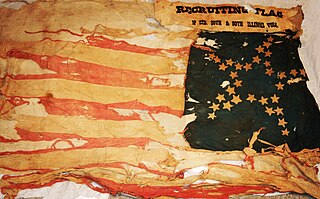
<span class="mw-page-title-main">80th Illinois Infantry Regiment</span> Military unit

The 80th Illinois Volunteer Infantry Regiment was an infantry regiment that served in the Union Army during the American Civil War. The regiment was composed of ten companies that drew primarily from eight southern Illinois counties. Over the course of the war the regiment traveled approximately 6,000 miles, and was in over 20 battles.
<span class="mw-page-title-main">88th Illinois Infantry Regiment</span> Military unit

The 88th Illinois Infantry Regiment was an infantry regiment from Illinois that served in the Union Army during the American Civil War. The regiment mustered into service in September 1862 and was engaged at Perryville a month later. The unit subsequently fought at Stones River, in the Tullahoma campaign, at Chickamauga, at Missionary Ridge, in the Atlanta campaign, at Franklin, and at Nashville. The 88th Illinois especially distinguished itself at Stones River, Missionary Ridge, and Franklin. The regiment mustered out of service in June 1865.

The 75th Ohio Infantry Regiment, sometimes 75th Ohio Volunteer Infantry was an infantry regiment from southwestern Ohio in the Union Army during the American Civil War. It served in the Eastern Theater, most notably in the battles of Chancellorsville and Gettysburg and then in the siege operations against Charleston, South Carolina.

<span class="mw-page-title-main">78th Illinois Infantry Regiment</span> Military unit

The 78th Illinois Infantry Regiment was an infantry regiment that served in the Union Army during the American Civil War.

<span class="mw-page-title-main">Iron Brigade</span> Military unit

The Iron Brigade, also known as The Black Hats, Black Hat Brigade, Iron Brigade of the West, and originally King's Wisconsin Brigade was an infantry brigade in the Union Army of the Potomac during the American Civil War. Although it fought entirely in the Eastern Theater, it was composed of regiments from three Western states that are now within the region of the Midwest. Noted for its excellent discipline, ferocity in battle, and extraordinarily strong morale, the Iron Brigade suffered 1,131 men killed out of 7,257 total enlistments: the highest percentage of loss suffered by any brigade in the United States Army during the war.

<span class="mw-page-title-main">Samuel Beatty (general)</span>

Samuel Beatty was an American soldier, sheriff, and farmer from Ohio. He was a brigadier general in the Union Army during the American Civil War. In 1866, he was awarded the brevet grade of major general of volunteers.

<span class="mw-page-title-main">George A. Cobham Jr.</span>

George Ashworth Cobham Jr. commanded the 111th Pennsylvania Infantry in the American Civil War and rose to the rank of brigade commander before being killed in battle.

Archibald Livingston McDougall was an officer in the Union Army during the American Civil War who commanded the 123rd New York Volunteer Infantry early in the war and subsequently led a brigade at the Battle of Gettysburg.

<span class="mw-page-title-main">Ezra A. Carman</span>

Ezra Ayers Carman was an officer in the Union Army during the American Civil War, commanding a New Jersey infantry regiment and (occasionally) a brigade.
<span class="mw-page-title-main">46th Pennsylvania Infantry Regiment</span> Union Army infantry regiment

The 46th Pennsylvania Volunteer Infantry was a Union Army regiment in the American Civil War. It served in both the Eastern and Western Theaters, most notably at the 1862 Battle of Cedar Mountain and during the 1864 Atlanta Campaign. During the war, the regiment lost 17% of its strength through combat losses and disease.

<span class="mw-page-title-main">Charles Garrison Harker</span> American brigadier general (1837–1864)

Charles Garrison Harker was a brigadier general in the Union Army during the American Civil War. He was killed in action at the Battle of Kennesaw Mountain in northern Georgia during the Atlanta Campaign. Fort Harker in Kansas, an active garrison of the United States Army from 1866 to 1872, was named in his honor. The Charles G. Harker School in the Swedesboro-Woolwich School District, New Jersey, is named in his honor.

<span class="mw-page-title-main">David Ireland (colonel)</span>

David Ireland was a colonel in the Union Army during the American Civil War. Commanding the 137th New York Volunteer Infantry, he played a key defensive role on Culp's Hill in the Battle of Gettysburg.

The 1st Maryland Infantry Regiment, Potomac Home Brigade was an infantry regiment that served in the Union Army during the American Civil War.

The 105th Illinois Infantry Regiment was an infantry regiment in the Union Army during the American Civil War. The regiment was made up of volunteers, primarily from the Illinois counties of DeKalb and DuPage but other counties were represented as well. The 105th Regiment served from 1862 through the end of the war in 1865.

<span class="mw-page-title-main">125th Ohio Infantry Regiment</span> Military unit

The 125th Ohio Infantry Regiment, sometimes 125th Ohio Volunteer Infantry was an infantry regiment in the Union Army during the American Civil War.

<span class="mw-page-title-main">Oliver Edwards</span> American major general in the Union Army

Oliver Edwards was a machine company executive, an inventor, and a volunteer officer in the Union Army during the American Civil War.

Clark's Missouri Battery was an artillery battery that served in the Confederate States Army during the American Civil War.

References