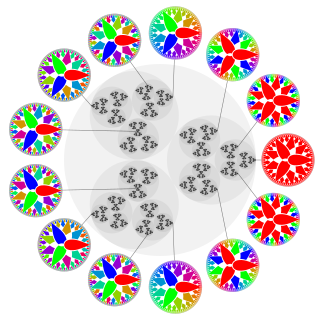
In number theory, given a prime number p, the p-adic numbers form an extension of the rational numbers which is distinct from the real numbers, though with some similar properties; p-adic numbers can be written in a form similar to decimals, but with digits based on a prime number p rather than ten, and extending to the left rather than to the right.
In mathematics, a field K is called a (non-Archimedean) local field if it is complete with respect to a topology induced by a discrete valuation v and if its residue field k is finite. Equivalently, a local field is a locally compact topological field with respect to a non-discrete topology. Sometimes, the real numbers R, and the complex numbers C are also defined to be local fields; this is the convention we will adopt below. Given a local field, the valuation defined on it can be of either of two types, each one corresponds to one of the two basic types of local fields: those in which the valuation is Archimedean and those in which it is not. In the first case, one calls the local field an Archimedean local field, in the second case, one calls it a non-Archimedean local field. Local fields arise naturally in number theory as completions of global fields.

John Torrence Tate Jr. was an American mathematician distinguished for many fundamental contributions in algebraic number theory, arithmetic geometry, and related areas in algebraic geometry. He was awarded the Abel Prize in 2010.

In abstract algebra and analysis, the Archimedean property, named after the ancient Greek mathematician Archimedes of Syracuse, is a property held by some algebraic structures, such as ordered or normed groups, and fields. The property, typically construed, states that given two positive numbers and , there is an integer such that . It also means that the set of natural numbers is not bounded above. Roughly speaking, it is the property of having no infinitely large or infinitely small elements. It was Otto Stolz who gave the axiom of Archimedes its name because it appears as Axiom V of Archimedes’ On the Sphere and Cylinder.
In mathematics, p-adic analysis is a branch of number theory that deals with the mathematical analysis of functions of p-adic numbers.
In number theory, Iwasawa theory is the study of objects of arithmetic interest over infinite towers of number fields. It began as a Galois module theory of ideal class groups, initiated by Kenkichi Iwasawa, as part of the theory of cyclotomic fields. In the early 1970s, Barry Mazur considered generalizations of Iwasawa theory to abelian varieties. More recently, Ralph Greenberg has proposed an Iwasawa theory for motives.
In mathematics, the ring of integers of an algebraic number field is the ring of all algebraic integers contained in . An algebraic integer is a root of a monic polynomial with integer coefficients: . This ring is often denoted by or . Since any integer belongs to and is an integral element of , the ring is always a subring of .
In mathematics, a Galois module is a G-module, with G being the Galois group of some extension of fields. The term Galois representation is frequently used when the G-module is a vector space over a field or a free module over a ring in representation theory, but can also be used as a synonym for G-module. The study of Galois modules for extensions of local or global fields and their group cohomology is an important tool in number theory.
In mathematics, ideal theory is the theory of ideals in commutative rings. While the notion of an ideal exists also for non-commutative rings, a much more substantial theory exists only for commutative rings
In mathematics an even integer, that is, a number that is divisible by 2, is called evenly even or doubly even if it is a multiple of 4, and oddly even or singly even if it is not. The former names are traditional ones, derived from ancient Greek mathematics; the latter have become common in recent decades.
In mathematical logic, Skolem arithmetic is the first-order theory of the natural numbers with multiplication, named in honor of Thoralf Skolem. The signature of Skolem arithmetic contains only the multiplication operation and equality, omitting the addition operation entirely.
In mathematics, crystalline cohomology is a Weil cohomology theory for schemes X over a base field k. Its values Hn(X/W) are modules over the ring W of Witt vectors over k. It was introduced by Alexander Grothendieck (1966, 1968) and developed by Pierre Berthelot (1974).
In mathematics, a p-adically closed field is a field that enjoys a closure property that is a close analogue for p-adic fields to what real closure is to the real field. They were introduced by James Ax and Simon B. Kochen in 1965.
In mathematics, a p-adic zeta function, or more generally a p-adic L-function, is a function analogous to the Riemann zeta function, or more general L-functions, but whose domain and target are p-adic. For example, the domain could be the p-adic integersZp, a profinite p-group, or a p-adic family of Galois representations, and the image could be the p-adic numbersQp or its algebraic closure.
In mathematics, the main conjecture of Iwasawa theory is a deep relationship between p-adic L-functions and ideal class groups of cyclotomic fields, proved by Kenkichi Iwasawa for primes satisfying the Kummer–Vandiver conjecture and proved for all primes by Mazur and Wiles. The Herbrand–Ribet theorem and the Gras conjecture are both easy consequences of the main conjecture. There are several generalizations of the main conjecture, to totally real fields, CM fields, elliptic curves, and so on.
In mathematics, p-adic Hodge theory is a theory that provides a way to classify and study p-adic Galois representations of characteristic 0 local fields with residual characteristic p. The theory has its beginnings in Jean-Pierre Serre and John Tate's study of Tate modules of abelian varieties and the notion of Hodge–Tate representation. Hodge–Tate representations are related to certain decompositions of p-adic cohomology theories analogous to the Hodge decomposition, hence the name p-adic Hodge theory. Further developments were inspired by properties of p-adic Galois representations arising from the étale cohomology of varieties. Jean-Marc Fontaine introduced many of the basic concepts of the field.
In mathematics, an algebraic number field is an extension field of the field of rational numbers such that the field extension has finite degree . Thus is a field that contains and has finite dimension when considered as a vector space over .
Mathematics is a broad subject that is commonly divided in many areas that may be defined by their objects of study, by the used methods, or by both. For example, analytic number theory is a subarea of number theory devoted to the use of methods of analysis for the study of natural numbers.
In mathematics, p-adic cohomology means a cohomology theory for varieties of characteristic p whose values are modules over a ring of p-adic integers. Examples include:


