Related Research Articles

A computer worm is a standalone malware computer program that replicates itself in order to spread to other computers. It often uses a computer network to spread itself, relying on security failures on the target computer to access it. It will use this machine as a host to scan and infect other computers. When these new worm-invaded computers are controlled, the worm will continue to scan and infect other computers using these computers as hosts, and this behaviour will continue. Computer worms use recursive methods to copy themselves without host programs and distribute themselves based on exploiting the advantages of exponential growth, thus controlling and infecting more and more computers in a short time. Worms almost always cause at least some harm to the network, even if only by consuming bandwidth, whereas viruses almost always corrupt or modify files on a targeted computer.
In computing terminology, a macro virus is a virus that is written in a macro language: a programming language which is embedded inside a software application. Some applications, such as Microsoft Office, Excel, PowerPoint allow macro programs to be embedded in documents such that the macros are run automatically when the document is opened, and this provides a distinct mechanism by which malicious computer instructions can spread. This is one reason it can be dangerous to open unexpected attachments in e-mails. Many antivirus programs can detect macro viruses; however, the macro virus' behavior can still be difficult to detect.
This timeline of computer viruses and worms presents a chronological timeline of noteworthy computer viruses, computer worms, Trojan horses, similar malware, related research and events.
The Melissa virus is a mass-mailing macro virus released on or around March 26, 1999. It targets Microsoft Word and Outlook-based systems and created considerable network traffic. The virus infects computers via email; the email is titled "Important Message From," followed by the current username. Upon clicking the message, the body reads, "Here's that document you asked for. Don't show anyone else ;)." Attached is a Word document titled "list.doc," containing a list of pornographic sites and accompanying logins for each. It then mass-mails itself to the first fifty people in the user's contact list and disables multiple safeguard features on Microsoft Word and Microsoft Outlook.
In computing, polymorphic code is code that uses a polymorphic engine to mutate while keeping the original algorithm intact - that is, the code changes itself every time it runs, but the function of the code stays the same. For example, the simple math expressions 3+1 and 6-2 both achieve the same result, yet run with different machine code in a CPU. This technique is sometimes used by computer viruses, shellcodes and computer worms to hide their presence.

Antivirus software, also known as anti-malware, is a computer program used to prevent, detect, and remove malware.
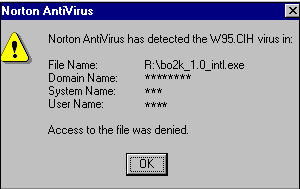
CIH, also known as Chernobyl or Spacefiller, is a Microsoft Windows 9x computer virus that first emerged in 1998. Its payload is highly destructive to vulnerable systems, overwriting critical information on infected system drives and, in some cases, destroying the system BIOS. The virus was created by Chen Ing-hau, a student at Tatung University in Taiwan. It was believed to have infected sixty million computers internationally, resulting in an estimated NT$1 billion (US$35,801,231.56) in commercial damages.
Metamorphic code is code that when run outputs a logically equivalent version of its own code under some interpretation. This is similar to a quine, except that a quine's source code is exactly equivalent to its own output. Metamorphic code also usually outputs machine code and not its own source code.
Norton AntiVirus is an anti-virus or anti-malware software product founded by Peter Norton, developed and distributed by Symantec since 1990 as part of its Norton family of computer security products. It uses signatures and heuristics to identify viruses. Other features included in it are e-mail spam filtering and phishing protection.
In computer security, a sandbox is a security mechanism for separating running programs, usually in an effort to mitigate system failures and/or software vulnerabilities from spreading. The sandbox metaphor derives from the concept of a child's sandbox—a play area where children can build, destroy, and experiment without causing any real-world damage. It is often used to kill untested or untrusted programs or code, possibly from unverified or untrusted third parties, suppliers, users or websites, without risking harm to the host machine or operating system. A sandbox typically provides a tightly controlled set of resources for guest programs to run in, such as storage and memory scratch space. Network access, the ability to inspect the host system, or read from input devices are usually disallowed or heavily restricted.
Win32/Simile is a metamorphic computer virus written in assembly language for Microsoft Windows. The virus was released in its most recent version in early March 2002. It was written by the virus writer "Mental Driller". Some of his previous viruses, such as Win95/Drill, have proved very challenging to detect.
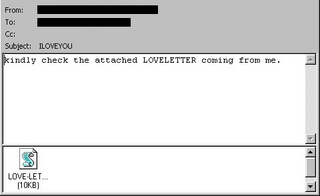
ILOVEYOU, sometimes referred to as the Love Bug or Loveletter, was a computer worm that infected over ten million Windows personal computers on and after 5 May 2000. It started spreading as an email message with the subject line "ILOVEYOU" and the attachment "LOVE-LETTER-FOR-YOU.TXT.vbs". At the time, Windows computers often hid the latter file extension by default because it is an extension for a file type that Windows knows, leading unwitting users to think it was a normal text file. Opening the attachment activates the Visual Basic script. First, the worm inflicts damage on the local machine, overwriting random files, then, it copies itself to all addresses in the Windows Address Book used by Microsoft Outlook, allowing it to spread much faster than any other previous email worm.
Mobile malware is malicious software that targets mobile phones or wireless-enabled Personal digital assistants (PDA), by causing the collapse of the system and loss or leakage of confidential information. As wireless phones and PDA networks have become more and more common and have grown in complexity, it has become increasingly difficult to ensure their safety and security against electronic attacks in the form of viruses or other malware.
SevenDust is a computer virus that infects computers running certain versions of the classic Mac OS. It was first discovered in 1998, and originally referred to as 666 by Apple.
Ontario is a family of computer viruses, named after its point of isolation, the Canadian province of Ontario. This family of computer virus consists of Ontario.1024, Ontario.512 and Ontario.2048. The first variant Ontario.512 was discovered in July 1990. Because Ontario.1024 was also discovered in Ontario, it is likely that both viruses originate from within the province. By the Ontario.2048 variant, the author had adopted "Ontario" as the family's name and even included the name "Ontario-3" in the virus code.
CTX is a computer virus created in Spain in 1999. CTX was initially discovered as part of the Cholera worm, with which the author intentionally infected with CTX. Although the Cholera worm had the capability to send itself via email, the CTX worm quickly surpassed it in prevalence. Cholera is now considered obsolete, while CTX remains in the field, albeit with only rare discoveries.
The WANK Worm and the OILZ Worm were computer worms that attacked DEC VMS computers in 1989 over the DECnet. They were written in DIGITAL Command Language.

A computer virus is a type of malware that, when executed, replicates itself by modifying other computer programs and inserting its own code into those programs. If this replication succeeds, the affected areas are then said to be "infected" with a computer virus, a metaphor derived from biological viruses.
Sality is the classification for a family of malicious software (malware), which infects Microsoft Windows systems files. Sality was first discovered in 2003 and has advanced to become a dynamic, enduring and full-featured form of malicious code. Systems infected with Sality may communicate over a peer-to-peer (P2P) network to form a botnet to relay spam, proxying of communications, exfiltrating sensitive data, compromising web servers and/or coordinating distributed computing tasks to process intensive tasks. Since 2010, certain variants of Sality have also incorporated rootkit functions as part of an ongoing evolution of the malware family. Because of its continued development and capabilities, Sality is considered one of the most complex and formidable forms of malware to date.
ANTI is a computer virus affecting Apple Macintosh computers running classic Mac OS versions up to System 6. It was the first Macintosh virus not to create additional resources within infected files; instead, it patches existing CODE resources.
References
- ↑ "What is a Polymorphic Virus? Examples & More - CrowdStrike". crowdstrike.com. Retrieved 2023-05-22.
- ↑ BOTEZATU, Bogdan. "From Michelangelo to Self-Mutating Engine". Hot for Security. Retrieved 2023-05-22.
- ↑ "Computer virus group arrested". The Independent. 1993-02-03. Retrieved 2023-05-22.
- ↑ Khanaka, Gizzing (May 21, 1998). "Virus Information Update CIAC-2301" (PDF). Computer Incident Advisory Capability.