Related Research Articles

Joseph ben Ephraim Karo, also spelled Yosef Caro, or Qaro, was the author of the last great codification of Jewish law, the Beit Yosef, and its popular analogue, the Shulchan Arukh. To this end he is often referred to as HaMechaber and as Maran.

Dov Ber ben Avraham of Mezeritch, also known as the Maggid of Mezeritch, was a disciple of Rabbi Israel ben Eliezer, the founder of Hasidic Judaism, and was chosen as his successor to lead the early movement. Dov Ber is regarded as the first systematic exponent of the mystical philosophy underlying the teachings of the Baal Shem Tov, and through his teaching and leadership, the main architect of the movement. He established his base in Mezhirichi, which moved the centre of Hasidism from Medzhybizh, where he focused his attention on raising a close circle of disciples to spread the movement. After his death the third generation of leadership took their different interpretations and disseminated across appointed regions of Eastern Europe, rapidly spreading Hasidism beyond Ukraine, to Poland, Galicia and Russia.

Adelbert von Chamisso was a German poet and botanist, author of Peter Schlemihl, a famous story about a man who sold his shadow. He was commonly known in French as Adelbert de Chamissode Boncourt, a name referring to the family estate at Boncourt.
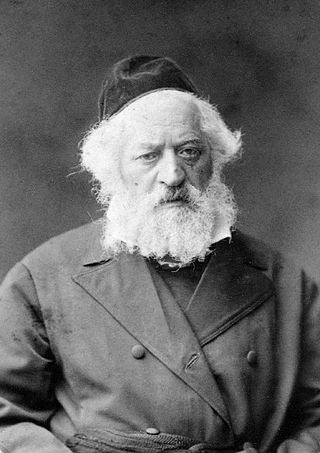
Yitzchak Elchanan Spektor or Isaac Elhanan Spector was a Russian rabbi, posek and Talmudist of the 19th century.

A maggid, also spelled as magid, is a traditional Jewish religious itinerant preacher, skilled as a narrator of Torah and religious stories. A chaplain of the more scholarly sort is called a darshan. The title of maggid mesharim probably dates from the sixteenth century.
Jacob ben Wolf Kranz of Dubno, the Dubner Maggid, was a Lithuanian (Belarus)-born preacher (maggid).

Solomon Buber was a Jewish Galician scholar and editor of Hebrew works. He is especially remembered for his editions of Midrash and other medieval Jewish manuscripts, and for the pioneering research surrounding those texts.
Tobiah ben Eliezer was a Talmudist and poet of the 11th century, author of Lekach Tov or Pesikta Zutarta, a midrashic commentary on the Pentateuch and the Five Megillot.
Isaac ben Abba Mari was a Provençal rabbi who hailed from Marseilles. He is often simply referred to as "Ba'al ha-Ittur," after his Magnum opus, Ittur Soferim.
Hillel Noah Maggid (1829-1903) was a Russian-Jewish genealogist and historian.

Paysach J. Krohn is an Orthodox Jewish rabbi, mohel, author, and lecturer on topics related to ethics and spiritual growth. He is the author of the "Maggid" series of books for ArtScroll, inspired by the stories of Rabbi Sholom Schwadron, who was known as the "Maggid of Yerushalayim". He also authored a seminal work on bris milah, also published by ArtScroll.
Joshua Lewinsohn was a Russian teacher and writer. He was born in 1833 at Vyeshiuti, in the Kovno region. He received his Talmudical education at Zhagory, in the house of his uncle Simon Hurvitz, and graduated in 1865 from the Gymnasium of Mitau, remaining there until 1874, when he was appointed inspector of the Jewish school at Tukum, Courland. His first articles in Hebrew appeared in "Ha-Maggid" in 1857; he contributed extensively to that paper and to Ha-Melitz, Ha-Shachar, and other Hebrew periodicals. He was also for many years a contributor to the German Rigasche Zeitung.
Vidal of Tolosa, alternate spelling Vidal de Toulouse, was a Spanish rabbi and scholar of the late 14th century, and is often referred to by the sobriquet, Harav Ha-Maggid, or the Maggid Mishneh, named for his magnum opus by that name.
Moses Botarel was a Spanish scholar who lived in the fourteenth and fifteenth centuries. He was a pupil of Jacob Sefardi, who instructed him in the Kabbala.
Enoch Zundel ben Joseph was a Russian Talmudist best known as author of a commentary on Ein Yaakov and Midrash Rabbah. He spent his life in Białystok, Poland; he was a maggid there and gave shiurim on Midrash.

Salomon Mandelkern was a Russian-Jewish poet and author.

Joshua Steinberg was a Russian Jewish writer and educator.
Naphtali Keller was an Austrian scholar. He was the son of Israel Mendel Keller, a well-to-do innkeeper.
Jacob Obermeyer was a Bavarian Jewish oriental researcher, scholar and a traveler, and the grandfather of the Israeli agent Meir Max Bineth.

Salomon Plessner was a German Jewish translator and maggid.
References
 This article incorporates text from a publication now in the public domain : Rosenthal, Herman (1901). "Abba Glusk Leczeka". In Singer, Isidore; et al. (eds.). The Jewish Encyclopedia . Vol. 1. New York: Funk & Wagnalls. p. 31.
 | This article related to a poem is a stub. You can help Wikipedia by expanding it. |